Hope, community and looking after yourself: a sicklecell warrior’s story
5 mins read
Thursday 15 October 2026
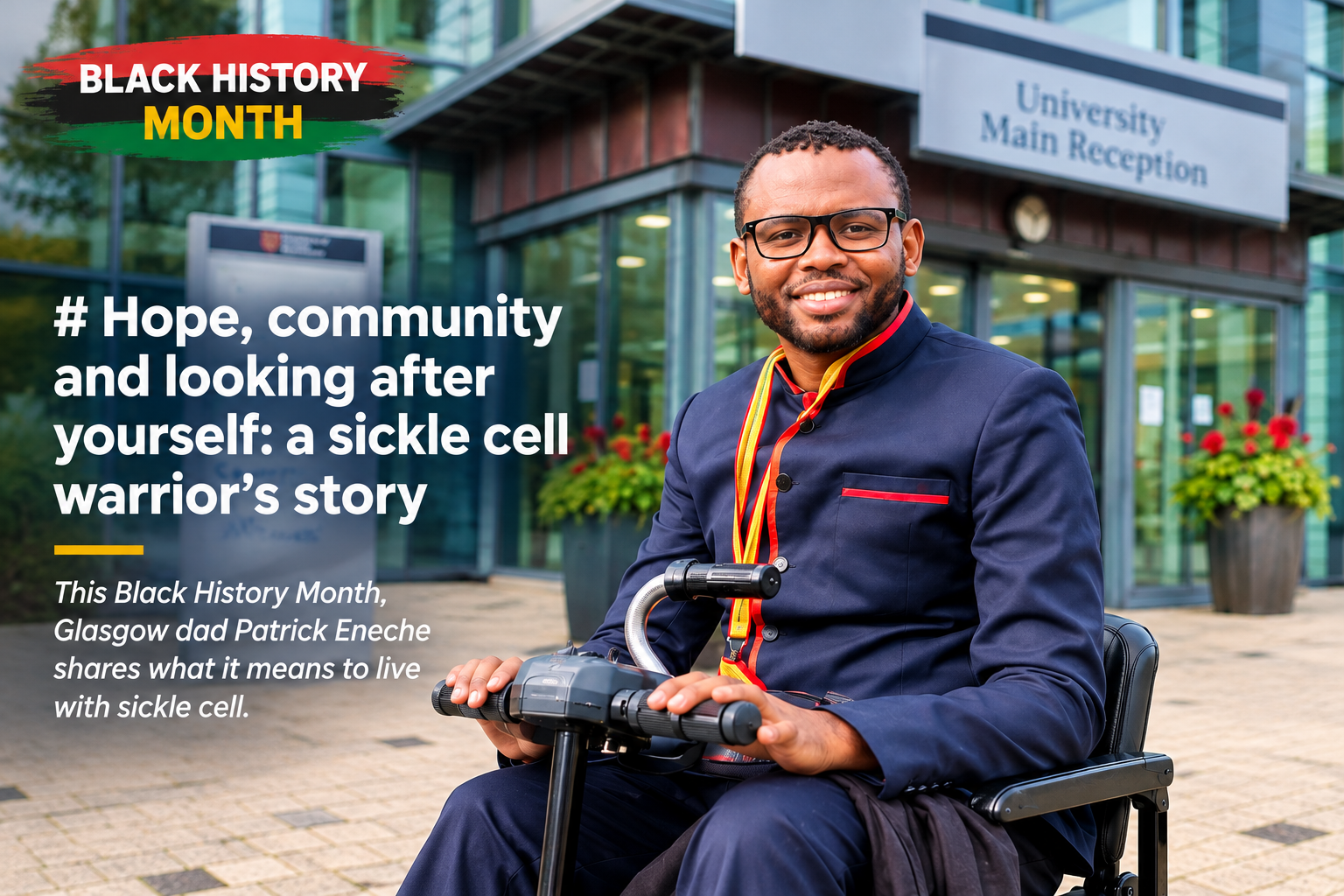
Continuing our series of articles for Black History Month, Glasgow dad Patrick Eneche shares what it means to live with sickle cell while caring for his autistic son, and how community, culture and support from Contact helped him find hope and a new sense of purpose.
For me, Black History Month is about more than looking back. It’s also about recognising the people in our communities today, listening to their stories and making sure their experiences are seen.
This year’s theme, Honouring Our Communities, feels very personal to me. I’m a father, a parent carer and a sickle cell warrior. I have lived with sickle cell disease all my life, and over the years it has caused joint damage, chronic pain, fatigue and a mobility impairment. I’m also dad to a young autistic son who has significant additional support needs and needs a high level of care every day.
A condition too often unseen
Sickle cell is an inherited blood condition. Red blood cells become hard and crescent-shaped, and they can block blood flow. This causes sudden episodes of severe pain, known as crises, and long-term damage to the body.
An estimated 17,000 people live with sickle cell in England alone, and around 250 people are diagnosed each year. In Scotland, more than 400 people with the condition are now registered with the national clinical audit, a number that has grown sharply over the past two decades.
Anyone can inherit sickle cell, but it most commonly affects people of African and Caribbean heritage. Around one in four West Africans and one in ten people of Caribbean heritage carry the sickle cell trait.
Because it mostly affects Black communities, many people living with sickle cell have felt unseen. The pain is invisible. You can look perfectly well while your body is in crisis. That can lead to misunderstanding at school, at work and sometimes even in healthcare, and for families it can mean barriers to the right services and support.
Two realities at once
Being a parent is demanding. Being a parent while managing your own long-term condition adds another layer. There are my hospital appointments and my son’s. There are school meetings, assessments and services to navigate. And there are days when my health limits what I can do, and moments I have missed that I would have loved to share with my family.
Like many parent carers, I became so focused on making sure my son was okay that I stopped asking whether I was okay.
Finding my community
Living with sickle cell has taught me how much community matters. The Hope Project Scotland supports families affected by sickle cell across Scotland, and it has been important to my family. It has connected us with people who share our condition and our cultural background. There, we don’t have to explain every part of our lives; people simply understand.
That sense of belonging, peer support and cultural connection eases isolation in a way that’s hard to put into words. But community isn’t only about sharing a diagnosis. It’s also about the people and organisations who are willing to listen and learn.
Support that put me first
Contact’s Scotland team has supported my family with information, guidance and practical help. Then I joined Contact’s Looking After Yourself Project, a programme for parent carers who also live with a health condition or disability.
For the first time in a long while, the support was about me, not my condition, and not my caring role. I had one-to-one wellbeing coaching. I learned practical techniques I still use every day. I kept a wellbeing journal, and I met other parents who understood. Most importantly, I learned that looking after myself isn’t selfish. It’s part of caring for my family.
That change in outlook has made a real difference. I have since completed my Master’s degree [in Educational Leadership], and I’m looking for work where I can use my skills and experience. I’m also proud to be the Champion of the Looking After Yourself Project, welcoming new parents and encouraging them to take that first step.
Turning lived experience into hope
I don’t pretend everything is easy. I still live with sickle cell. I still have difficult days, and I’m still navigating my son’s needs. But I’ve learned that our challenges don’t have to be the end of our story.
That’s why I talk openly in my community in person and online about life with sickle cell. When I speak with young people living with a rare condition, I want them to hear one thing clearly: your diagnosis does not erase your hopes and ambitions. I’m living proof that you can face real challenges and still learn, grow, raise a family and build a future.
Sharing lived experience is powerful. It helps others understand what it means to live with a condition that is often invisible. It replaces misunderstanding with understanding. And it can give another parent permission to say, “I need help too.”
Honouring our communities
For me, honouring our communities means listening. It means recognising that families don’t all experience disability, health conditions and services in the same way. And it means organisations being willing to learn, so that every family can see themselves in the support on offer.
I’m sharing my story not because I’ve overcome every challenge, but because I’m still moving forward. I’ve learned to ask for support, to look after myself and to value community. And I’ve learned that hope can live alongside difficulty.
Our experiences matter. Our voices matter. Our family’s matter. Together, we can build communities where everyone feels seen, heard, valued and supported.
If you’re a parent carer of a disabled child and need advice or support, call Contact’s free
helpline on 0808 808 3555. To find out more about The Hope Project Scotland, visit their
website.