The NHS is urging parent carers across the UK to check whether their child has had one or both doses of the MMR vaccine. This vaccine protects against measles, mumps and rubella, three serious illnesses that are spreading again.
Measles spreads easily and there have been outbreaks in England and Scotland this year, mainly in unvaccinated children under 10. This month, a child in Liverpool died after getting the disease. Summer is known to be a riskier time as families travel to countries where there are also outbreaks.
Health chiefs say it is very important that every child gets both doses for full protection. The number of children who have got the first dose of the MMR vaccine is nearly at target levels, but there is a big drop in the number of children getting the second dose.
The vaccine is free and available anytime, so if your child has missed one or both doses or is now older, it’s never too late to catch up.
How do I check if my child has had the MMR vaccine?
Look in your child’s Red Book under the vaccination section.
Call your GP surgery and ask them to check your child’s vaccination record
Speak to your child’s health visitor if they have one
How do I book an MMR Vaccine?
There are various ways to book an MMR vaccine depending on where you live in the UK. But in all four nations, the vaccine is free and can be booked at any time.
England: Call your GP practice to book. Some areas also have walk-in clinics which are listed on council websites.
Scotland: Contact your local NHS immunisation team (full list by area here) or contact your GP.
Wales: Contact your GP
Northern Ireland: Contact your GP or visit nidirect.gov.uk for local clinics.
Need more information or want to speak to someone?
Public health bodies say that some communities, such as ethnic minority groups, newly arrived migrants, and people whose first language isn’t English, face more barriers to getting vaccinated and have lower rates of vaccination. This can be for many reasons including not knowing how to get vaccinated and finding it harder to access information. It’s also understood that parents from all communities may have concerns about the vaccine and its safety.
If you’re worried or have questions, speak to your GP practice. They can explain the process and talk through any concerns you might have.
Useful resources
Easy-to-read leaflets and videos in many languages are available at:
This news story is for families in Northern Ireland only. If your child has a statement of SEN, please see our Education in NI pages as the process is different.
In Northern Ireland, secondary school offers were sent out on Saturday 10th May. Keep an eye on your inbox or letterbox! Below, we explain what happens and what your options are if you’re not happy with the offer you’ve received.
What happens on national offer day?
Each child gets a single offer of a school. The offer will be the highest preference school on your list that can give your child a place.
Schools can only take a set number of pupils, so if a school has more applications than places, they use their admissions criteria to decide who gets in.
If none of your preferences can offer your child a place, you’ll be offered another school.
What if I’m not happy with the school offer?
If you are not happy with the school offer, don’t panic. There are a few things you can do:
Keep your child on the waiting list for any schools you originally applied for. Sometimes there is quite a bit of movement before September.
Consider other options – you could apply for schools not on your original list. Admission to a different school does not affect your right of appeal or the decisions of a tribunal.
Appeal against the decision (see below)
How do I appeal?
In Northern Ireland, you can only appeal against a decision if you think the school didn’t correctly apply its admissions criteria. An Independent Admissions Appeal tribunal hears the case. If successful, your child will be offered a place at the school of your choice.
The first step is to make contact with the school to discuss the reason they didn’t offer your child a place. You should also ask for details of their admissions criteria. This will help you to decide whether to appeal.
The Education Authority website has details on how to appeal using EA Connect (if you used this to submit your original application) or how to request a paper application.
This year, the deadline to make your appeal is on 22 May 2025, so you don’t have long to do it.
Exceptional Circumstances appeal
Parents can also apply to the independent Exceptional Circumstances Body (ECB) if they believe that there are exceptional reasons why their child must go to a particular secondary school.
There is no deadline for applications to the ECB.
A claim of exceptional circumstances can only be considered after you have applied to a secondary school through the normal admissions process and been refused a place.
More information and the application form for exceptional circumstances can be found on the NI Direct website.
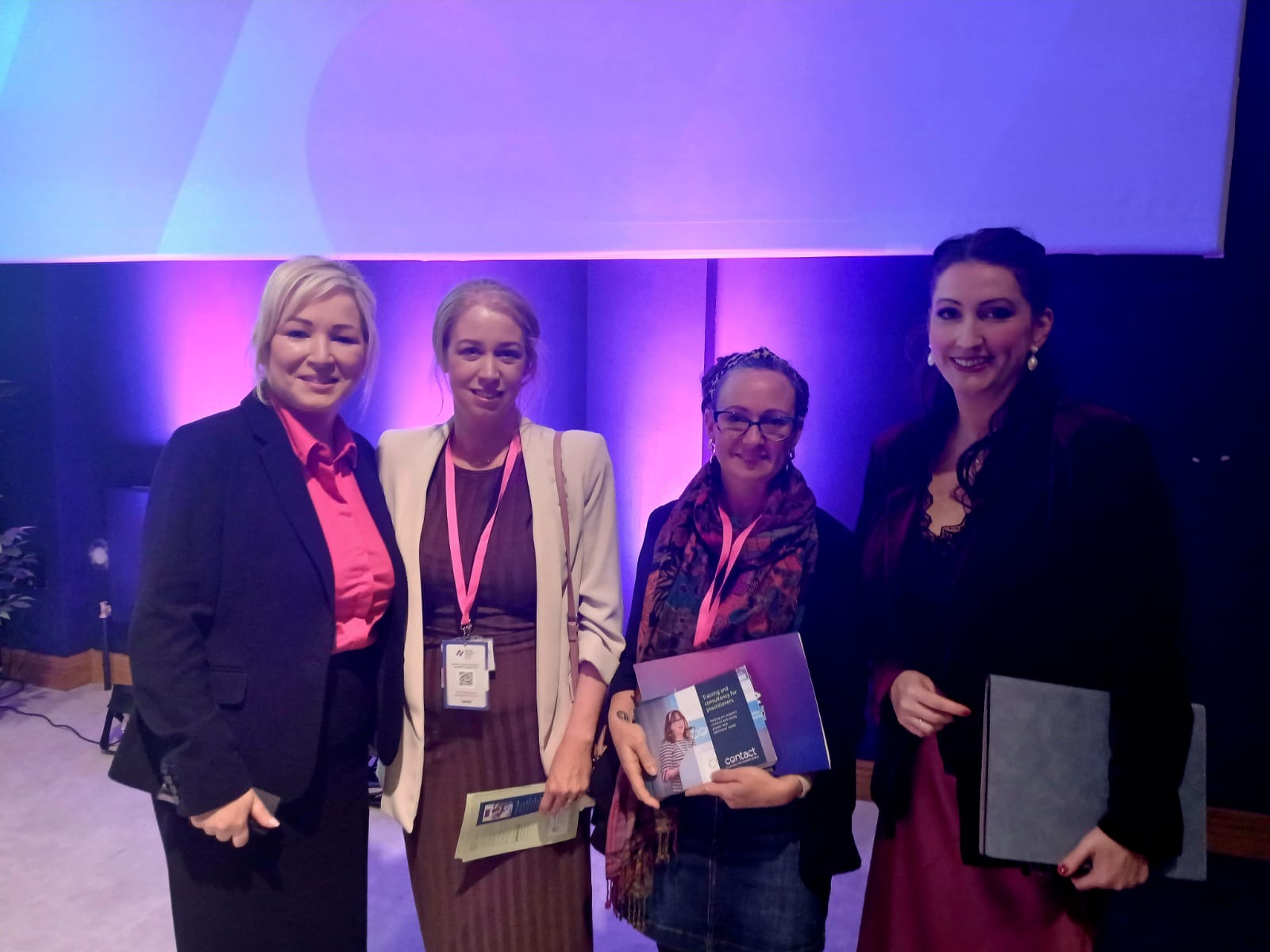
First Minister Michelle O’Neill and Deputy First Minister Emma Little-Pengelly MLA with Ursula McWilliams and Ellie Goff from Contact.
Last week, some of the Contact’s Northern Ireland team attended the first ever NICVA (Northern Ireland Council for Voluntary Action) “Future Thinking” Summit in Belfast.
We were joined by over 350 other representatives from charities and community groups across Northern Ireland, to learn, share, and celebrate the impact of the voluntary and community sector.
First Minister Michelle O’Neill, and Deputy First Minister Emma Little-Pengelly, both addressed the summit. They spoke about the vital role that charities and community organisations play in delivering services to the public.
They shared their support for better funding. And they highlighted the importance of politicians and charities working together to address the key challenges in Northern Ireland.
We were especially delighted that the First Minister and Deputy First Minister took the time to have a chat with our team about Contact NI’s work and the challenges faced by families with disabled children and those with additional needs.
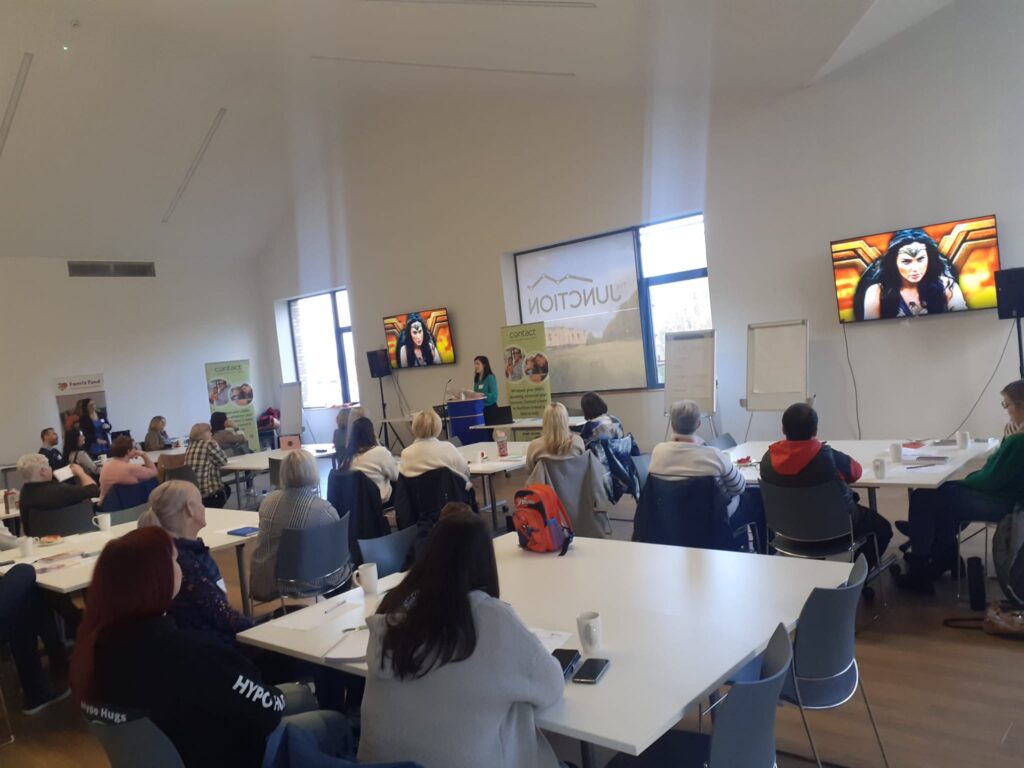
Last month around 65 parent carers and practitioners attended Contact NI’s second rare conditions conference, Supporting Children and Families Living with Rare Diseases in Northern Ireland.
Held in collaboration with the Northern Ireland Rare Disease Partnership and supported by the Pears Foundation and Dormant Accounts Funding NI, May’s conference built on the momentum of Contact NI’s rare conditions conference which took place in January to provide another opportunity for parents and practitioners to connect, exchange information, and learn from each other.
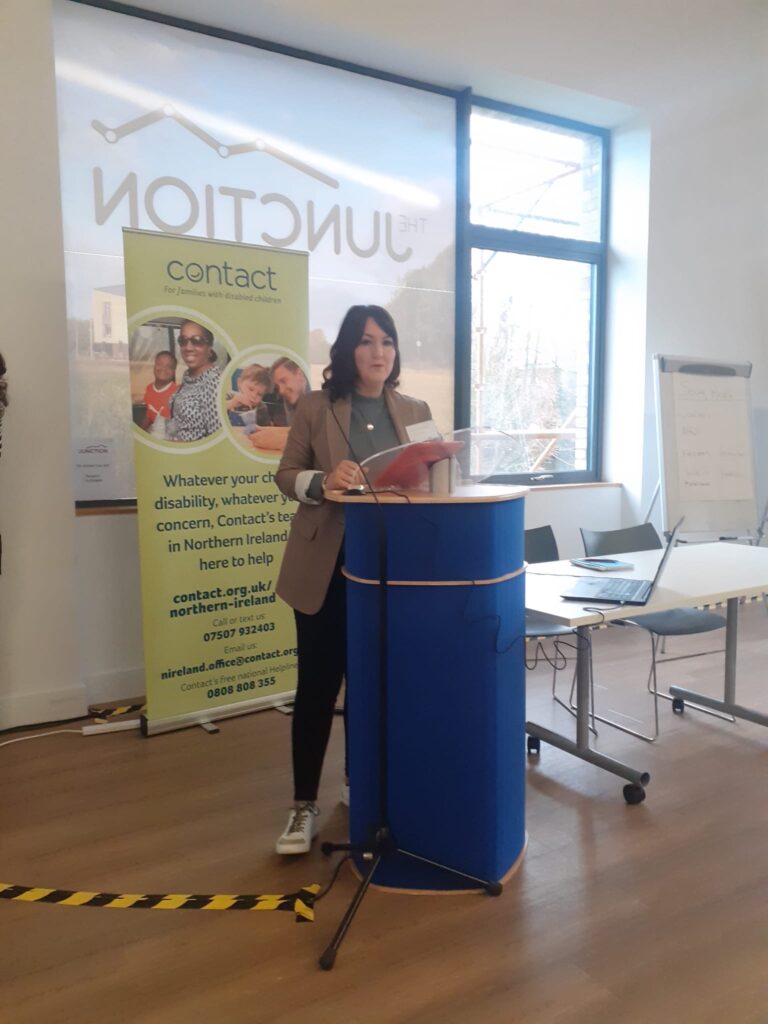
Contact’s Northern Ireland Trustee, Kate Fleck, opened the conference and attendees heard some of the key insights and findings that came out of January’s conference which included the challenges parent carers have getting information and support for their child.
“It is a real help to know that Contact is focused on our needs. Too many times we feel as parent carers that we are on the defensive, always battling. Today was a piece of respite for me.”
Parent carer who attended Contact’s NI Rare Conditions Conference
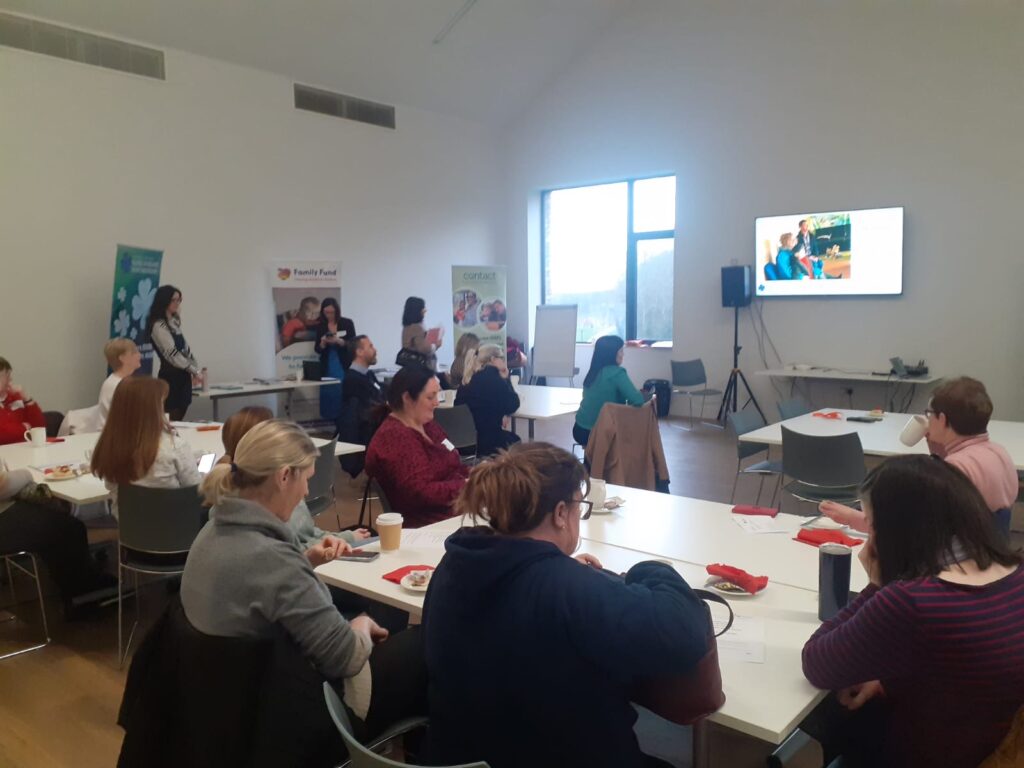
A panel discussion also took place, featuring expert insights from a paediatric specialist, solicitor, and other healthcare professionals, who addressed some of the critical issues faced by rare conditions families and provided a space for in-depth discussion and Q&As.
Attendees had the opportunity to try out our workshops for practitioners and parent carers which offer practical tools and strategies for managing rare conditions and improving communication between carers and the professionals they come into contact with.
“I felt emotional during the wellbeing workshop…I think it was the first time in a long time that I actually realised how much trauma I’ve been holding since our daughter’s diagnosis.”
Parent carer
Catherine Murnin from Contact’s Business Development team said: “Our conference created a supportive environment for sharing experiences, learning, and developing meaningful connections – and we were delighted to receive such positive feedback from attendees.
“It was a great opportunity for families to share their experiences and highlight some of the unique challenges they face like having to explain their child’s condition to different professionals over and over again for example. This conference has given us even more valuable insight as we continue to advocate for better resources and support for families affected by rare conditions and ensure that parent carer voices are heard and listened to.”
Other organisations attending the conference included the NHSCT Carers Hub, C&YPSP Department of Health, NICHI Health Alliance, SENSE NI and Children in Northern Ireland (CINI).
Following the success of Contact NI’s rare conditions conference in January, a second event has been announced for next month in Northern Ireland.
“Supporting Children and Families living with Rare Diseases in Northern Ireland” will take place on Wednesday 15th May from 9.30am-1.30pm at the Dunsilly Hotel in Antrim.
The free half-day conference is open to anyone caring for or supporting a child or young person with a rare condition. It will bring together parent carers and professionals to share experiences, find out about information and resources, and create a space for conversations and connections.
During the event, Contact will be launching a new report detailing some of the key findings from our January conference. The programme also includes taster workshops for parent carers and professionals, a Q&A panel discussion, and an exhibition hall where a number of local and national organisations will be on hand to offer information and support. The conference is being delivered in collaboration with the Northern Ireland Rare Disease Partnership, the Pears Foundation and Dormant Accounts Funding NI.
A free buffet lunch will also be provided at the end of the morning.
For more information and to book a place, please visit our Eventbrite page.
On Wednesday 22 January, Contact NI brought together parent carers and practitioners for a free conference, “Supporting families with rare conditions across Northern Ireland”.
The half-day event aimed to open up dialogue and collaboration towards improving health and wellbeing outcomes for parent carers of children with a rare condition. The event was a combination of open discussions and guest talks.
A total of 43 people attended, with an even mix of parent carers and professionals.
A range of guest speakers
Participants first heard from Caroline McFerran of the Northern Ireland Disease Partnership (NIRDP), one of our two partner organisations for the event, alongside the Pears Foundation. Caroline introduced us to the charity’s ‘Rare Stories – Voices of the 1 In 17 project’. She also spoke about the story of Saul, who lives with Spondyloepiphyseal Dysplasia Congenita (SED).
Also speaking at the event were parent carers Ann-Marie Hoey and Claire O’Hanlon. Ann-Marie is mum to identical twin daughters living with the rare genetic condition PKU. Claire O’Hanlon is mum to Luke, who lives with Duchenne Muscular Dystrophy.
Claire is an experienced business mentor, charity founder and MBE recipient for her services to Muscular Dystrophy campaigning and fundraising. She spoke about ensuring that the lived experiences of parent carers are valued and listened to when services are designed and delivered.
Discussion groups brought frustration, but optimism too
Before the conference, participants were asked to consider three key questions around co-production, family support, and training and support for practitioners. During the event, parent carers, practitioners and staff from Contact and NIRDP formed breakout discussion groups.
Attendees highlighted persistent challenges, including the postcode lottery in accessing support services and waiting lists for diagnosis and support. Frustration over bureaucratic hurdles and a lack of awareness about rare conditions in certain settings, such as A&E, resonated strongly. Practitioners also felt frustrated by red tape and wanted to better understand the experiences of families in navigating services.
Despite the challenges faced, there was optimism about the potential for positive change in practice and policy.
Overwhelmingly positive feedback
Catherine Murnin, Associate for the Business Development team at Contact said: “The event underscored the importance of ongoing support, understanding, and advocacy in navigating the challenges parent carers face. We gained a lot of valuable insight, which we plan to follow up on with the relevant organisations and services to keep the momentum building. We were delighted with the attendance and feedback, and thoughts are already turning to a follow-up event in the future”.
Feedback from attendees was overwhelmingly positive and highlighted how much they valued the opportunity to share their experiences:
“This was one of the best events I’ve attended to give us a balance of information, social time, learning with others and hope that something might change for the better.”
“I was a bit nervous about coming along today as I am new to my role, but felt welcomed and learned a lot from what the parent carers shared. I hope this will improve my practice and how I share with other professionals”.
“It felt like something special happened today. Listening, laughing and having a chance just to talk with others. I enjoyed the informal discussions over the comfort break and lunch. Everyone was so supportive and I would like to join something else again in the future”.
This January, our team in Northern Ireland is bringing families and practitioners together for a free half-day conference for the rare community.
“Supporting Children and Families living with Rare Diseases in Northern Ireland” takes place on 24 January in Dungannon, 9.30am to 1.30pm. Contact Northern Ireland is running the event in collaboration with the NI Rare Disease Partnership and the Pears Foundation.
For parent carers, this will be your opportunity to connect with other families, share experiences and hear from professionals working in the field. You’ll find out more about the support and resources available.
Sessions will include parent/practitioner forums, a talk from a Rare Disease Nurse, and a keynote presentation from Claire O’Hanlon MBE about her lived experience as a parent carer. Interactive group discussions will look at what services are doing well and what could be done better. And we’ll explore how everyone in the rare disease community can work together to improve the experiences of families. Lunch will also be provided at the end of the morning. For more information and to book a place, visit our Eventbrite page.
The Department of Health has recently commissioned a report into social care services in Northern Ireland and made a number of recommendations for improvements.
We will be responding to this report, and we want to include the views and experiences of families with disabled children in Northern Ireland.
What are the recommendations?
There are 53 recommendations in total. They address the range of issues currently facing the services and how best to meet the needs of children and families who access them.
Our response will focus on the following six recommendations:
There needs to be a re-set and re-focus for children’s social care services to give a greater focus and attention to family support (recommendation 22).
The success and contribution of Sure Start should be recognised. Along with other family support services, Sure Start should be expanded, including for children aged four-10 years (recommendation 23).
Respite care for children with a disability should be expanded. Children receiving respite care should not be seen as looked-after children (recommendation 30).
Extend the transition period where appropriate and necessary for young people moving to adult services (recommendation 31).
Introduce a region-wide transitions advice and advocacy service (recommendation 32).
To tackle with pace the difficulties facing children’s social care services (recommendation 50).
Share your thoughts with us
If you have ever used any of the services mentioned or they’ve affected you in some way, we would welcome your thoughts.
We want to know whether you agree with these recommendations, as well as your views on how to improve them. Please feel free to comment on as few or as many as you see fit.
If you would like to contribute to our response, please email Susan Walls, Head of Programmes, at [email protected] by Thursday 30 November at 12 noon.
You’ll find full details of the report, the recommendations and the consultation questions on the Department of Health website. You can also share your views directly on any of the 53 recommendations and see the 66 consultation questions in full. (You don’t need to answer every question). Use the link above and select “Consultation Questionnaire” before 1 December 2023.
More information
Visit our social care web pages for more information and advice on accessing practical support for your disabled child.
The Department for Communities has confirmed that the process of asking existing means tested benefits claimants in Northern Ireland to move onto Universal Credit – known as managed migration – is starting this month.
Initially, this will only apply to claimants who only receive Child Tax Credit or Working Tax Credit and not any other means-tested benefits. The Department for Communities says that it will be randomly selecting ‘tax-credit-only claimants’ and sending them managed migration notices.
This will be happening in all Northern Ireland postcode areas.
What happens after I receive a managed migration notice?
You will not be moved onto Universal Credit automatically – instead, you will need to make a claim. You will be sent a letter telling you that your existing legacy benefits are ending and asking you to claim Universal Credit. This is known as a managed migration notice.
The notice you gives you a deadline by which you need to claim Universal Credit. This is normally at least 3 months from the date of your managed migration notice.
Your legacy benefit payments will stop on the date you claim Universal Credit, or on your deadline day if you haven’t lodged a claim for Universal Credit by then. If you haven’t claimed by your deadline day, you will have a further month within which to claim Universal Credit (although your legacy benefits will have already stopped). This is known as your final deadline.
So long as you claim by your final deadline, you will be eligible for transitional protection payments to make sure that you are no worse off on Universal Credit.
More information about moving onto Universal Credit
At Contact, we wouldn’t be able to do what we do without the insight and support of parent carers just like you. We are now looking for two new people to join our board of trustees and play a crucial role in steering our fantastic charity.
With our new CEO, Anna Bird, at the helm, this is a brilliant time to join our Board and make a real impact.
We’re particularly looking for:
A trustee with skills in fundraising.
A trustee based in Northern Ireland to support our work there.
Watch our vice chair of trustees, Angela, talk about why she volunteers for us:
Interested in applying?
If you are a parent carer and think you could have the skills and qualities we’re looking for, we’d love for you to apply!
The Education Authority has established the SEND Transformation Programme to follow through on recommendations for change that various reports have made over a number of years.
The vision for the programme is that all children and young people with SEND and their families receive the right support, at the right time, to reach their educational goals and get the best possible start in life.
The Education Authority is putting on a series of information events where parent carers can find out more. The events are also an opportunity to share your views and experiences.
Each event will have two sessions. The first session will provide advice and information on general concerns relating to SEN. The second session will introduce parents and carers to the SEND Transformation Programme.
When and where do events take place?
The events take place this week and next. There is a combination of face-to-face and online events.
Parents and carers are welcome to attend both sessions. If doing so, you must complete a registration for each session.
Households in Northern Ireland will today start to receive a £600 payment to help with winter energy costs.
£400 of the total is made up of an energy bill support scheme payment. Households in the rest of the UK started to receive the payment in October 2022.
Northern Ireland households will receive an additional £200 Alternative Fuel Payment. The government is paying this to all households given the high proportion that use alternative fuels.
Whereas families in England, Scotland and Wales will receive £400 in six instalments up to March 2023, families in Northern Ireland will receive £600 in one payment.
Get the latest SEND updates, benefits advice, practical help caring for your child, plus free workshops and family events in our weekly email newsletter.
(Make sure you select ‘News updates’)