Contact’s latest podcast episode featuring ARFID awareness advocate Michelle Jacques is shining a spotlight on Avoidant/Restrictive Food Intake Disorder (ARFID) – a complex and often misunderstood eating disorder affecting children and young people across the UK.
In the episode, Michelle shares her family’s journey as her autistic son developed increasingly restrictive eating from early childhood. What began as sensory sensitivities progressed to a severely limited diet, bringing years of anxiety and battles to get medical support.
Michelle speaks candidly about the emotional toll on the whole family, the frustration of having concerns dismissed as ‘fussy eating’, and the daily challenges ARFID brings.
But the conversation is also one of hope. Michelle explains how removing pressure around food, focusing on happiness, and accessing appropriate medical support has helped transform her son’s health and wellbeing.
In this article
Advice for parents navigating ARFID
Drawing on her lived experience, Michelle shared several key messages for other parents in the episode.
Remove pressure around food
For many children with ARFID, pressure can worsen anxiety and restriction.
Focus on nourishment, not perfection
The goal is a happy, fed child – not a picture-perfect plate every mealtime. Better eating habits can be built over time.
Understand sensory and anxiety triggers
ARFID is often rooted in sensory sensitivity, fear of choking, vomiting, or negative past experiences. Try to understand what the triggers are for your child.
Prepare for setbacks
ARFID is a rollercoaster – you might make some progress, but illness or another trigger could lead to some ‘safe foods’ being rejected again. Learn to accept that this will happen and know that it can improve again.
Accept that it isn’t your fault
The guilt can feel overwhelming at times, but try to remind yourself that it is not your fault.
Advocate
Available support through the NHS can be a postcode lottery, even after obtaining a diagnosis. Keep pushing for recognition, referrals, and appropriate support.
Find community
Parenting a child with ARFID can feel lonely – connecting with other parents who truly understand can really help.
Where to find ARFID support
Michelle also shared some links to support that she’s personally found very helpful.
Many disabled children are entitled to free school meals, but struggle to access their entitlement to them because of their disability or medical condition. This includes some children with ARFID.
Schools have a legal duty to make “reasonable adjustments” to the way they deliver free school lunches. Use our legal guide and these template letters to ask your school for a food voucher. This includes if your child is in receipt of an EOTAS package.
More ARFID support from Michelle
Michelle co-hosts a brilliant podcast 3 Mums 1 Mission – ARFID, available on Spotify and other podcast platforms.
Michelle also runs face-to-face and online workshops for families in Essex via the charity SEND The Right Message. Here she shares her lived experience and knowledge to help parents understand eating difficulties within neurodivergent families.
Michelle and her co-hosts from the 3 Mums 1 Mission – ARFID podcast
Where can I listen?
You can subscribe to our podcast on your platform of choice:
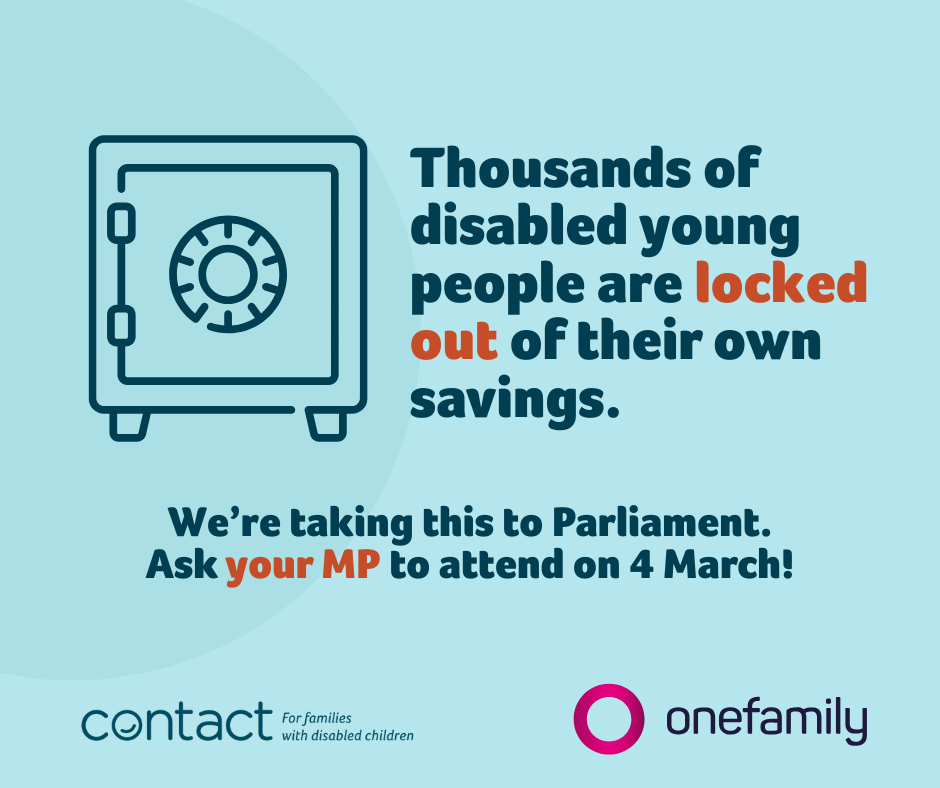
Thousands of disabled young people are being locked out of their own savings when they turn 18.
Child Trust Funds and Junior ISAs are designed to give young people a financial start in adulthood. But for those who lack mental capacity to manage their money, accessing those savings can mean facing a complex, lengthy and often costly legal process.
For many families, this feels deeply unfair. These savings were set aside for their child’s future yet when that future arrives, the money can be out of reach.
We are taking this to Parliament
On Wednesday 4 March, Contact and the UK’s largest Child Trust Fund provider, OneFamily, have organised a parliamentary meeting.
MPs will have the opportunity to hear from families and financial providers about the possible solutions to unlocking savings.
MPs are much more likely to attend if they hear from families in their constituency.
This is a real opportunity to move the issue forward. Together, we can help unlock savings for disabled young people.
Need advice?
To find out the steps you need to take in order for your child to claim their Child Trust Fund, please use our flow chart below.
It’s important to note that the Child Trust Fund may have been converted to a Junior ISA. If so, you may encounter the same challenges accessing a Junior ISA as accessing a Child Trust Fund.
Because the donation comes out of your salary before income tax is deducted, you’ll pay less to give more to support our vital services.
So if you pledge a £10 monthly donation, Contact will receive the full amount. But only £8 will be deducted from your net pay each month if you’re on the basic 20% tax rate.
How to start payroll giving
We’d love for your employer to encourage their staff to consider supporting Contact in this way.
Here are a few easy steps to get started:
Speak to your HR or Payroll team to check if they have a Payroll Giving scheme in place.
Just like we did for Yasmin, who says: “The extra money helps with our travel costs to our many hospital appointments and the additional care we need to support Arisha. I feel less isolated knowing I can contact you if I need advice or someone to talk to.”
A parent carer who plays Contact’s weekly charity lottery to support families like her own has been celebrating after scooping our first £1,000 prize of 2026!
Elizabeth, whose child has special educational needs (SEN), said winning felt “incredibly exciting” – and even more meaningful because she knows first-hand how important Contact’s services are for families with disabled children.
“I joined the Contact Lottery over five years ago because I truly believed in the charity and the difference a small monthly contribution can make to families,” she said. “As a parent of a child with SEN, I know how vital that kind of support is.”
Elizabeth now plans to treat herself to some new craft supplies, a hobby she enjoys in her spare time.
And thanks to amazing players like her, we can continue to be there for thousands of families with disabled children across the UK who rely on our advice and support.
Join today and get a FREE photo magnet
We celebrated a whopping 16 jackpots in 2026. That’s a £1,000 winner around every three weeks – alongside hundreds of other cash prizes throughout the year.
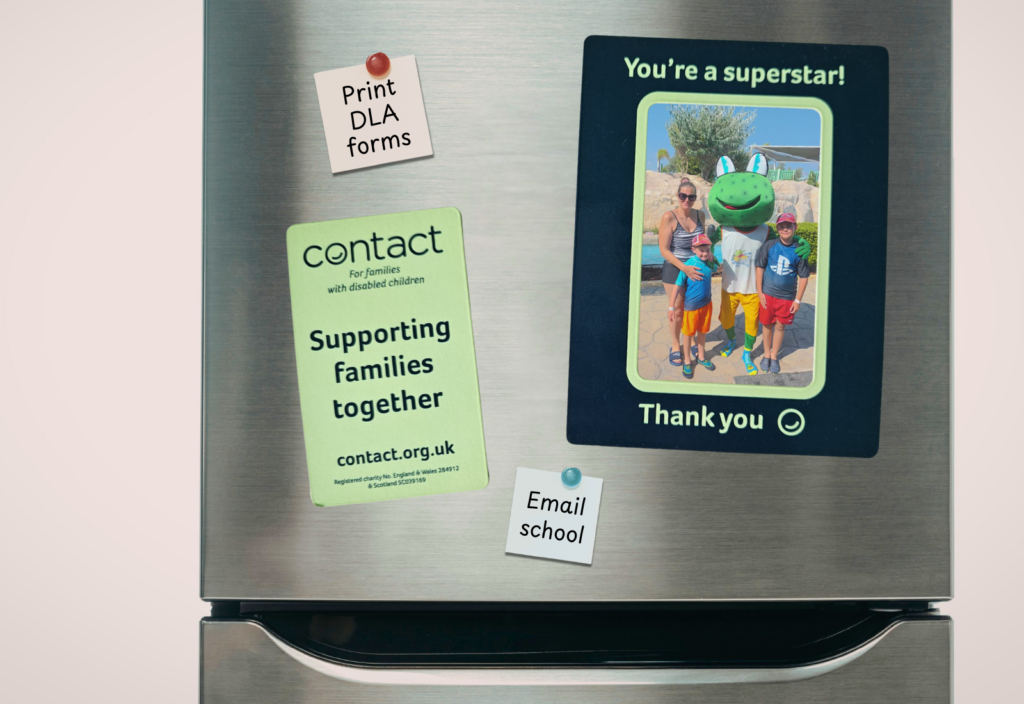
Join the fun for just £1 a week and we’ll send you a FREE photo frame magnet in the post as a thank you for your support!
The special magnet features a detachable window so you can display your favourite family photo on your fridge. It’ll be a small daily reminder of the BIG difference you’re helping to make for families with disabled children.
The Department of Work and Pensions (DWP) has published new regulations this week that should increase the number of people who receive higher Universal Credit health element payments when rules change in April.
What is the health element of Universal Credit?
The health element is also known as the limited capability for work- and work-related activity (LCWRA) element. It is an additional payment in your Universal Credit award where you have health problems and have been assessed as having LCWRA. Currently it is paid at a flat rate of £423.27 per calendar month.
How is the health element changing from April?
From 6 April, the health element will be paid at one of two rates. There will be a higher rate of £429.80 per month and a new lower rate of £217.26 per month. The higher rate will be paid to three groups of Universal Credit claimants:
Pre-existing claimants – this is known as being a ‘pre-2026’ claimant.
New claimants who are terminally ill.
New claimants who meet new severe conditions criteria.
To meet the severe conditions criteria, you must both:
Have a life-long condition that a practitioner acting on behalf of the NHS has diagnosed.
Be assessed as “constantly” meeting at least one of the LCWRA descriptors used in the work capability assessment.
What difference do the new regulations published this week make?
The new regulations increase the number of people who will be classed as a pre-2026 claimant. These claimants are automatically protected to receive the higher rate of the health element.
The new regulations mean that anyone who has claimed Universal Credit before 6 April, and who also has requested that their capacity for work be assessed before that same date, should be treated as a pre-2026 claimant. It doesn’t matter if their entitlement to a health element starts from a later date.
Until now, it was understood that to be protected as a pre-2026 claimant, you not only needed to have claimed Universal Credit on or before 5 April 2026. You also would have needed to have an entitlement to the health element that started on or before that date.
Protected if you claim before 6 April
You will therefore be protected as a pre-2026 claimant if you are a Universal Credit claimant who either:
Is awaiting a work capability assessment before 6 April and you are awarded LCWRA at a later date.
Already has LCWRA, but entitlement to the LCWRA element is not yet in place because of the three-month “qualifying period”. (There is normally a three-month period between first submitting fit notes as part of a Universal Credit claim and getting the health element added to the award.)
A disabled adult who claims Universal Credit and asks for their capacity for work to be assessed before 6 April should be protected.
People moving onto Universal Credit from ESA
The new regulations also benefit some people who move from Employment and Support Allowance (ESA) to Universal Credit.
ESA claimants will be protected as a pre-2026 claimant, even if they claim Universal credit after 5 April. For this to apply, you must:
Be entitled to a support component as part of an ESA award on 5 April 2026.
Continue to receive this ESA support component until the date you eventually claim Universal Credit.
My child will claim Universal Credit after 5 April. He had previously established LCWRA via a credits-only claim for ESA. Will he be protected?
No, unfortunately not.
The rules allowing someone to be protected as a pre-2026 claimant, even though they claim Universal Credit after 5 April, only apply to claimants who have an actual award of ESA. It doesn’t apply to those who don’t get ESA, but who have instead established LCWRA via a ‘credits only’ claim.
A young person who has established LCWRA via a ‘credits-only’ claim for ESA will only be protected as a pre-2026 claimant if they manage to successfully claim Universal Credit on or before 5 April.
If, because of their studies, your child does not get Universal credit until some date after 5 April 2026, they will not be classed as a pre-2026 claimant. This remains the case even if they have already established LCWRA via a credits-only claim for ESA.
In this scenario, your young person’s chances of getting the higher rate of the health element as part of their later Universal Credit claim will depend on whether they meet the new severe conditions criteria.
More information on our website
You can find more information about these topics on our website:
The government has today announced that each mainstream secondary school in England must have an inclusion base. An inclusion base is the umbrella term for SEN (special educational needs) units, resource bases and specialist units. These are designed spaces away from the classroom where children with SEN can get additional support.
Contact welcomes measure but cautions against under-resourcing
Anna Bird, Chief Executive at Contact, said:
“We welcome any initiative that increases inclusion in and accessibility of schools. To function well, inclusion bases must be appropriately resourced. That means they need access to teachers, teaching assistants and therapists, as well as designated space.
“Calls to Contact’s helpline suggests the bases that already exist vary dramatically from school to school. If they are appropriately funded, staffed and resourced and effectively interact with the wider mainstream school, they have the potential to improve inclusion. If not, disabled children are segregated from their peers and not given the chance to feel welcome and thrive at school.”
In the autumn we ran focus groups for parents about their experience of SEN units for their children. Here, too, parents reported that the bases their children used varied widely. One parent described how flexible support helped their daughter access mainstream lessons:
“She has some classes where the staff from the unit will drop in partway through to see how she’s doing. With other lessons like English or Geography, where there’s a lot of writing, there will be someone from the unit in the classroom with her.”
Other parents raised serious concerns about staffing and quality:
“The hub he’s in has never had a qualified teacher teaching the class. There is only a teaching assistant and a lunch supervisor. I feel it’s more like a daycare than a school.”
Anna Bird added: “We were concerned that more units are opening without guidance. So we welcome the government’s intention to publish guidance in the spring.”
We have already shared the findings from our parent focus groups with officials at the Department for Education (DfE). We also supported parent carers to speak directly to DfE officials about their experiences of SEN units and bases.
Our Family Finance Team received almost 30 questions from parent carers across the UK.
Below are the key themes that came up most frequently, along with the advice we provided:
Most 16-, 17- and 18-year-olds in full-time education can’t get Universal Credit
The Universal Credit rules prevent most claimants who are ‘receiving education’ from getting Universal Credit. The definition of receiving education includes:
Young people in full-time non-advanced education (e.g. school or college) who have not yet reached the 1st September after their 19th birthday.
Young people in full-time advanced education (university or equivalent), regardless of their age.
Young people in these groups won’t get Universal Credit unless they are exempt from the student restrictions. Exempt young people include those with children of their own or those estranged from their parents.
Which disabled students are exempt from the rules?
Even if your son or daughter falls into one of the groups of students who cannot normally get Universal Credit, they can claim if they are disabled and meet two tests.
They have undergone a DWP assessment known as a work capability assessment and have established a limited capability for work. However, they need to have done this at some point BEFORE they started their current period of ‘receiving education’.
It is easier for someone in full-time non-advanced education to get Universal Credit once they have reached the 1st September after their 19th birthday. Different rules apply at that point.
Part-time students are usually able to claim Universal Credit, whether they have reached the 1st September after their 19th birthday or not.
19-year-olds in full-time non-advanced education
When a young person is 19 and still in full-time non-advanced education, it can be easier for them to qualify for Universal Credit despite being on a course.
There are two circumstances where the rules help a 19-year-old. These are where:
A 19-year-old is on a course that they were accepted or enrolled onto at some point after they turned 19.
They have passed the 31 August after their 19th birthday.
If either of the above apply, there is only one other way the DWP can refuse them Universal Credit. This is if their Universal Credit claim includes any work-related conditions (e.g. job-seeking or attending training) and the DWP argues that these conditions are not compatible with their course.
Universal Credit staff can use their powers to switch off all work-related conditions. Or they can accept that your child’s course is flexible enough to meet the work-related conditions alongside the course. If they do either, there is no incompatibility between the course and claim, and they should award Universal Credit.
Establishing LCWRA
Rather than hoping Universal Credit staff switch off work-related conditions, it is possible to force them to do this.
If your child makes a credits-only claim for new-style Employment and Support Allowance (ESA) now and establishes that they have a limited capability for work- and work-related activity (LCWRA), the DWP are legally obliged to switch off all work-related conditions. By doing this you can guarantee that come September, your child won’t be refused Universal Credit as a student. The decision won’t be left to the discretion of individual Universal Credit workers.
If your child has already passed the 31st August after their 19th birthday, or if they were accepted/enrolled onto a new course of full-time non-advanced education at some point after they turned 19, you should get advice about them claiming Universal Credit now.
If your 19-year-old was accepted onto their course before age 19 and they don’t turn 20 until sometime after 31 August, get them to make a credits-only claim for new-style ESA as soon as possible. That way, they can try to get a decision that they have LCWRA in place for September.
How does my child go about establishing a limited capability for work?
In order to do this, your child will need to get fit notes from their GP. You’ll submit these to the DWP alongside a claim form for new-style ESA.
Unless your child has been working and paying national insurance, they are not actually going to qualify for ESA. You are completing the claim form not to get ESA itself. Instead, you are aiming to force the DWP to carry out a work capability assessment and to make a decision on whether or not your child has a limited capability for work. This is known as making a ‘credits only’ claim for new style ESA. You can read more about what’s involved in making a ‘credits only’ claim for ESA on our website.
Once you’ve lodged a claim, you’ll get a decision telling you that your child does not qualify for ESA. Don’t be worried by this. A refusal is what you are expecting.
The DWP should then start the process of organising a work capability assessment. They should send you a work capability questionnaire to complete. Once you’ve completed and return the questionnaire along with any other supportive evidence you have, the DWP may make a decision about your child’s capability for work based solely on the paperwork. Or they may ask for an interview over the phone/video call. Or your child may have a face-to-face consultation with a health professional.
My child established limited capability for work. Will they be able to get Universal Credit straightaway despite being in education?
No. Making a credits-only claim for new-style ESA will not necessarily help them get Universal Credit while on their current course.
However, it will maximise their chances of getting Universal Credit in the future if they:
Have a break in their education, before returning to a new course at a later date.
Move from non-advanced education to advanced education (e.g. they will be starting university after the summer).
Stay on in non-advanced education beyond the 31 August after their 19th birthday.
Are 19 and start a new course of full-time non-advanced education after their 19th birthday.
The situation is different if your child has already passed the 31 August after their 19th birthday and remains in full-time non-advanced education. It’s also different if they are in part-time education. In these two groups only, establishing LCW can help you get Universal Credit straightaway, even if it was done on your existing course of education.
When should I make a ‘credits only’ claim for new-style ESA?
So long as your child is at least 16, the earlier you make a ‘credits only’ claim the better.
The last we heard, it was taking four-six months to get a decision that someone has limited capability for work. This means you want to make a claim at least six months before your child is likely to claim Universal Credit.
For example, your child is 19 or about to turn 19 and in full-time non-advanced education and you want to help them claim Universal Credit from 1st September. You should not delay in making a credits only claim. You need to leave enough time to get a decision back that they have a limited capability for work. Similarly, if your child is going to start university, you need to get a decision before that new course starts.
The best advice is simply just to get it done as soon as you can. That way you don’t need to worry about whether or not you will get a decision back in enough time.
Will my Child Benefit and Universal Credit child payments be affected if I help my daughter make a credits only claim for ESA?
Making a ‘credits only’ claim for new-style ESA will NOT impact any payments you currently get for your child. So long as your child hasn’t worked and paid any national insurance they will not actually receive any ESA payments. This means your benefits won’t be affected.
The benefits you currently receive for them will stop once when they actually start to get Universal Credit in their own right. They’ll also stop when they become too old for you to receive payments for them as a child.
My child is 17 and on PIP. He will be moving from school to a special education college after the summer. He’s just had a decision back that he has LCWRA. Does this mean he can claim Universal Credit once he starts his new course?
This will depend. The law says your child will be exempt from the student rules if they established LCWRA on a date before they started ‘receiving education’.
However, it’s not certain the DWP will accept that your son will have had a break in receiving education when he moves from school to college. They may instead argue that the new college course is a continuation of the previous period of receiving education.
Young people in full-time non-advanced education are treated as receiving education not only while they are on their course. They are also receiving education during any period when they have been accepted or enrolled onto another non-advanced course that they are waiting to start.
For example, a young person who moves from school to a non-advanced college course is treated as receiving education:
While on their school course.
During the summer holidays (assuming they were accepted onto their college course before their school course ended).
Once they start their new course.
The DWP are likely to argue they have remained in one single period of ‘receiving education’ throughout this whole time. If they take this view, they will argue that your son is not exempt from the student restrictions because he established LCWRA during his current period of receiving education, rather than before it.
The situation will be different if there is a delay in him being accepted onto his new course. For example, where someone’s school term ends and there is then a gap of some days or weeks during the summer before they are accepted onto a new college course. In that case, it should be possible to argue that there has been a break in them receiving education. If so, they should be entitled to Universal Credit on their new course.
My daughter is 18 and on Adult Disability Payment. She’s still in school but will be starting university after the summer. She has already made a ‘credits only’ claim for ESA and established LCWRA. Does this mean she will definitely get Universal Credit payments once she is at university?
Someone moving from non-advanced to advanced education is treated as having a break in receiving education during the summer. Your daughter should be able to claim Universal Credit during the summer holidays (as long as she meets the normal rules). It also means she will be exempt from the student restrictions and eligible for Universal Credit on her university course. This is because she will be a student who established LCWRA before they started receiving education.
However, the fact that she is exempt from the student restrictions doesn’t necessarily guarantee that she will actually get Universal Credit while at university. Universal Credit is a means-tested benefit. Depending on her income and savings, her Universal Credit award may be very low or even reduced to nil. Some student finance such as a maintenance loan is treated as income and deducted from a Universal Credit award. So, any Universal Credit payments will depend on her individual circumstances including her student income and how much rent she pays, if any.
My disabled son is 18, on PIP and on a non-advanced college course. He wants to claim Universal Credit for himself. If he is awarded Universal Credit, will this affect any payments that I get for him?
Your son may not have the option of getting Universal Credit at this point in time. As an 18-year-old in full-time non-advanced education, he’s likely to be refused Universal Credit unless he already established a limited capability for work (LCW) at some point before he started his current period of receiving education.
If he is able to receive Universal Credit, any Child Benefit you get for him will stop. If you get Universal Credit child elements for him as part of your own Universal Credit claim, these will also stop immediately. So will any child support maintenance paid for him.
You will need advice about whether him making a Universal Credit claim is a good idea. You must take into account what you will lose for him as a dependant and what he would be paid in his own right. It may be better to put off claiming Universal Credit for him until he is older and some of these child payments end anyway. You will need individual advice about this, as it will depend on your family’s specific circumstances.
If you decide not to claim Universal Credit at this point, it would be a good idea to make a credits only claim for new-style ESA for him.
Still have questions?
Our helpline team is here to help. Call us on 0808 808 3555 or submit an enquiry.
Thank you to everyone who submitted a question as part of our Facebook Q+A.
Martin Monaghan is Partner, Head of Civil Court Department and Accredited Specialist in Incapacity and Mental Disability Law at Parent Carers Legal Support (PCLS).
Martin has written an article to help parent carers in Scotland understand what the changes could mean for their family.
Guardianship is a court order that allows parents or family members to make important decisions for a young person aged 16 or over who cannot make those decisions themselves. This can include managing money and benefits, dealing with housing, and accessing Self-directed Support.
At the moment, some solicitors can do most of this work through legal aid. This means families don’t usually have to pay large legal fees. Court costs alone can be £4,000 or more, but these are currently covered.
What are the proposed changes?
Under the proposed changes, many solicitors may stop offering guardianship work under legal aid.
This could mean families are asked to pay legal fees privately by using the young person’s own money, savings, or property for example.
If that’s not possible, the local council may apply instead. Social work -not the family – could make key decisions.
The changes would replace the current detailed payment system for solicitors with fixed fees, which may not cover the real amount of work involved. This could lead to fewer solicitors, long delays, and more pressure on councils and law centres. Without financial guardianship, families may also face barriers to accessing parts of Self-directed Support and other essential services.
After strong feedback from families, charities and the legal sector, the Scottish Government paused these changes for now. However, reform is still likely.
“Clearly reform is on the way in some shape or form. We would therefore urge anyone who has been putting off applying for Guardianship for their Adult child to make a start on the process now.”
Martin Monaghan from Parent Carers Legal Support (PCLS)
Join our FREE online workshops in February and March:
On Wednesday 18 February, 10:30-12, Martin from PCLS will be leading our workshop about Guardianship & Powers of Attorney. You can book your free place on our Eventbrite page.
On Tuesday 3 March 10.30- 12, a Guardianship workshop will be led by Greg Douglas, Partner, Caesar & Howie. Please register your free place today to find out more about the proposed changes in Scotland and the potential impact on your family.
If so, this coming 15 February is an important deadline. By this date, local authorities must have reviewed, amended (if necessary), and finalised the EHC plans for children transferring between different phases of education.
What must the local authority do to finalise an EHC plan?
Before the local authority issue the final plan, they must send you a draft EHC plan and ask for your views. The local authority must also consult you about your preferred school for your child. However, expressing a preference does not automatically guarantee a place, but the local authority must name your preferred school unless one of the legal exceptions applies.
To meet the statutory deadline, the local authority should already have completed these steps and issued the final EHC plan.
If the local authority misses the 15 February deadline for finalising an EHC plan, contact the local authority to remind them of their legal obligation and request immediate action.
The rules around when a disabled young person aged 16-20 can claim Universal Credit while in education are complicated. Many families need to take the right steps months in advance.
In many cases, families will need to make a ‘credits only’ claim for new-style Employment and Support Allowance (ESA) before their son or daughter can later move on to Universal Credit as a young adult. These claims can take several months to be decided. So if you’re hoping your child will be able to claim Universal Credit from September, it’s important not to delay.
To help families navigate this complex system, our Family Finance Team is running a dedicated Q&A, offering personalised answers to your questions about:
Universal Credit for young people in education.
Making a ‘credits only’ claim for new-style ESA.
What applies when a young person is staying in education, changing courses, or leaving education.
This is your chance to get clear, tailored advice from our expert advisers.
Receive a personalised reply from our Family Finance Team
We’ll also share a round-up of common issues raised on our website, so families can learn from each other’s experiences.
The Q&A is open to families across the UK, but there is a 30-question cap as we’re a small (but mighty!) team. Don’t wait too long to submit your question.
Around 300,000 children are now on community health waiting lists. More than 77,500 have been waiting over a year – a six‑fold increase since the start of 2023.
The Royal College of Paediatrics and Child Health described the long waits as “catastrophic”. And it says these delays are undermining early intervention with children who have developmental needs.
Children and those with complex needs most impacted
Many of the children waiting the longest have complex needs, including learning disabilities, physical disabilities, autism, ADHD, and developmental language disorders.
Analysis by the BBC shows stark inequalities between children and adults:
26% of children on community waiting lists have been waiting more than a year.
Only 1% of adults face waits that long
Impact on education, development and family life
Amanda Elliot, Contact’s health lead, said long waits for community health services had a knock-one effect across every part of a disabled child’s life.
“Contact sees firsthand the impact these delays have on children and their families. They are desperate for support.
“These delays mean children are missing out on early intervention and support. Many will never catch up. They are fueling rising school absences and mental health difficulties as many children are being left to struggle in school without the support they need.
“Meanwhile families are reaching crisis point. The children’s health workforce needs significant and urgent investment to bringing it into line with investment in adult services.”
What is happening to address waiting times?
The Department of Health and Social Care agreed the waiting times were “unacceptable”.
Officials told the BBC that they are planning a new 18-week wait target for community health services and bringing in more staff and digital changes under the NHS Plan.
The Government is also hoping Integrated Care Boards (ICBs) adopting the NHS ‘neighbourhood’ models of care will bring services closer to families.
The report examines the services that support this critical period of child development. It highlights:
The need for equity in the expansion of Family Hubs.
Severe shortages in the children’s community health workforce.
The importance of better integration between child health services and early years family support services.
Contact urges the government to include disabled children and their families in any reforms resulting from the report.
Access to Family Hubs
The Committee supports government plans to increase access to Family Hubs. And it stresses that these vital early years services should be accessible in every community.
The report highlights the need for clarity on how Neighbourhood Health Services and Family Hubs will work together. Parent carers need clear information about where to go for help and how to access advice, support and services for their child’s needs.
We urge the government to ensure forthcoming guidance on the role of Best Start Family Hubs for children with special educational needs and disabilities (SEND) sets this out.
Children’s health workforce plan
We welcome the Committee’s call for a clear children’s health workforce plan. Disabled babies and young children need timely access to a range of specialists close to home, including:
Physiotherapists.
Speech and Language Therapists.
Other children’s community health services.
Waiting times for these services urgently need to improve. In July 2025 our CEO Anna Bird gave evidence to the Committee, highlighting the long waits children under two years face to get an assessment and diagnosis, and the impact this has.
Provide trusted, practical advice on toileting, sleep, behaviour and communication.
Build parental confidence and reduce isolation.
Offer impartial support to families struggling to access statutory services.
The Committee also welcomes government plans for a shared outcomes framework and improved data sharing. We ask the government to ensure this work explicitly includes the needs of children with SEND.
This work must also make it easier for families to access support and entitlements. We continue to hear that families of young disabled children struggle to access free nursery care and other early years entitlements.
Finally, consistent communication from health visitors can provide vital reassurance to parents. However, families of babies and young children with emerging or complex needs find it frustrating when developmental concerns are not explored fully.
We urge Family Hubs and Neighbourhood Health Services to ensure that:
Universal services, such as health visiting, work effectively alongside specialist provision.
Early intervention is triggered by observed need.
For young disabled children, prevention means earlier access to healthcare, including timely testing, assessment, treatment, therapies and equipment, to prevent needs escalating.
Please note, the information in this webinar is for families in England and Wales only.
Hosted by Renaissance Legal and Contact, our latest webinar Decision making and accessing a Child Trust Fund for a disabled child is now available to watch on YouTube, or below.
Renaissance Legal’s leading and trusted experts Philip Warford and Sarah O’Sullivan explain:
Assessing mental capacity and what happens if a person doesn’t have it.
The Court of Protection process.
What are the potential issues and solutions around accessing Child Trust Funds/Junior ISAs.
The government has announced a £200m special educational needs and disabilities (SEND) training programme will roll out to every nursery, school and college in the country. The programme will mean every teacher in England receives training to offer the right support to pupils with SEND.
New courses will help teachers learn how to adapt their teaching methods to different needs, including visual impairments and speech and language difficulties. Teachers will also learn how to use assistive technology like speech-to-text diction tools. An update to the SEND Code of Practice will make clear that teachers nationwide should access the training.
The government says it is launching the programme in response to parent feedback at its national conversation on SEND events. It recognises that for too long training on SEND has been inconsistent. One of Contact’s 3 SEND Asks, alongside investing in specialists like speech and language therapists, is that school staff are trained to better support pupils with SEND.
Contact CEO Anna Bird says:
“We welcome the investment in training for teachers. This is an essential part of making mainstream inclusive, and many parents have told us of the need for this.
“Alongside this, children need access to specialists such as educational psychologists and speech and language therapists. The training must not be a substitute for ensuring schools have access to those specialists.
“Parents tell us that social workers and health professionals also lack training in disability. Decision makers in councils would also benefit from training too.”
This news story applies to families in Scotland only.
On Tuesday, Finance Secretary Shona Robison announced the Scottish Budget for 2026/7.
Below we’ve highlighted the key changes that families with disabled children or children with additional needs should know about.
Benefit changes
The Scottish Child Payment – payable to parents in receipt of certain benefits – will increase to £28.20 a week per child from April 2026, in line with inflation (up from £27.16.)
From 2027, the rate will rise to £40 for families with children under the age of one.
£7 million of funding in Discretionary Housing Payments (DHPs) to mitigate the effects of the benefit cap and bedroom tax. (This is for families who will not see an increase in payments after the removal of the two-child limit in Universal Credit). Where a member of the household receives a disability benefit, they will be exempt from the benefit cap).
Tax changes
A tax cut has been provided to some low earners. The basic (20%) rate, which currently starts at £15,398, will increase to £16,547. The intermediate rate (21%), which currently starts at £27,492, will increase to £29,526.
Education
A pledge to deliver breakfast clubs in all primary and additional support needs schools from August 2027. Schools will receive funding to provide up to an hour of supervision in the morning, helping parents to manage childcare around work.
Additional funding will expand wraparound childcare, including after-school and holiday provision, with the aim of supporting parents to enter or stay in work while reducing childcare costs.
A “Summer of Sport”, including free children’s sport and swimming lessons for every primary school pupil.
In this article, our Family Finance parent adviser Polly explains how with your support this winter, we can make a transformational difference to families with disabled children.
Working on the frontline and hearing families with disabled children disproportionately affected by financial hardship is tough.
But every day, our expert advice is making a transformational difference for families across the country.
I’m Polly, and I work in the Family Finance team at Contact, part of our helpline. We give parent carers the tools they need to cope and build a more secure future for their family.
“I won’t need to worry any more”
Just like we did for Francesca*. She was worried about affording the essentials and initially called our helpline for advice to check if her Universal Credit was correct.
Through our specialist support, Francesca unlocked an incredible £17,000 in unpaid benefits for her family!
With rising heating bills, this life-changing amount will keep her family home warm and pay for essential clothing and specialist equipment for her disabled children.
‘Getting this money will make such a difference to my life and my children, and I can’t thank Contact enough. I won’t need to worry any more about how I will afford all the things they need. I really can’t believe it.’
The positive difference we make to families like Francesca’s is what motivates me to speak to as many parent carers as possible.
Could you make a £10 donation to transform lives?
Can you kick-start the year by showing your parent carer solidarity and making a £10 donation today? Your gift could help us respond to the increasing number of calls reaching out to us for support right now.
As a thank you, we’ll post you four special stickers for every gift of £10 or more. We invite you to display them this winter to show your support for families with disabled children – because being seen, heard and supported can change everything for them.
*Francesca’s story is real, but we’ve changed her name to protect her identity and used an unrelated family photograph.
We are delighted to announce that Contact Scotland has secured funding from the National Lottery Community Fund to deliver a one-year project for families living in North Lanarkshire.
The project, Looking After You and Yours, will support families with a disabled child or a child with additional needs, with or without a diagnosis.
Thanks to this funding, families will be able to access one-to-one appointments with Contact’s experienced and local parent adviser. We’ll provide hospital-based support at University Hospital Wishaw, regular face-to-face and online workshops, and free family days. We will build on our digital resources, developing factsheets, webinars and guides, so families can find clear and trusted information at a time that suits them.
Susan Walls, Head of Programmes in Scotland, says:
“This funding comes at a crucial time for families in North Lanarkshire. We are seeing high levels of child poverty, rising living costs and increasing pressure on local services. Many families with disabled, seriously ill, and additional needs children are struggling to get the help they need.
“Families tell us they feel exhausted, overwhelmed and unsure of where to turn. This is especially so when they are waiting for a diagnosis or help for their child.
“We are very grateful to National Lottery Community Fund for awarding us this grant. It will will make an incredible difference to families.”
Many disabled children and young people in families Contact supports require full-time care from both of their parents.
Only one parent can make a claim for Carers Allowance, the Scottish Carer Support Payment, or the carer element in Universal Credit for each disabled child. The Department for Work and Pensions (DWP) does not expect this parent to work or look for work as part of their Universal Credit award.
Unfortunately, this means that in order to claim Universal Credit, the other parent will normally need to actively search for work. This is unless there is another disabled child in the household.
Our new templates can help you
The DWP does have the power to exempt the second caring parent from work-related activity. Regulation 89(1)b of the Universal Credit regulations 2013 sets this out.
But work coaches aren’t always aware that they have the power to exempt second caring parents from searching for work.
We have a new page with more detailed information about caring couples. Our page explains how to ask your work coach to exempt a second caring parent from work searching. And we have developed template letters you can use to make this request to your work coach in your online journal.
Get the latest SEND updates, benefits advice, practical help caring for your child, plus free workshops and family events in our weekly email newsletter.
(Make sure you select ‘News updates’)