Extra help at school
10 mins read
This advice applies in England only. Read information for families in Northern Ireland, Scotland or Wales.
If your child has special educational needs (SEN), their school can provide extra help through a system called SEN support.
In this article
What is SEN support?
SEN support is extra help for children who need different, or additional, support than is normally available to children of the same age.
Your child does not need a diagnosis to get SEN support.
Mainstream schools have legal duties to identify and support children with SEN. These duties help make sure your child gets the support they need. Schools must:
- Identify whether a child has SEN and provide the support they need. SEND Code of Practice, paragraphs 6.14-6.20 and 6.44-6.56.
- Use their best endeavours to make sure children with SEN receive the support they need. The words “best endeavours” mean schools must do everything they reasonably can. Children and Families Act 2014, section 66.
- Involve children and their parents when planning and reviewing SEN support. SEND Code of Practice, paragraphs 6.64 – 6.71.
- Involve specialists, such as an educational psychologist, occupational therapist or speech and language therapist, if a pupil continues to make little or no progress despite SEN support. Parents should always be involved in this decision. SEND Code of Practice, paragraph 6.59.
What does SEN support look like?
The support your child receives will depend on their individual needs. It could include:
- Extra help from a teaching assistant.
- Different materials or equipment.
- Working in a small group.
- Movement breaks.
- Access to a quiet space.
- Visual timetables or task boards.
- Support with personal care such as eating, dressing or moving around school safely.
- Support with emotional regulation using tools like feelings fans or emotional scales.
- A temporary pass to leave the classroom for a short time if they feel overwhelmed.
- Advice from specialists, such as educational psychologists, speech and language therapists or occupational therapists.
The role of the SENCO
A SENCO (sometimes called a SENDCO) stands for special educational needs (and disabilities) co-ordinator. A SENCO is a qualified teacher who organises support for pupils with SEN.
If your child receives SEN support, the SENCO will work with your child’s teachers to make sure the right help is in place. The SENCO should give you clear information about the support your child is getting and how the school provides it.
How do schools provide SEN support?
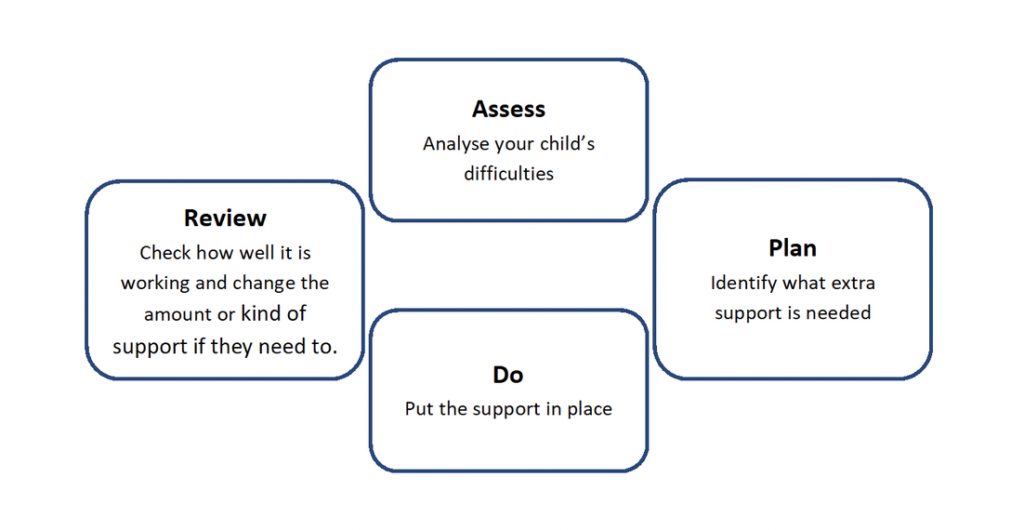
Schools use a “graduated approach” to putting SEN support in place. The graduated approach is an ongoing cycle. It has four stages.
Assess
Your child’s teacher, working with the SENCO, builds a picture of your child’s needs. The teacher or SENCO should talk to you and your child (if appropriate) and consider any advice from professionals such as an educational psychologist or an occupational therapist.
Plan
The teacher and SENCO work with you and your child to agree:
- What support your child needs.
- What the support should achieve.
- When the support will be reviewed.
The school must formally tell you when it decides to provide your child with SEN support.
Do
The school puts the agreed support in place. Your child’s teacher remains responsible for your child’s progress, even when other staff or specialists are involved.
Review
The teacher and SENCO review how well the support is working. What they learn should feed into the next “Assess” stage, then the cycle starts again.
Schools should meet with you at least three times a year to review your child’s progress and support. The school must also provide you with a report on your child’s progress at least once a year.
Four areas of need
When using the graduated approach, schools should consider the four broad areas of need set out in the SEND Code of Practice. These are:
- Communication and interaction.
- Social, emotional and mental health difficulties.
- Cognition and learning.
- Sensory and/or physical needs.
What do SEN support terms mean?
You may hear teachers use different terms when talking about your child’s SEN support. Here’s what they mean.
SEN register
If the school identifies your child as having SEN and provides SEN support, it should keep a record of this. Schools normally do this by including these children on their SEN register.
SEN support plan
If your child is receiving SEN support, the school should record the support it has agreed to provide in a plan. The plan should include:
- Your child’s strengths and needs.
- The support the school will provide.
- The outcomes the support is intended to achieve.
- When the school will review the support.
Schools use different names for these plans. Your child’s plan might be called an Individual Education Plan (IEP), Pupil Support Plan, My Plan or One Plan. The name of the SEN support plan in your child’s school will be in the school’s SEN Information Report (see below). You can also ask the SENCO.
The SEN Information Report
Every mainstream school must publish an SEN Information Report on their school website. This sets out how the school supports pupils with SEN. It should include information such as:
- The kinds of SEN the school supports.
- How the school:
- Identifies and assesses pupils with SEN.
- Consults parents and children about support.
- Assesses and reviews progress towards outcomes.
- How teaching and the learning environment are adapted.
- Staff expertise and how the school accesses specialist support.
- Support for children moving between stages of education (often called “transition”).
- How children with SEN take part in activities alongside their peers.
- Arrangements for handling complaints.
- The name and contact details of the SENCO.
What if I have questions about my child’s support?
If you’re worried about your child’s progress or the support they’re receiving, talking to the school is often a good first step. Many concerns can be resolved by talking things through with your child’s teacher, tutor or SENCO. You can ask to meet with the school to discuss your child’s support.
Before the meeting
Have a look at the SEN, equality and behaviour policies on the school’s website before the meeting. These policies can help you understand how the school supports pupils with SEN. You could also collect information about your child’s needs, such as:
- Examples of schoolwork, homework, school reports and test results.
- SEN support plans and behaviour support plans.
- Emails you have written to the school or notes you’ve made in a home/school diary.
- Any professional reports.
- Information from a previous school.
It can also help to write down any concerns about your child’s:
- Progress, schoolwork or concentration.
- Physical skills.
- Relationships.
- Behaviour at school.
- Feelings about school.
- Behaviour and mood at home.
Think about any other relevant issues, such as bullying or changes that may have happened at home. You may also want to consider what is working well for your child and what you would like to change.
During the meeting
You may want to ask:
- Is my child on the SEN register?
- Is my child getting SEN support?
- Can I see my child’s SEN support plan?
- What assessments has the school carried out to identify my child’s difficulties?
- Does my child get extra help from a teacher or another adult? What do they help them with?
- Is the help in a group or individually? Is it every day? How long is that for?
- How do you measure my child’s progress? Are they making the progress you would expect?
- Has the school referred my child to specialist services, for example educational psychology or speech and language therapy?
- What can I do at home to help my child?
- What will the next steps be if my child needs more help?
After the meeting
Before the meeting ends, agree the next steps and ask the school to put them in writing. If possible, agree a future date for a review meeting.
It’s helpful to end the meeting on a positive note. Emphasise that you hope you and the school can work together to support your child.
What if my child needs more help?
Some children require more help than their school, college or nursery can provide from its own resources. If you think your child needs more than SEN support, talk to your child’s SENCO about your concerns.
Children who need more than SEN support have their needs and provision set out in an education, health and care (EHC) plan. The first step to getting this extra support is to request an EHC needs assessment.
Other services and provisions
Children with SEN may receive SEN support as well as other services and provisions. The information below explains relevant additional duties and types of support.
Reasonable adjustments
Schools have a duty to make reasonable adjustments so disabled pupils are fully included and not disadvantaged. Many children with SEN are protected under the Equality Act. Read our webpage on disability discrimination for more information.
Medical conditions and SEN support
Schools must make arrangements to support pupils with medical conditions. A medical condition does not necessarily mean your child has SEN, but medical support and SEN support should work together when both are needed. Read our Help with medical needs webpage for more information.
Support for different age groups
Mainstream further education colleges support young people aged 16 and over with SEN in a similar way to schools. Read our Education beyond 16 page for more information.
Early years settings that receive government funding must take steps to include and support children with SEN and any medical condition they have. Local authorities must make sure that all settings providing free early education receive additional funding to support children who need extra help. Read our Support in the early years webpage for more information.
Where can I find more information?
Find out more about SEN support by reading:
- Our factsheet: Extra support in mainstream school – SEN support.
- Chapter 6 of the SEND Code of Practice.
- Your child’s school SEN Information Report from their website.
Do you need to talk to someone about your child’s SEN support?
Our parent advisers can help with any questions you have about your child’s SEN support. You can call our free helpline, email us via our web form or contact us using Charlie, our chatbot, on our website.
You can also contact your local Special Educational Needs and Disabilities Information, Advice and Support Service (SENDIAS). Every local authority must provide this impartial service. You can find details of your local service on our webpage Local advice and support organisations.
Related information

EHC plans
Some pupils receive support through an Education, Health and Care (EHC) plan.
Read more
Applying for a school place
We can help you apply for a place for your child, whether starting school for the first time or changing to another.
Read more
Help with education costs
Information about free school meals, help with uniform costs, school transport, EMA and the 16-19 bursary, and the Disabled Students' Allowance.
Read more
Learning products at Fledglings
Visit our partner shop for learning resources and sensory equipment.