School transport is consistently in the top 10 issues on Contact’s education helpline.
When the Department for Education updated the school age guidance on home to school transport, on the back of a Contact campaign, we welcomed many positive changes including clearer wording and sections on benefits and allowance, behaviour and independent travel training.
However, some concerns remained, including the section on accompaniment, which leaves parents largely responsible for accompanying their teenage disabled children to and from school.
Contact has been working withCerebra, IPSEA, SOS!SEN to raise concerns about this section. We need to gather the experiences of families to inform our work to push for change.
Today we are asking affected families to complete a short survey. Do you have a disabled child aged 11-16 who’s been refused school transport because you live within 3 miles of their school and you’re expected to accompany them? If so, please do take the survey – it should only take a few minutes.
What is the issue
The guidance says that the daily pressures of fitting work and family commitments around the school run apply to all parents in the same way and it’s up to parents to “fulfil their various responsibilities”.
But the guidance doesn’t acknowledge that the pressures on parents with disabled children are different because their children will need to be accompanied to a much higher age than their non-disabled peers.
The consortium believes the guidance on accompaniment requires urgent review in order to uphold school transport and equalities law and to protect the rights of disabled children and their parents.
If you are affected please do take a few minutes to complete the survey. It will help us challenge the guidance and push for change.
New research from the End Child Poverty Coalition (ECPC) shows that the government’s current two-child limit on benefits policy is pushing families with disabled children even further into poverty.
The two-child limit policy introduced in 2017, restricts means-tested benefits like universal credit and child tax credits to the first two children in most households. As a result, affected families miss out on benefits worth over £3,000 a year per extra child after the second.
The policy formed part of the government’s drive to reduce welfare spending and its belief that removing eligibility for benefits for a family’s third and subsequent children would encourage parents to move into work, or work more hours. However, the new research from the ECPC reveals that the policy is hitting many parents with at least one disabled child most severely with 20 per cent of all households affected by the two-child limit having at least one disabled child and impacting 87,500 families with a disabled child.
The ECPC says removing the two-child limit on benefits would result in lifting 300,000 children out of poverty overall and mean 800,000 would be in less deep poverty.
Una Summerson, Contact’s head of policy said: “As well as scrapping the two-child limit on benefits there are other changes that would help families with disabled children avoid being pushed further into poverty. For example, scrapping the Carer’s Allowance earnings limit. This would allow carers to earn more without losing their entitlement and avoid the risk of overpayments.
“We also know that more than100,000 disabled children would be better off by around £2,290 a year if the 50% cut to the lower child disability addition under universal credit was scrapped. This, and other quick fixes to Universal Credit such as making it easier for disabled young people in education to claim, could put more than £200 million back into their pockets.”
If you have a disabled child, or you are on a low-income or not working, you may be entitled to certain benefits and tax credits to help with the extra costs you face. Visit our webpage for more information.
This follows a long-running campaign by parent carer Andrew Turner, supported recently by Contact.
Bim Afolami, Economic Secretary to the Treasury, responded confirming that he was working with colleagues. He confirmed, “this has the support of me and the Treasury and we’ll work across government to get this right”.
Mr Afolami MP expressed the government’s recognition that the current situation isn’t working for families, adding “we do want to get this problem fixed”.
It comes on the back of a Westminster Hall debate in March, where Minister Mike Freer committed to speaking with colleagues at the Treasury to solve this problem.
Families need action
Financial institutions such as One Family and Foresters, who have been leading the way in finding an industry fix, were recognised, with the Minister acknowledging the need to work with the Financial Conduct Authority (FCA) to ensure that financial institutions “doing the right thing” were not penalised for their efforts.
Contact welcomes the positive statements from the Minister, but would like to see them backed up by concrete actions. Along with Andrew Turner, the parent leading this campaign, we met with Shadow Justice Minister Alex Cunningham this week. Mr Cunningham MP confirmed his party’s desire to work with us in finding a solution.
As part of the Carer Poverty Coalition, we’ve joined forces with other carer charities to get as many signatures as possible. We need to get to 10,000 signatures for the government to respond and 100,000 to get a debate in parliament. Sign the petition today.
What is the overpayment issue?
Carer’s Allowance overpayments continue to make headlines in the media.
Eligibilty for Carer’s Allowance includes a maximum weekly earnings threshold of £151 a week. In some cases, carers have unknowlingly had their earnings rise above this limit, perhaps after a small pay rise. They’ve discovered the error only when years later the government has notified them that it will reclaim the full overpayment. By this stage the overpayment can amount to a significant sum.
New government data shows that it is attempting to claw back Carer’s Allowance overpayments from 156,000 unpaid carers. Around 11,600 of these carers have debts of over £5,000.
The experience of families with disabled children
We have heard from parents having to pay back money because they have gone over the threshold of the earnings limit by a few pence.
Other parents reported that when they contacted the Department of Work and Pensions (DWP) to inform them of a change in circumstance, there was a backlog, with officials saying it could take eight weeks to update the system.
So despite doing everything correctly and notifying the department, carers are wrongly receiving their allowance. They will then have to pay this back.
Government failings
Last month a Work and Pensions select committee told a government minister to fix the system. It was highlighted that the DWP is sometimes not quick enough to intervene when recipients are being wrongly paid, leading to large sums owed back.
And a government adviser, Johnny Timpson, resigned in protest at the situation of Carer’s Allowance overpayments. He said a lack of progress on the overpayments issue, coupled with carers not receiving help during the pandemic and no progress made in fixing social care, had prompted his resignation.
Carer Support Payment in Scotland
In Scotland, Carer’s Allowance is being replaced by the Carer Support Payment. Carers are being moved over to the new payment gradually. New claimants in certain areas are receiving the replacement benefit first.
The system in Scotland is more generous. Families with disabled children in receipt of Carer’s Allowance or Carer’s Support Payment can expect a supplement next month.
The Carer’s Allowance Supplement of £288.60 will be paid to carers in Scotland in June and October of this year.
Attendance is one of the top concerns on Contact’s helpline. Children with additional needs may have different reasons for being off school including appointments, anxiety and unmet need in school.
The government’s Moments Matter, Attendance Counts campaign upset some parents because it didn’t acknowledge those difficulties publicly. While the guidance does mention it, the poster campaign does not.
Imogen Steele, Education Policy Lead at Contact said: “We are concerned that the government’s attendance drive puts pressure on schools to only accept 100% attendance at a time when there is increasing unmet need leading to more children with disabilities unable to attend school. It could lead to a lack of understanding in schools about the reasons why a child with a health condition or disability might be off school. This could put parents and schools in an adversarial position.”
We asked for parents to contact us with their stories so that we can share their situations with the Department for Education to increase understanding. And we are delighted to have a blog from a parent sharing their school attendance experience.
A parent’s story
I am the parent of two autistic children. Both my children had 100% attendance throughout school, until a time when they were unable to maintain the level of masking they had previously.
My daughter, aged 15, was able to mask her difficulties completely. So much so, that none of the staff even knew she was struggling. They didn’t see her meltdowns in the bathroom cubicle or her exhaustion when she got home at the end of the school day. They didn’t understand the toll her disabilities took on her body and mind and they didn’t acknowledge how difficult it must have been for her to function whilst battling with insomnia. They didn’t see why she chose to sit in the car until the bell was about to ring each morning.
The fact she got up every single day and pushed herself to get into school was courageous. There were times when she told me she didn’t want to go and cried. I told her firmly that she must. After all, going to school is what children do and parents must work, so what other option did I have?
I drove to work in tears and awaited the secret text from the toilets. There were times when she felt unable to disclose her discomfort and I made excuses to collect her early.
She was able to push down her own emotions and prioritise the feelings of others above her own. She felt guilty asking for the day off and so she continued to mask.
These Moments Mattered. I taught my daughter that she shouldn’t listen to her own body and mind. She should ignore her own needs and please those around her. Of course, I didn’t realise that’s what I was teaching her at the time.
Masking
My youngest’s disability meant that masking was incredibly difficult. But for a whole year, I told my son he had to go to school and that I had to go to work. I helped him feel better about going by inviting friends over for tea and I used lots of distracting strategies to get him into his uniform, out of the door, into the car, through the gates and into class. But none of these things were enough to make the setting appropriate for him.
The school system didn’t feel safe to him. His disabilities meant that the uniform was uncomfortable and he became unable to wear it. There were issues with friendships and teachers and more than anything the demands of school. He eventually stopped engaging with the learning.
I advocated for support and reasonable adjustments. But by the time I was listened to, his meltdowns were so bad, and his mental health began to suffer. I began to question why I was sending him somewhere that was causing such distress.
I realised that my priority was the mental health of my children.
These were the Meaningful Moments that Mattered. The moments where I listened to the voices of my children. The moments where I empathised with their experiences. And the moments where I advocated for their voices to be heard by others. I was finally in full attendance in my role as their Mother.
Would you like to write a blog on attendance?
We would like to hear from parents whose disabled children are unable to attend school. Please get in touch with [email protected] if you would like to write a blog sharing your personal experience of the current 100% attendance policy. Once you get in touch, we’ll be able to help you put something together. We’ll be sharing these blogs with all political parties in the hope of influencing future attendance policy.
Carer’s Allowance overpayments have increased in the last year, official data shows. This is despite the government pledging to address the issue in 2019.
In recent months Contact has heard from parents who have had a small lump sum pay rise which has pushed them over the Carer’s Allowance earnings limit, so they have had to pay it back. Some have been worried about, others have had to refuse a pay rise for fear of losing their Carer’s Allowance.
Fear of losing Carer’s Allowance
Anna Bird, Chief Executive of Contact, said: “During this cost of living crisis every penny counts for families with disabled children. Families are telling us they are working harder than ever in the home and at work to care for their child as well as make ends meet. To hear of families on low incomes having to turn down a well-earned pay rise for fear of losing their Carer’s Allowance is shocking.”
Contact has long campaigned for improvements to Carer’s Allowance – an increase in the weekly payment, an increase in the earnings limit and the removal of the cliff edge when a carer earns over that limit and loses all their benefit. As well as reforming the system so that carers who study or claim a pension are not penalised.
Over the limit
Lisa Jenkins said: “I currently work 15hrs a week in school catering for my local authority at £9.96hr. (My wages are skimmed off to pay me through school holidays as I work in school catering).
“Last April we were awarded a pay rise (which brought us to the current limit of £9.96). However the payment wasn’t made until November, so I had 7 months backdated in my November pay. This took me over the Carer’s Allowance earnings limit. I now have to pay back £383, and I’ve had my Carer’s Allowance suspended since February.
“I can’t work anymore hours, I struggle to do a full month with my little boy because he has so many illnesses. I’ve been left to feel like I’ve committed a fraud and purposely pulled the wool over their eyes.”
In 2019 it was revealed that the Department for Work and Pensions intended to recover £150 million in overpaid Carer’s Allowance from 80,000 carers. At the time, the National Audit Office warned that the Government had failed to consider the impact the fines will have on already vulnerable families – many of whom are unemployed due to caring responsibilities. And we alongside many other disability charities warned that the majority of cases of overpayment are due to innocent mistakes by the claimant or the DWP’s own administration errors.
Punitive system
Contact urged the DWP to drop its pursuit of carers for overpayment and continue to do so.
Anna Bird added: “Instead of pursuing carers for repayment, we urge the Department for Work and Pensions to address the Carer’s Allowance earnings threshold. It is an indictment on our welfare system that carers who are doing so much are faced with such a punitive system.”
If your earnings are slightly above the limit, you can look at making deductions for example paying for childcare costs or into a pension scheme to ensure you keep your Carer’s Allowance.
Plans to cut short break (respite) services in Derbyshire have been put on hold following legal action by Contact Changemakers, Jen and Steve Jackson.
Jen and Steve instructed lawyers from Rook Irwin Sweeney following advice from Contact that found the consultation to be flawed. It only ran for two weeks, and proposals were unclear. Rook Irwin Sweeney issued an urgent legal letter [PDF] to stop any decisions being made at a council meeting due to be held on Thursday 11 April. The council have now withdrawn the proposal and said it will consult again.
Jen and Steve hope their action inspires other parent carers to challenge unlawful decisions and cuts to services. They say having the backing of the local parent carer forum, lawyers and the Disabled Children’s Partnership has really made them feel “heard”.
Charlee is thriving at The Getaway
Jen and Steve explain why their daughter Charlee loves attending the short break service called the Getaway:
“Charlee has never had the opportunity to go to a friend’s house for tea, or on a school trip. She gets all of this and so much more at The Getaway. Charlee is thriving at the Getaway. Her communication has massively improved, she’s started using the toilet, she’s much more adventurous with her food, she’s better at feeding herself – all of which give her a much better quality of life, and will be a HUGE help for her ‘care’ in the long term”.
They go on to say:
“We were devastated when we heard about the consultation to dramatically reduce Short Break services in Derbyshire. The plans were clearly based on short term cost savings, pitting families who need a break against families who need full time residential care. It feels like we are an ‘easy target’ who have very little ‘spare time or energy’ to push back.”
Flawed consultation
Alex Rook from law firm Rook Irwin Sweeney, who acted under the firm’s innovative Social Justice Fund, said:
“Public bodies have a duty to consult fairly, including making sure that families fully understand the implications of any proposal, and giving them sufficient time for them to respond.
“This consultation was very clearly flawed – the actual proposed cuts, and the consequences of them, were very vague and two weeks does not give enough time for families to properly respond. The consultation was therefore unlawful, and any decision made in reliance upon would also be unlawful. We welcome the decision to withdraw the decision from the Cabinet meeting.”
The local parent carer forum also raised concerned about how the consultation has been conducted and back the legal action.
“We understand the very difficult financial position that Derbyshire County Council, and indeed almost every other council, are currently facing. However, that does not mean that cuts to vital disability services ‘need’ to be made. It isn’t fair to balance the books on the backs of families with disabled children.”
Please email [email protected] if you are worried about cuts to respite services in your area.
Tim Oliver, leader of the County Councils Network, has called the costs “unsustainable” and suggests that parents might have to pay for their child’s transport.
Anna Bird, Chief Executive of Contact, said:
“We understand the very real difficulties that local authorities have with their squeezed budgets, but it isn’t fair to balance the books on the backs of families with disabled children.
“School transport costs are being driven up by a combination of factors, including the lack of funding for support in mainstream school for children with special educational needs (SEN), driving more to special schools that are often further away. This, together with more eligible children, plus higher fuel and staff costs and the reliance of local authorities on private companies to provide school transport, has led to increased costs. But the law is very clear on what transport must be provided to disabled children.
“We have seen school transport policies placing emphasis on cost-cutting rather than transport based on individual need and legal entitlements. It places all responsibility on parents already under enormous pressures. Disabled children are more likely to travel further to school or college because local schools can’t meet their needs. Unlike their non-disabled peers, many can’t travel independently, even as they reach secondary school age.”
The guidance now includes a section on making reasonable adjustments for disabled children, such as by offering a food voucher. It describes the duty to make reasonable adjustments as “anticipatory”. Schools should be actively looking at which disabled pupils might be missing out on their school lunch and offering an alternative.
The guidance also now includes a section on children with an education package called education otherwise than at school (EOTAS). This makes clear that local authorities should provide free school meals to eligible children unable to attend school due to their special educational needs and who have an EOTAS package.
The publication of the updated guidance today shows the power of parent campaigners.
For the last three years, parent Natalie Hay has led a campaign to stop disabled children missing out on free school meals. Natalie independently raised £8,000 through crowdfunding to steer the campaign into legal action. This funding enabled the instructing of human rights lawyers to draft legal letters to help support all families of disabled children eligible for free school meals, but not getting help. It also allowed Natalie to recruit and lead a group of parents to take legal action and take the government to court.
In November 2023, the government conceded the case and admitted discrimination may be happening. The government agreed, in their letter to Natalie, to “issue new guidance around March 2024”. In the government’s response to legal action, they agreed for the first time to make their free school meals policy fully inclusive to such children receiving EOTAS. This legal action was a pivotal part of the campaign, because the government finally promised to update policy according to the Equality Act 2010.
Along the way, Natalie has been supported by Contact and other parent campaigners, including Irene Dow, who secured a Westminster Hall Debate in January via her local Labour MP, Ian Byrne. It was at this debate that Mr Byrne called on the government to update its free school meals guidance to make clear local authority and school responsibilities to make reasonable adjustments to disabled pupils. The School Minister, Damian Hinds, MP agreed to do this.
The scales have tipped to a more equal position
Anna Bird, Chief Executive of Contact, says:
“We welcome the updated guidance and its inclusion of the duty on schools to make reasonable adjustments.
“This will benefit more than 100,000 eligible disabled children up and down the country. They’ve been missing out on free school meal entitlement worth £570 a year. It’s a question of fairness, and today the scales have tipped to a more equal position.
“The guidance makes clear that schools do have a duty to provide an alternative to disabled children who can’t access their free school meal in the regular way. It comes on the back of a hard-fought campaign by parent carer Natalie Hay. She led and steered the campaign over three years, including launching a legal challenge that paved the way to today’s outcome.
‘We hope schools and councils are made aware of the guidance changes. We look forward to the Department for Education sharing how they are going to communicate the updated guidance with schools and councils across England.”
Next steps
We hope the updated guidance published this week will make it easier for parents to access food vouchers in lieu of their free lunch entitlement. We will update the template letters to include links to the updated guidance.
We’ll also continue to work with other UK governments to ensure their guidance on reasonable adjustments is clear too.
Missing out on free school meals?
Download our resources
Thanks to campaign leader Natalie Hay’s fundraising we have been able to work with human rights lawyers to produce a series of resources to help eligible families claim the free school meals they’re entitled to, but missing out on.
This includes newly-updated template letters for children in different school settings, with EOTAS packages or awaiting placements.
Today, along with 130 other members of the Carer Poverty Coalition, we have launched a joint manifesto. We’re calling on all political parties to commit, ahead of an upcoming General Election, to end poverty amongst unpaid carers,
Led by Carers UK, the Carer Poverty Coalition advocates for policy change that values, recognises and supports unpaid carers. Carers are particularly vulnerable to poverty due to the additional costs they face and the difficulty balancing work and care. Last year, over a third (34%) of carers were cutting back on essentials such as food or heating. The rate of poverty for carers getting Carer’s Allowance more than doubled in the decade from 2010/11 to 2020/21.
The manifesto sets out our key policy recommendations for a future Government to ensure carers facing financial hardship receive the support they need and that there are comprehensive plans in place to prevent carers falling into poverty to begin with.
We have called on all political parties to commission a full review into Carer’s Allowance and other means-tested benefits for carers. This must include raising the level of financial support and increasing the earnings limit. To help carers at all stages of their caring journey, we are recommending scrapping the 21-hour study rule so carers can study alongside caring. And we want extra payments for those over state pension age who are no longer eligible for Carer’s Allowance.
We are also calling for carers to receive more support in managing paid work alongside their caring responsibilities through a support programme for those wishing to return to work and the removal of barriers to employment.
Minister commits to work with DWP as Labour MP says any future government must act
Sir Jeremy Quin MP introduced the debate, on behalf of parent campaigner Andrew Turner. He pushed his own government to talk to the finance industry about the simple process they have been using to help some families unlock their savings.
There was a speech by Sir Ed Davey MP, leader of the Liberal Democrat. His disabled son John will also be unable to access his savings. Labour’s shadow Justice minister, Alex Cunningham MP, said a Labour government will want to fix this injustice if they win the next election. He also included a statement from Contact’s Campaign lead, Una Summerson. She says: “implementing a less restrictive approach is in the best interests of disabled young people. Disabled young people must be allowed to enjoy their savings like everybody else. Continuing to promote actions that fail to address this issue will simply perpetuate injustice. There is an opportunity to bring common sense into the debate and to commit to a new approach”.
Mike Freer MP, responding for the government, made a potentially-valuable promise to talk to the Department for Work and Pensions about using the appointee scheme.
Thanks to Nasreen Yasin, Claire Binney, Michele Creed, Ramandeep Kaur, Rachel Dixon and John Roberts and their son Joseph for joining us at debate.
Martin Lewis raises issue on Good Morning Britain
This morning, the money journalist Martin Lewis raised the issue with a government minister on Good Morning Britain. In response, the Minister said it is a “priority area for the government.”
You can watch Martin Lewis talk about the Child trust Fund debate with Sir Ed Davey MP on Good Morning Britain at 6.54am (timestamp: 0.48:00). The panel speak to the Minister at 8.38am (2:13:30).
This is a small step in the right direction, but not an immediate solution for the vast majority of disabled youngsters. So the fight continues alongside parent campaigners, finance and legal firms.
Thank you again to all our supporters taking action.
Westminster Hall Debate calls for safe, simply and swift solution
By 2029, when all Child Trust Funds have matured, 80,000 disabled young people in England and Wales will be locked out of their savings worth almost £210 million.
Jeremy Quin, MP for Horsham, is leading a Westminster Hall Debate today, Tuesday 19 March. He aims to press the Justice Minister for a solution that could unlock millions held in these Child Trust Funds.
Tune in and watch the debate live on Parliament TV at 4.30pm (Please go to the Westminster Hall debate section).
Mr Quin said: “This is a simple question of fairness. We all want young disabled people to have access to their Child Trust Funds in a way that is not only safe, but simple and swift.
“We need to ensure young people with a learning disability don’t lose their savings. Parents have enough to cope with without having to battle to access money invested for their children.
“Ministers have already taken positive steps, but there is much more that can be done. This debate will highlight routes that could provide easier access to Child Trust Funds for families supporting disabled young people.”
Mr Quin will urge the Minister to extend the Department for Work and Pensions Appointee scheme to cover Child Trust Funds. This is a safe and protected way already used by many families to manage benefit income for their disabled child.
Mental capacity rules locking disabled youngsters out
While non-disabled youngsters can access Child Trust Fund savings on their 18th birthday, many with a learning disability cannot. Due to Mental Capacity rules, the families of young people with learning disabilities unable to manage their money have to apply through the court of protection to access their Child Trust Funds. This is a prohibitively lengthy, costly and complex process.
Due to the bureaucratic process, there were just 70 court applications between Sept 2020 and May 2023. This compares to around 27,000 accounts maturing over the same period – 0.26%. The Ministry of Justice made tweaks to the last year process – moving some of the application online, waiving the fees and creating a toolkit for parents. Despite this, it still involves completing 12 forms of 84 pages. And it requires time-pressured GPs or social workers to complete a legal document, which many refuse to do.
Parent campaigner, Andrew Turner, said: “I’m afraid the Ministry of Justice’s measures are woefully inadequate and have made no discernible difference. For the majority of families, the process of accessing their disabled child’s savings remains out of the question without legal help.
“Back in September 2020, my disabled son Mikey was locked out of his Child Trust Fund. He simply wanted to buy an adapted bike with his money, and his life-limiting condition meant that time was of the essence. The Child Trust Fund was his only financial asset, which made it special. Nobody warned us we would need to go to court when the account matured. When we took advice, we were told it would be easier and cheaper for us to wait until Mikey died, when we could use a simpler process to reclaim the money. It was deeply upsetting. Four years later, this situation has not changed.”
Families already under pressure don’t have time or energy
Anna Bird, Chief Executive of Contact, said: “Every day on our helpline we hear from families with disabled children and young people struggling to make ends meet during this cost-of-living crisis. Surely it is more important than ever that disabled young people can access their own money. Families already under enormous pressures simply don’t have the time or energy to go through such a bureaucratic process.
“Some providers are already using the DWP appointee scheme to help families access their child’s savings. It is a tried and tested system to enable families manage their child’s benefit income. It provides adequate protection and is the obvious solution to unlock the savings of disabled young people.”
Philip Warford, Managing Director of Renaissance Legal, said: “We founded the Child Trust Fund Access Campaign back in 2016, years before the first Child Trust Funds matured. We could see this was a ticking time bomb for families with a disabled or vulnerable child who lacked capacity.
“We talk to families all over the country who have made the decision not to apply to the court to access their money because it’s too onerous, or who’ve started the process and have simply given up because of the number of hurdles they have to overcome.
“Together with our fellow campaigners, we believe that families of disabled children who lack capacity should be able to access and use savings put aside for their future. We urge the Government to invest time and energy in finding a workable solution.”
It’s important that lots of MPs attend the Westminster Hall debate. The government must understand what it needs to do to stop disabled youngsters missing out on their savings.
We are grateful to Jeremy Quin, MP for Horsham, who is leading the Westminster Hall debate, “Child Trust Fund access for people seeking to manage the finances of others”.
Why this debate is important
More than 80,000 disabled young people have a Child Trust Fund – a type of tax-free savings account. However, due to lacking mental capacity, the vast majority of are struggling to access their own savings. This is because families must apply to the Court of Protection – a process that many find complicated, lengthy and in many cases, costly.
We all agree that there must be a process in place that protects vulnerable people from financial abuse. But alternative solutions are available. One is the expansion of the Appointee scheme, under which many parents are entrusted to manage their child’s benefits.
At the debate, we want MPs to ask the Government to do more so that disabled youngsters don’t miss out on their savings.
A government minister will have to respond to the debate, so it’s important that lots of MPs attend to show what an important issue this is for families with disabled children.
Today, Chancellor Jeremy Hunt set out the government’s plans for the country’s finances in the Spring Budget. But there was very little announced that will help families with disabled children and young people.
Samantha Tolmie, mum to Lewis, had written to the Chancellor asking for extra financial support for families like hers. She appeared in a BBC News film highlighting the situation she and others faced with energy costs and cuts to benefits. Here she reacts to today’s budget.
Ignored
Samantha says:
“Families like ours were pretty much ignored in today’s budget. We won’t benefit from the announced tax cuts. I worked for many years as a PA, and I adored my job. I had no choice but to give up employment to care for Lewis full-time. I’d dearly love to work, but I am now a carer around the clock. As a result, I am entirely reliant on benefits.
“There was nothing in recognition of the massive extra costs that disabled households face, which have been cruelly exacerbated by the cost of living crisis. I pay £500 a month for energy, which powers all Lewis’ life-saving electrical equipment. That is unlikely to change, except to go up, as Lewis is able to breathe only with the ventilators and other essential life support equipment. I won’t get any more of the cost of living payments to help towards those costs as they have come to an end, and there was no extension of these announced today.
“In fact, the only support measure aimed at families experiencing financial difficulties was a six-month extension to the Household Support Fund. This has of course been very welcome, but like the cost of living payments, barely scratches the surface.”
Faced with debt
Samantha continues:
“It is hugely disappointing that yet again families like mine have been let down. We are left to muddle through, faced with debt and the prospect of losing our home. We just want help and genuine, valid support to care for our children as best we can.”
As well as extra financial support for families, Contact, working with over 100 disability charities as part of the Disabled Children’s Partnership (DCP), had also called for increased funding for disabled children’s services.
The Chancellor did announce extra money to build additional special schools. But there was very little to address the wider systemic issues of a funding shortfall for SEND support in mainstream schools and social care on top of a workforce shortage and increased demand.
Money for additional special schools
Anna Bird, Chief Executive of Contact and Chair of the DCP, says:
“We hear time and again from families with disabled children who cannot access the help they need from education, health and social care. The cost of living is leaving them isolated and unable to enjoy the family life others take for granted, and preventing their children from thriving.
“There is an immediate need for increased funding for support. 70 Conservative MPs wrote to the Chancellor at the weekend to call on him to invest £4.6bn annually in special educational needs and disability services.
“We, therefore, welcome the £105million for 15 additional special schools in the budget. We are pleased that the Chancellor has recognised the need for more specialist provision. However, it is only a tiny part of the picture. It does not explain where the specialist staff for these new schools will come from. Nor does it address the need for more specialist support in mainstream schools; nor the wider needs of disabled children and their families. There remains an annual funding gap of £573million for social care alone.
“This funding must be followed by more sustained investment, alongside stronger accountability, so that parents do not have to fight for the support their children need.”
Parent carer Samantha, who has written to the Chancellor asking for more help for disabled households, has made a powerful film for BBC News to share her demands.
The BBC spent the day with Samantha and her son Lewis, who has a terminal condition similar to Batten Disease, to find out more about their money worries.
Samantha’s three simple asks
Watch Samantha and Lewis’ BBC News film
More than 3,000 families with disabled children have signed up to support Samantha’s three asks, which she explains in her letter [PDF]. More than 100 disability charities from the Disabled Children’s Partnership, which Contact CEO Anna Bird leads, also support the campaign.
Samantha is calling for:
An energy social tariff for families like hers reliant on life-saving electrical equipment.
Better support under Universal Credit for disabled young person like Lewis.
Cost of living payments for disabled households to help cover their extra costs.
Samantha writes:
“I was absolutely devastated to hear that plans for a social tariff had been shelved. I am literally terrified and too afraid to think about how we are going to cope financially when our financial support drops at the end of this month when we are due to move over to Universal Credit…
“I am urging you to take steps to ensure families with disabled children and young people are not financially disadvantaged during this cost of living crisis. We did not choose to live this way. We are doing the absolute best we can for our children.”
Constant battle to keep afloat
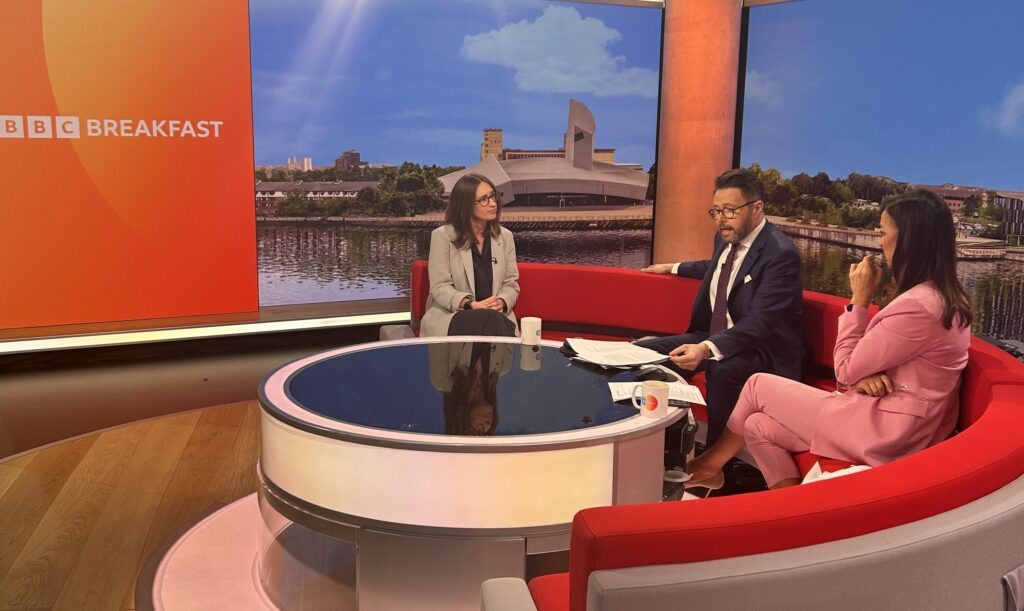
Contact Chief Executive Anna Bird on BBC Breakfast
Speaking to BBC Breakfast Anna Bird, Chief Executive of Contact, said:
“Families with disabled children face a constant battle to keep financially afloat, because everything costs more when you have a disability.
“There are almost 100,000 critically ill children in the UK. Many need life-saving equipment like ventilators, food pumps and hoists. Their time is precious with their child, and they shouldn’t be spending that time worrying about household bills. Not only are they struggling with higher than average costs in a cost-of-living crisis, some also face a drop in their income. Young disabled people like Lewis have to claim Universal Credit due to their age, and they lose money. It’s a hugely complicated process too.
“That’s why Samantha’s letter to the Chancellor has struck a chord with almost 3,000 families and 100 disability charities who have signed up in support of it.
An opportunity to make a huge difference
Thank you to all of you who signed up to support Samantha. With thousands of people behind her, Samantha is right to tell the Chancellor that her situation is far from unique.
Tomorrow, Chancellor Jeremy Hunt has the opportunity to make a huge difference to families with disabled children across the UK. We hope he takes it.
Energy prices will drop by £238 a year from 1 April for households in England, Scotland and Wales, the energy regulator Ofgem has announced today.
The energy price cap will fall to £1,690 a year from £1,928, the current cap from January-March 2024.
The Ofgem energy price cap is the maximum annual price an energy supplier can charge for average usage on its standard variable rate. Ofgem reviews its energy price cap every three months based on wholesale markets.
It is important to be aware that the cap is not a limit on your energy bill. It is a limit on what the supplier can charge for each unit of energy, so that average usage at that unit rate won’t exceed a given annual cost. If your energy usage is above average, it could exceed the price cap.
A different energy market operates in Northern Ireland. There, an energy price guarantee will remain as a safety net until March 2024.
Disabled households still paying vastly more
While this is good news for many households, it’ll be little comfort to the thousands of families with disabled children who depend on vital medical equipment.
This essential equipment can’t always be turned off. As a result, families with disabled children are punished with far higher average energy costs. This is leading to debt and even health issues.
Mum Samantha is asking the Chancellor to use his Spring Budget to commit to an energy social tariff for families like hers reliant on life-saving electrical equipment. Her energy bills are a staggering £500 per month (three times the UK average). This is because her son Lewis needs electrical equipment, including ventilators, feeding pumps, suction machines, to keep him alive.
Support Samantha’s social tariff demand
Samantha knows she isn’t alone with her money worries. That’s why she has written to the Chancellor with three simple asks:
An energy social tariff for families like hers reliant on life-saving electrical equipment.
Better support under Universal Credit for disabled young person like Lewis.
Cost of living payments for disabled households to help cover their extra costs.
Samantha is calling on families and supporters up and down the country to support her three asks. She says, “together we can make the Chancellor listen”.
Ahead of the Spring Budget on 6th March, parent carer Samantha has written to the Chancellor demanding action on sky-high energy and living costs that continue to hit families with disabled children hardest.
Samantha lives in Doncaster with her son Lewis. Lewis has a terminal condition called Batten Disease. She was told he might reach his 10th birthday. This month he turns 20 – he is a miracle every day.
Samantha tries to make everyday count with Lewis. But like many families caring for critically ill children, she spends a lot of her time worrying about household bills. Her energy bills are a staggering £500 per month (three times the UK average). This is because Lewis needs electrical equipment, including ventilators, feeding pumps, suction machines, to keep him alive.
On top of this Samantha, is scared about claiming Universal Credit for Lewis and how they will survive on considerably less than they get under Child Tax Credit.
Samantha knows she isn’t alone with her money worries. That’s why she has written to the Chancellor with three simple asks:
An energy social tariff for families like hers reliant on life-saving electrical equipment.
Better support under Universal Credit for disabled young person like Lewis.
Cost of living payments for disabled households to help cover their extra costs.
Samantha is calling on families and supporters up and down the country to support her three asks. She says, “together we can make the Chancellor listen”.
Get the latest SEND updates, benefits advice, practical help caring for your child, plus free workshops and family events in our weekly email newsletter.
(Make sure you select ‘News updates’)