HM Revenue and Customs (HMRC) is currently undertaking an exercise to identify families in England wrongly refused Child Benefit or Child Tax Credit payments for a 16–18-year-old being educated outside of school or college.
What was the error?
In 2014, the Child Benefit and Tax Credits rules were changed to allow parents in England to claim benefit for a 16–18-year-old who was being educated as part of a “study programme” provided outside of school or college. The study programme could be at home or elsewhere.
However, these new rules weren’t worded properly. They unintentionally removed the requirement for the young person to be involved in more than 12 hours study per week. As a result, according to the rules a young person on a study programme was eligible even if they were in less than 12 hours study.
Some HMRC decision makers assumed that the 12-hour rule still applied to those on study programmes. They wrongly refused benefit to families whose young person was being educated outside of school or college for less than 12 hours a week.
What is HMRC doing about this?
Since October 2025, HMRC have been carrying out a correction exercise. The aim is to identify families who were underpaid either Child Benefit or Child Tax Credit.
They believe around 500 families may have lost out, but have only been able to identify a very small number of these families themselves. They are now asking families who think they may have lost out to identify themselves.
Who missed out and is due arrears?
HMRC say that the parents or guardians who may be due arrears will be those refused Child Benefit/tax credits payments because their young person was studying for less than 12 hours a week and where the young person was:
Aged between 16 and 18 at that time.
Living in England.
Being educated somewhere other than a school, or college.
And where the local authority had assessed that education as suitable for that disabled young person.
HMRC say they can correct any wrong Child Benefit decisions made since 2014. They can correct any wrong tax credits decisions made since March 2019.
What should you do?
If you think you may be affected by these rules, contact HMRC as soon as possible. You may be asked to provide a letter from your local authority confirming that the education being provided at the time was suitable for your disabled young person.
If you think you missed out on Child Benefit, contact the Child Benefit office helpline by calling 0300 322 9620. You can also write to HM Revenue and Customs: Child Benefit Office, PO Box 1, Newcastle upon Tyne NE88 1AA.
If you think you missed out on Child Tax Credit, contact the tax credits office by calling 0345 300 3900. Or you can write to HM Revenue and Customs, Tax Credit Office BX9 1ER.
This advice applies in England and Wales only.
We understand that supporting your child’s financial future can be daunting, especially if they are disabled or have additional needs.
Knowing where to start can be hard. Parent carers often worry that being left money might affect their child’s entitlement to means-tested benefits or social care support.
To help, Contact once again partnered with Renaissance Legal to offer our supporters a free Wills & Trusts webinar on 7 May about planning for a disabled loved one’s future,
Since the white paper was published, many parent carers have told us they are worried about the proposals. And many are unsure if their voices are being heard.
Contact has been working directly with families across England to make sure lived experiences are reflected in the national debate. Over the past few months, we have gathered evidence from a number of sources to inform our consultation response, including:
Eight parent carer focus groups involving 49 parents of children and young people with a wide range of SEND needs.
Insights from our national helpline and online advice services alongside our ongoing conversations with families navigating the current SEND system every day.
A survey for parent carers about support for disabled children aged 0-5 (the early years).
Meetings and discussions with ministers, Department for Education policy teams, select committees and SEND working groups.
And we will ensure your voices are heard
Contact’s CEO, Anna Bird, said:
“We know many parent carers are exhausted by the challenges of navigating the SEND system and may not have the time or energy to respond to the consultation themselves. While there is still time to take part, we want families to know that we hear your concerns loudly and clearly. We are committed to ensuring your voices are represented.
“Contact will continue to make sure decision-makers understand the day-to-day realities parent carers face. This includes serious concerns that have been raised consistently about the possible loss of legal protections currently provided through education, health and care (EHC) plans; reduced access to tribunals; and fears that the proposed reforms could weaken children’s rights rather than strengthen support.
“Parent carer forums and the NNPCF have also been working tirelessly to represent parents’ voices during this consultation. If you’ve been involved in your forum in any way, your views will have been heard.”
Your lived experience is valuable evidence. Even a short response can help highlight issues and improve services for children and young people with SEND.
And if you feel the consultation is missing questions about something important to you, you can still submit your views wherever feels most appropriate, explaining why it is important to you and your thoughts and concerns.
The Scottish Government is consulting on unpaid carers’ rights to breaks and the timescales for support plans.
We want to make sure your voice is heard, so we are inviting parent carers to join us for an online discussion where we’ll gather your thoughts and experiences.
The session is open to anyone caring for a disabled or additional needs child or young person in Scotland.
Session details
Date: Tuesday 19 May 2026 Time: 11am – 12.30pm Location: Online via Zoom
We know many families struggle to access meaningful breaks and support. A new law made in 2025 (the Care Reform Scotland Act 2025) will mean that carers will be given a right to get short break support if they cannot get enough breaks from caring.
This is your chance to share your views on the different options being suggested before the new rules are introduced. After the session, we will write up all of the feedback into a report, which we will send to the Scottish Government’s consultation.
What to expect
This session is all about listening to you, so no preparation is needed. If you’re interested, you can take a look at the consultation documents in advance:
After you register, we will send you a Zoom link the day before the session, along with simple joining instructions for anyone unfamiliar with Zoom. We’ll also send a quick reminder on the morning of the session.
If you can’t make the session but would still like to share your views, please email [email protected] or call 07458 046071 by Tuesday 19th May at 5pm.
This advice applies in England only.
Across England, there is long-standing evidence of ethnic disproportionality in identification of special education needs and disability (SEND), access to support, and outcomes. However, the intersection of ethnicity and SEND is complex, and the reasons behind ethnic disproportionality are not clear.
A recent Contact research project set out to examine the experiences of education of London families with children with SEND from ethnic minority backgrounds and explore any inequalities in experiences between ethnic groups. The project sought to hear directly from parents about their experiences. And it aimed to understand how statutory services and charities such as Contact can improve their support for families.
The SEND system must provide inclusive support
The research, commissioned by Contact and funded by the City Bridge Foundation, found that:
Parents face significant challenges navigating the SEND system.
Ethnicity intersects with other challenges to exacerbate inequalities.
Trusted, culturally sensitive and empowering support makes a substantial difference.
The SEND system must provide inclusive, proactive and culturally responsive support.
The research’s recommendations are also set within the context of the recent schools white paper, ‘Every Child Achieving and Thriving’, and propose ways the reforms could go further to improve the system for families from minority backgrounds.
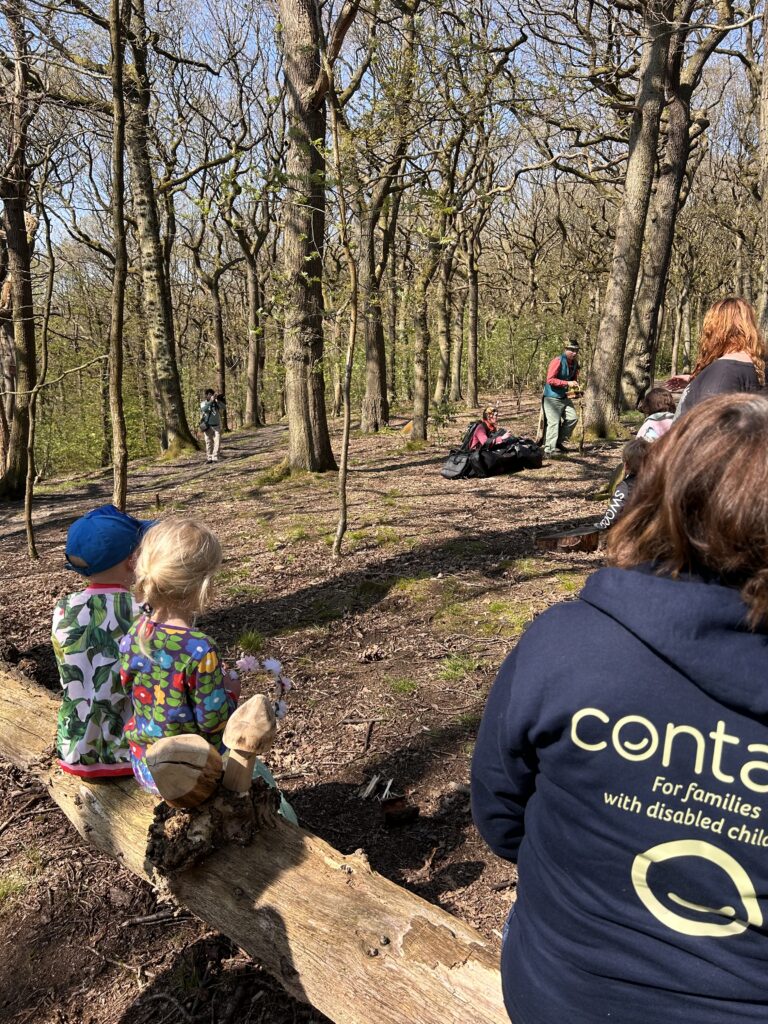
Families joined us at Northcliffe Woods in Shipley, near Bradford, last Sunday for the first of our woodland workshop and circus events of the year. It was a brilliant start to the series!
A Future for All is an arts-led project involving Contact bringing together families, theatre and climate partners to create space for parent carers — especially those often left out of climate conversations — to connect, reflect and take action.
The playful and thought-provoking Positive Imaginings circus show sparked curiosity, laughter and reflection. Children joined in the enchanting show and explored the beautiful setting, while parents and carers enjoyed the chance to pause and share the experience together.
At the woodland workshop, children played while adults talked about their hopes for the future — for their children, their communities and the environment. Parent carers talked about advocacy and campaigning, sharing their priorities and the actions they wanted to take to have their voices heard and make change happen.
Parents said the day created a welcoming, inclusive opportunity to connect and spend time outdoors, and families left with practical ideas to turn their hopes into action.
Don’t miss our future events
We’ll be building on this momentum with more events across Yorkshire over the coming months, including two sessions during May half term at Northcliffe Woods.
Parents in the Bradford and Shipley area, click the links below to find out more and book your place:
Now in its fourth year, our beloved DinoDay Challenge is a chance for families across the UK to take on exciting activities throughout June to help raise vital funds for Contact’s services.
Last year, thousands of children and families raised a huge £50,442, and this year’s event promises to be even bigger!
Register to take part today and we’ll send your child a FREE t-shirt and activity tracker (once your fundraiser gets at least one donation) so they can complete their challenge in style!
What’s new this year?
For our 2026 event, as well as a digital certificate and a medal, your family could earn an exclusive DinoDay Trophy to celebrate your fundraising achievement!
The DinoDay Challenge is an inclusive and family-friendly fundraising event suitable for children of all ages and abilities.
All you have to do is pick a challenge to take on, and then ask your friends and family to sponsor you. This could be anything you’d like, as long as the number 19 is involved!
You could visit the park 19 times, read 19 stories, try 19 new foods… Big or small, what you choose to do for your challenge is totally up to you.
How can I register to join?
Getting involved couldn’t be easier. Here’s how:
Register for your free t-shirt and activity tracker.
DinoDay was inspired by a little boy called Cameron Mathieson, who had both Duchenne muscular dystrophy and cystic fibrosis. Contact helped his family to launch a long (and ultimately successful) landmark legal challenge that guaranteed no other child would have their Disability Living Allowance (DLA) payments suspended while in hospital.
Cameron, who was born on 19 June, loved dinosaurs – or Dowsers, as he called them – especially his green triceratops called Troy! So every year, we celebrate his birthday with our annual fundraising day, DinoDay. It’s a chance to honour Cam’s huge legacy while raising vital funds so we can continue to support thousands of families like his.
It was a truly fantastic day in the capital. Our 10 dedicated runners joined thousands of participants to complete the iconic course, cheered on by Contact staff and supporters. It was a joy to see their resilience in action. Whether it was their first marathon or one of many, each and every runner gave something extraordinary.
Their fundraising will help Contact continue our mission to ensure families with disabled children feel supported, informed and empowered to live the lives they choose. We couldn’t be more grateful to them!
Feeling inspired to take on a challenge for Contact?
Were you inspired watching thousands of people taking on an epic challenge all to help others? If so, we’d love for you to join our team next year. Just get in touch with us at [email protected]
We have heard from many parent carers who feel strongly about the proposed changes and want to raise the issues that matter to them and their disabled child.
Do you want to share your views with MPs and local decision-makers, but you’re not sure where to start, or how to do this effectively?
In this session, you’ll learn how to build positive relationships with politicians. You’ll also gain practical tips on how to engage effectively once the White Paper consultation closes.
Whatever your child’s age, we want you to find us at the right time and get the support you need. That’s why we regularly reach out to the families we support to hear directly what that support looks like.
We’re running a survey all about support for disabled children aged 0-5: what we call the early years. In this case, due to funding restrictions we’re looking to hear from families in England only*. Your child doesn’t need a diagnosis to take part.
We will use the results of this survey to develop Contact’s services and to influence government policy, including the Government’s SEND White Paper consultation (details and links are shared at the end of this survey).
There is an opportunity at the end to win one of two vouchers worth £50 each as a thank you for taking part.
The questionnaire should take no longer than 10 minutes to complete. If you have any questions please contact [email protected]
But wherever you are, it’s important to know that disabled people have a right to help voting. Whether your disabled child is of voting age or you are disabled yourself, read below what support you should expect to be available.
How polling stations must help disabled people
Polling stations must be accessible to disabled people. This means that reasonable adjustments to the premises must be made where necessary.
At a minimum, polling stations should provide:
Seating for users who may need a rest after being on their feet for long periods.
Magnifiers and tactile voting devices to help blind or partially-sighted people vote. You can take your phone into the polling booth to use magnifier or text-to-speech apps. You can use your phone’s torch to improve lighting.
A pencil grip for voters with dexterity difficulties and a polling booth at wheelchair level.
A large sample copy of the ballot paper.
A ramp (for buildings with steps), temporary doorbells as required, appropriate lighting and, where parking is available, reserved disabled spaces.
Bringing a companion
Anyone who is disabled or unable to read is allowed to bring a companion into the ballot booth to help them vote.
The companion must be over 18 in England, and over 16 in elections in Wales and Scotland. In Scotland, the companion must be able to vote in that election or a close relative.
You can also ask for help from the Presiding Officer at the polling station.
The Helplines Standard is the nationally-recognised quality standard which defines and certifies best practice in helpline work. Meeting this standard means our helpline is rated consistent, relevant to the needs of service users and effective.
Achieving re-accreditation for a further three years means parents can be assured they are receiving first-rate information, advice and support from our team. Our advisers can help you with issues such as education, benefits, health, social care and getting support.
How was our helpline assessed?
The assessment process included:
The assessor reviewing documentary evidence produced by the helpline and conducting follow-up interviews with the team.
Making test calls, email and chat enquiries to the helpline.
In-person observation of the adviser handling enquiries.
Conducting telephone interviews with key team members.
The assessor noted several areas of strength during the assessment process. These included a well-established strategic plan, as well as our advisers’ breadth of knowledge of the parent carer experience, alongside the dedication and professionalism of the team.
Quality backed up parent carers
And it’s not just the Helpline Partnership who’ve rated our helpline service top standard.
Twice a year we run a survey all about our information, advice and support (IAS) services. In March 2026, almost 400 people took part. Of the 370 who answered questions about using our services:
94% were satisfied / very satisfied with our telephone helpline.
89% were satisfied / very satisfied with our website.
88% were satisfied / very satisfied with our helpline team’s email advice.
90% were satisfied / very satisfied with our printed guides and factsheets.
Of the 338 who answered questions about the impact of our services:
92% felt better informed about how to get support.
85% felt more confident.
96% would recommend Contact to others.
Thank you to everyone who took part.
“I can’t really put it into words to show the impact Contact has had on our family. Amazing. Everything is amazing, helpful, easy to understand, made us aware of things we didn’t know before, gave us support when we had none, signposted us to other support we didn’t know we could get. Amazing staff in all aspects of Contact. Thank God for them. Came to our knowledge at a critical time but wish we had known about them years ago! Finally got the right support for our disabled son thanks to the services provided by this God-send group of people!!“
The start of the new financial year has seen several changes to the benefit system. One of these is the long-awaited removal of the “two-child limit”.
The two-child limit meant that it wasn’t possible to receive the main child element of Universal Credit for a third or subsequent child born after 6 April 2017, with some exceptions. The limit applied to Universal Credit and used to apply to Child Tax Credit as well. It has never applied to Child Benefit. It has always been possible to receive the disabled child element of Universal Credit for a third or subsequent child who receives an appropriate disability benefit, even where the main child element was not paid.
The government removed the two-child limit from 6 April 2026. All families with three or more children can now claim the main child element of £303.94pcm for all of the children they are responsible for.
What action do I need to take to get the extra payments?
If you are a Universal Credit claimant affected by the two-child limit, the Department for Work and Pensions (DWP) will now automatically add the additional child element for each child included in your claim. Provided Universal Credit have the details of each of your children, you won’t need to take any action. Letters have been sent to claimants where Universal Credit expects to see an increase in their payments.
If you haven’t told Universal Credit about all the children you are responsible for, notify the DWP straight away. You can use the “notify of changes” section in your online Universal Credit account to add your child’s details.
When will I see an increase in my payments?
Claimants will not see the additional element, or an increase in their overall payments, until around 12 May at the earliest. The first day of a claimant’s assessment period must be within the new financial year for the changes to apply. Some claimants won’t see an increase in their payments until June.
Some examples
Nigel and Lubna have four children. Their two younger children were born in 2018 and 2020, and they haven’t been receiving the child element for them. Their assessment period is from the 10th to the 9th of each month, and they normally receive Universal Credit on the 16th. The first assessment period with a start date in the new financial year begins 10 April and ends 9 May. They will receive the additional child elements for their two younger children in the payment they receive on 16 May.
Monika has three children, and her youngest child was born in 2019. Her assessment period runs from the 3rd to the 2nd of each month, and she is normally paid on the 9th. Her first assessment period with a start date in the new financial year begins 3 May and ends 2 June. She will receive the additional child elements for her youngest child in the payment she receives on 9 June.
Will the new element affect the rest of my award of Universal Credit?
In some cases, the additional child element will have an impact on the other parts of your award. This means that some families won’t be better off overall even though they receive extra child payments.
Families who receive the transitional protection element
Claimants transferred to Universal Credit through the managed migration process and receive the transitional protection element may not see an immediate increase in their payments.
Any increase in other elements of Universal Credit reduces the amount of transitional protection you receive by the same amount.
For example, a claimant who receives a transitional protection element of £567.90, and has a third child element of £303.94 added to their award, will see their transitional protection element reduced to £263.96. Their overall Universal Credit payment will not increase.
However, families should gain in the longer term. While transitional protection erodes over time, the additional child elements will remain in place and increase with inflation.
Families subject to the benefit cap
Unfortunately the benefit cap is not being removed. This limits the total amount of benefit that some households can receive.
The cap covers a wide range of benefits and includes Child Benefit as well as Universal Credit. There are exemptions to the benefit cap though, including:
Where someone in the household is in receipt of a disability benefit (either a child or a parent).
Where someone in the household is working and earning above £881 per month.
This means that most families with a disabled child are exempt from the benefit cap.
However, if you are not exempt, you may not gain at all if you are already over the cap before you get an extra child payment. You may also find that any increase you get is limited by the cap, so that you don’t receive the full payment you’d otherwise get.
I have three children and my youngest child gets Disability Living Allowance (DLA). I don’t get any elements for them. Will they now get a disabled child element as well as the main child element?
You should already have been receiving the disabled child element for your youngest child in your award of Universal Credit. The two-child limit only applied to the main child element, and you will always have been eligible for the disabled child element.
Contact welcomes the government’s renewed focus on early years as central to SEND reform and better outcomes for children and families. We are particularly encouraged by the emphasis on prevention, inclusion and stronger transitions, especially into reception. For families of younger children, the impact of these reforms could be felt for years to come.
Last month the government also announced over 200 new Best Start Family Hubs across England, offering free services like parenting advice, infant feeding support, and help for children with SEND to ease cost-of-living pressures. Backed by over £900 million, the government plans to expand to 1,000 hubs and 2,000 community locations by 2028. The programme brings multiple services together in one place, helping families save money and access support more easily, building on the legacy of Sure Start. These hubs form an important part of the government’s wider early years reforms.
What does the White Paper say about early years?
Key points in the White Paper about early years include:
A stronger focus on early years as the foundation for better outcomes
Greater emphasis on prevention, inclusion and smoother transitions into reception
The £200 million investment to fund SEND practitioners in Best Start Family Hubs, helping families access earlier, more joined-up support
Proposals for early years EHCPs to carry forward into the primary phase, providing greater continuity of support
The Government has also signalled a commitment to ensure children and young people who need specialist support receive it more promptly, supported by £1.8 billion in “Experts at Hand” funding. Families need support in place early for toddlers and pre-schoolers with additional needs.
Where we think more clarity is needed
Contact would welcome greater clarity on how workforce plans will deliver earlier support, so parents are not left waiting for assessments or forced to choose between care they are not confident in and giving up work.
While the proposed fast-track route for children under five with complex needs is a positive step, more detail is needed on how this will work in practice, including:
How eligibility for fast-track access to Specialist Support Packages will be determined
How this pathway will enable quicker access to higher levels of support, without unnecessary funding or process barriers
How decisions will be made jointly across health, education and local services.
There is also a clear focus on partnership working between early years settings and schools, alongside the introduction of minimum expectations around transitions. These should include parent voice, so that families of children with SEND—including those from under-represented communities—are actively involved in shaping how transition support works in practice.
The proposal to introduce digital Individual Support Plans in early years settings is also a helpful development, particularly if these are accessible to parents and bring together information from everyone supporting a child. However, more clarity is needed on how this will work in practice, given that most early years provision is delivered through private nurseries and childminders.
What families tell us
Families tell us that access to a suitable early years place remains a key concern and too many parents of children with additional needs struggle to find a nursery place or are offered reduced hours.
It will be important to understand how the reforms will improve sufficiency of places and ensure that children with SEND – whatever their learning difference or support they require- can access the right early education to help them thrive.
How to respond to the government’s consultation
The White Paper reforms offer real opportunities, but key details are still to be worked through. Contact encourages families of younger children to make their voices heard through the consultation and help shape how these changes are delivered.
SENDAP Reform, Sanctuary Buildings, Great Smith Street, London, SW1P 3BT
The consultation closes on 11:59pm on18 May 2026.
The DLA (Disability Living Allowance) Unit is currently undertaking a review of DLA decisions involving claims for children with congenital heart disease made between 1 February 2017 and 13 October 2020.
Read below to find out whether this might impact you, and what to do if so.
Why is the DLA Unit carrying out this review exercise?
The Department for Work and Pensions (DWP) introduced medical guidance in February 2017 to help DLA staff make decisions on cases where a child had congenital heart disease. Following a review, new guidance replaced it in October 2020.
The DLA unit will now review decisions it made between February 2017 – October 2020. It will apply the newer 2020 guidance to these cases, rather than the old 2017 guidance.
As a result, some children are likely to be entitled to arrears of underpaid DLA.
Which cases is the DLA Unit reviewing?
The DLA Unit is only reviewing cases where both:
A child had congenital heart disease listed as a condition.
It made the decision about the child’s DLA claim between 1 February 2017 and 13 October 2020. This includes where a decision was made not to award any DLA at all.
It will not be reviewing any decisions it made before February 2017, nor any decisions made after 13 October 2020.
The DLA Unit has also made clear that it will not be reviewing cases where a child was on the maximum rate of DLA payable throughout this period. That means the high rate of both components (or highest rate care if aged under three years).
It also won’t be reviewing any decisions that were made by an appeal tribunal.
What do I need to do if I think my child’s case should be reviewed?
The DWP has tried to identify affected families from their own records. But it has been unable to identify or contact everyone who was potentially impacted by the old guidance.
Were on DLA between 1 February 2017 and 13 October 2020.
Think their DLA award might have been affected by the old guidance.
If you think this applies to your child, contact the DLA Congenital Heart Disease Helpline on 0800 904 7413 (Mon-Fri 10am-3pm). Explain that your child’s claim could have been affected by the “DLA CHD administrative exercise” and ask for a review.
Alternatively, you can write to Freepost DWP DLA Child. Quote the “DLA CHD administrative exercise” and provide your child’s reference number or National Insurance number on each page you send them. You will also need to provide:
Your child’s name and date of birth.
Your name and address.
A contact telephone number.
Copies of any information you have about the decision you want the DLA Unit to review.
What will happen next?
If the DWP finds the wrong decision was made at the time, they will revise it and pay any money owed.
The DWP also says that no claimants will have their DLA awards reduced as a result of having the new guidance applied to their case.
Heating oil prices have more than doubled due to the conflict in the Middle East. We know this is a real concern for families who use oil or Liquid Petroleum Gas (LPG) to heat their homes. Families of disabled and seriously ill children are particularly vulnerable to price rises.
Eligibility for a payment, how to get it, and how much you will receive is different in each nation. In this article, you can find out how to apply in your country.
If you are not eligible for the direct payments, you may be able to access discretionary or other funds. We have listed these as well.
In this article
Help in England
In England, local authorities will provide help with heating oil costs as part of their Crisis Resilience Fund.
Crisis Resilience Funds became available on 1 April 2026 to help a wide range of “low-income households”. Talk to your local council to find out whether you might be eligible for support.
Help in Northern Ireland
The NI Executive is yet to announce details of the scheme or any direct payments.
In the meantime, you can try the following organisations for help and advice:
Discretionary Support – Not oil specific, but can help with living expenses in the form of an interest-free loan or a free grant.
Advice NI – offers independent advice and support around budgeting and debt. https://www.adviceni.net/money-debt/debt
Community Advice Centres – The Citizens Advice Bureau has a list of community advice centres across NI, who may be able to help identify further sources of support, such as local council grants:
The Oil Savings Network has suspended its savings scheme. However, they continue to offer advice and support about how to get the best prices. Freephone: 0800 111 4455
Help in Scotland
Scottish Emergency Heating Oil and LPG Scheme
Each household will be able to apply for two £300 payments in a six-month period.
The new scheme is managed by Advice Direct Scotland and aimed at low-income households who are facing increased oil and Liquid Petroleum Gas (LPG) heating costs. The funding prioritises households in receipt of means-tested benefits and vulnerable people in financial hardship.
The payments will be made directly to fuel suppliers, where possible, to help qualifying households to place an order.
People on the following benefits should automatically qualify:
Full details on the eligibility criteria and how to apply can be found at homeheatingadvice.scot or call 0800 048 7413. Alternatively, you can send a form via post. Applicants will need to supply evidence of eligibility. The fund will run until 30 September 2026 or until the funds run out.
If you are not eligible for the Emergency Heating scheme, you can apply for a Crisis Grant via the Scottish Welfare Fund. There is no set criteria for this Fund, but generally, the grant is for those on a low income (you do not need to be in receipt of specific benefits) and for those most in need of financial help. You have to contact your council to apply.
You can only get three Crisis Grants within a 12-month period, unless exceptional circumstances apply.
Help in Wales
People on low incomes who use heating oil or liquid petroleum gas (LPG) will be eligible for a one-off £200 payment if they are on the Council Tax Reduction Scheme.
Local authorities will contact eligible households directly and invite them to apply.
Those in severe financial hardship who do not qualify can apply to the Discretionary Assistance Fund. The maximum award for heating oil has been increased from £500 to £750. You can now apply up to twice in a 12-month period. Applications can be made through local authorities and other fund partners like housing associations and third sector organisations, such as Citizens Advice.
Advicelink Cymru can give clear, confidential advice to those dealing with money worries or unsure what support they are eligible for: 0800 702 2020.
The Nest Warm Homes scheme offers free energy efficiency advice and improvements to low-income Welsh households: 0808 808 2244.
There are now only seven days to go before the government introduces cuts in the amount of the Universal Credit health element paid to some new claimants.
If you are one of the following, you need to consider taking action before Monday 6 April:
A disabled person who isn’t on Universal Credit yet, but who could claim this benefit.
Someone already on Universal Credit who has health problems, but who has never submitted fit notes/
A disabled person who gets Universal Credit, has been assessed as having a limited capability for work only, and whose condition has deteriorated.
Below we explain in detail what you need to do to protect yourself from potential benefits cuts.
You might be able to get this element if you are a Universal Credit claimant with health problems.
How is this payment changing?
From 6 April there will be two rates of the Universal Credit health element, rather than one rate.
Existing claimants will retain the higher rate of £429.80 per month. New claimants who meet extra severe conditions criteria rules will also receive this rate.
However, most other new claimants will only get a lower rate of £217.26 per month.
Who counts as an existing claimant?
You will be protected with the higher rate as an existing claimant if either of the following applies to you:
You are already on Universal Credit and get a LCWRA element in your award.
You claim Universal Credit on or before 5 April and, on that date, you’re awaiting a DWP decision on your capacity for work.
You will need to take action on or before 5 April at the latest. But the earlier you take action the better.
Who needs to take action?
Some disabled people will need to take action before 6 April if they want to try to qualify for the health element as an existing claimant.
There are three groups of people who need to consider taking action before 6 April:
A disabled person who isn’t on Universal Credit yet, but who could claim this benefit.
Someone already on Universal Credit who has health problems, but who has never submitted fit notes/
A disabled person who gets Universal Credit, has been assessed as having a limited capability for work only, and whose condition has deteriorated.
Read on to find out more about each of these individual groups.
A disabled person who isn’t on Universal Credit yet, but could be
You should try to lodge your Universal Credit claim on or before 5 April. If you eventually qualify for the health element, it will automatically be paid at the higher rate.
You will need to provide a fit note from your GP to support your claim. If possible, try to submit this fit note on or before 5 April. However, if you cannot get a fit note before then – for example because your GP is unavailable – you should still make sure you claim Universal Credit on or before 5 April.
If you don’t have a fit note at the point you claim, you should state in your online journal that you are unfit for work and ask for a work capability assessment. If possible, you should also declare a health condition in the “report a change section” of your online account.
So long as you do this on or before 5 April, you will then have a further seven days from the date that you declare you are unfit to work to provide a fit note. You should be able to access your online account as soon as you complete your claim.
How to lodge a claim
You can claim Universal Credit either online or via the Universal Credit Helpline on 0800 328 5644.
Bear in mind that the helpline is only open during weekdays 8am-6pm. It will be shut on Friday 3, which is a bank holiday. Given this, an online claim is the best option for most people who don’t claim until just before 6 April.
Universal Credit claims for a young person in education
Not everyone who would like to claim Universal Credit has the option of doing this. Unfortunately, many young disabled people still in education cannot get Universal Credit due to rules preventing claims by most students. Some students are exempt, but the rules are complex
Visit our webpage all about this topic, below. The page includes an interactive flowchart to work out whether a young student is likely to get Universal Credit.
If your child cannot currently get Universal Credit due to their education, they will be treated as a new claimant when they claim Universal Credit at some later date. Their chances of getting the higher health element will depend on them meeting the extra severe conditions criteria.
If a young person aged 16-19 in full-time non-advanced education gets Universal Credit, any benefit payments you get for them as a dependent child will stop. This includes Universal Credit child payments and any Child Benefit. Some households could be left worse off as a result.
Someone already on Universal Credit with health problems, but who has never submitted fit notes
It is worth trying to submit fit notes on or before 5 April and asking that your capacity for work be assessed.
You should declare a health condition in the “report a change” section of your Universal Credit account. Also state in your online journal that you are unfit to work and ask for a work capability assessment.
If you qualify for a health element, you will automatically get this at the higher rate as an existing claimant.
If you cannot get a fit note from your GP until after 5 April, you can instead notify Universal Credit that you are unfit for work in your online account. Do this on or before 5 April and then ensure you submit a fit note within a further seven days.
If you miss these deadlines and ask for your capacity for work to be assessed at some later date, your chances of getting the higher existing rate of the health element, rather than the new lower rate, will depend on you meeting the severe conditions criteria.
A disabled person who gets Universal Credit,has been assessed as having a limited capability for work only and whose condition has deteriorated
You can ask Universal Credit to reassess you for LCWRA. So long as you do this on or before 5 April, and they agree you have LCWRA, you will qualify for the health element at the higher rate.
You do not need to submit a fit note in this scenario. A message in your online account should be suffice. You should declare a new or worsened health condition in the “report a change” section of your Universal Credit account. Also state in your online journal that you are asking for a reassessment of whether you have LCWRA.
However, you need to be aware that asking for a reassessment carries risks. It’s possible that the DWP instead decide that you are fit to work. If that happens, you could be left worse off.
Note: If you have a partner and they already qualify for a health element, you cannot get a second one. There will be no financial gain in asking for a reassessment in this case.
Which new claimants will get the higher rate?
While all existing claimants are guaranteed the higher rate health element payment, new claimants will also get a higher rate if either:
They are terminally ill.
They meet new severe conditions criteria.
All other new claimants will get the new lower rate of the health element.
What are the severe conditions criteria?
To meet the severe conditions criteria, you must show that all of the below apply:
You have a condition that has been diagnosed by an appropriately qualified NHS healthcare professional. Government ministers have said this covers not just a diagnosis carried out by NHS staff. A private diagnosis carried out in line with NHS best practice, and which has been accepted in your NHS records, will count.
Your condition will last for the rest of your life.
Your level of function must mean you would “constantly” meet one of the LCWRA descriptors “on all occasions on which the claimant undertakes or attempts to undertake an activity”. This is likely to mean that you cannot have prolonged periods where there is a recovery of function to the extent you don’t meet that LCWRA criteria.
Existing claimants can get the health element without needing to meet these additional severe conditions criteria.
Special rules that protect ESA claimants
The general rule is that you must have claimed Universal Credit on or before 5 April.
However, there is an exception to this. Special rules say that someone getting Employment and Support Allowance (ESA) and whose award already includes a support component is protected as an existing claimant. This is the case even though they claim Universal Credit after 5 April.
This rule protects disabled adults with an ESA award where there has been some delay migrating over to Universal Credit.
My 18 year old son doesn’t get Universal Credit yet as he is still receiving education. He won’t get Universal Credit until the summer when his course ends. However, he has already established LCWRA via a “credits-only” claim for ESA. Will he be protected as an existing claimant?
Unfortunately not. The special rules for ESA claimants only apply to those who are actually getting ESA itself. It doesn’t apply to young people who only established LCWRA via a ‘credits only’ claim and don’t get ESA.
He therefore won’t be protected as as an existing claimant as he will be claiming Universal Credit after 5 April. A young person who has established LCWRA via a ‘credits-only’ claim for ESA will only be protected as a pre-2026 claimant if they manage to successfully claim Universal Credit on or before 5 April.
If they can’t claim Universal Credit until a later due to their education, their chances of getting the higher rather than lower rate of the health element will depend on them meeting the new severe conditions criteria.
By this date, local authorities must have reviewed, amended and finalised the EHC plans for young people transferring from secondary school to a post-16 institution.
What is a post-16 institution?
Post -16 institutions include:
Further education colleges.
Sixth form college.
A “designated institution” (independent specialist schools and colleges approved under Section 41 of the Children and Families Act).
31 March is a legal deadline, which means the local authority must comply with it. The deadline is set out in Regulation 18 of the Special Educational Needs and Disability Regulations 2014.
What must the local authority do to finalise an EHC plan?
Before the local authority issue the final plan, they must send you a draft EHC plan and ask for your views. The local authority must also consult you about your preferred setting for your young person.
To meet the statutory deadline, the local authority should already have completed these steps and issued the final EHC plan.
What can I do if the local authority misses the deadline?
If the local authority misses the 31 March deadline for finalising an EHC plan, contact the local authority to remind them of their legal obligation and request immediate action.
Get the latest SEND updates, benefits advice, practical help caring for your child, plus free workshops and family events in our weekly email newsletter.
(Make sure you select ‘News updates’)