In this article
Introduction
This guidance has been co-created with the NNPCF.
Parent Carer Forums (PCFs) play a vital role in supporting the improvement of services for families with children and young people with special educational needs and disabilities (SEND). Through parent carer participation and co-production, PCFs bring lived experience into decision-making by working in partnership with local authorities, health, education and other partners.
This collaborative approach is what makes PCFs effective and influential. This guidance sets out what PCFs can and cannot do in relation to campaigning or lobbying, while remaining true to their purpose and the conditions of Department for Education (DfE) funding.
Participation, Co-production and Campaigning
Parent carer participation
Participation means parent carers have a voice. They are involved in discussions and decisions that affect them, although final decisions may still rest with professionals or authorities.
Co-production
Co-production goes further. Parent carers share power and responsibility throughout the whole process – planning, designing, delivering and evaluating services together. Read more about Participation and co production.
Campaigning
Campaigning involves trying to influence or persuade others to bring about change, often through public or political pressure.
In this guidance, “campaigning” refers to activity focused on issues affecting children and young people with SEND. Campaigning on unrelated issues (for example, environmental or animal welfare campaigns) in a personal capacity would not usually present a conflict. However, it is important to consider whether involvement could overlap with PCF work or create a perception that the PCF supports or represents that campaign.
Individual parent carers remain free to campaign in a personal capacity, including on issues relating to SEND. However, this must be separate from the PCFs role and activity. Individuals should not present personal campaigning as being on behalf of the forum. They should also take care to avoid any actual or perceived conflict with the PCFs partnership and co-production role.
Participation, Co-production and Campaigning – key differences
| ASPECT | PARTICIPATION | CO-PRODUCTION | CAMPAIGNING |
|---|---|---|---|
| PURPOSE | Parent carers’ views inform decisions | Shared power and responsibility | Influence or persuade change |
| HOW IT WORKS | Experiences feed into decision-making | Planning, designing, delivering and evaluating together | Influence from outside decision-making structures |
| DECISION-MAKING | Decisions made by authorities | Shared decisions | Decisions challenged or changed |
| APPROACH | Constructive and collaborative | Equal partnership, centred on lived experience | Advocacy and public or political pressure |
| FOCUS | Service improvement | Shared solutions | Awareness raising or policy change |
| TIMESCALE | Ongoing | Long-term | Issue based and time limited |
The role of Parent Carer Forums
PCFs exist to support the improvement of services for children and young people with SEND through participation and co-production. DfE funding is provided only for this purpose and not for campaigning or lobbying activity.
PCFs work in several key ways:
Participation and co-production
PCFs support meaningful parent carer participation and aspire to co-production. This approach is based on trust, relationship building and open communication.
The collective voice
PCFs represent the thematic views of parent carers in their local area. They work on a range of priorities identified by their membership and local context. While PCFs aim to represent all SEND needs, capacity and resources vary.
Working in partnership
PCFs work with local authorities, health, education and other partners. Each PCF operates under an annual Memorandum of Understanding (MOU) with their local authority, underpinned by co-production, independence, respect and honesty. This MOU is part of the Department for education grant process.
Engagement
PCFs gather feedback through surveys, consultations, social media, events and informal engagement (such as coffee mornings).
Representation
PCFs represent parent carers’ views in meetings with local services, highlighting what is working well and where improvements are needed.
Key considerations for Parent Carer Forums
DfE grant conditions
The DfE grant conditions state:
“The grant will not be used to fund any party-political activity, or to promote a particular religion.”
“The grant should not be used for campaigning or lobbying purposes.”
PCFs must also comply with the HM Code of Conduct for Recipients of Government General Grants, including maintaining political impartiality and public trust.
What PCFs can do
PCFs may:
- Share or acknowledge local or national campaigns for information only, where it is clear this is not on behalf of the PCF
- Reaffirm their role in supporting the improvement of services through participation and co-production
- Recognise appropriately families’ frustrations and the aims of campaigns where these align with PCF priorities
- Manage any activity by those involved in the PCF that could be perceived as campaigning or lobbying, through robust conflict of interest and code of conduct policies
- Have general forum members – meaning parent carers who are not on the steering group and are not trustees or directors – who may also belong to campaign groups, as long, as long as PCF and campaign roles remain clearly separate
- Individual parent carers remain free to campaign in a personal capacity, including on SEND issues, provided this is clearly separate from the PCFs role and activity and does not create any actual or perceived conflict with the PCFs partnership and co-production role.
What PCFs need to avoid
PCFs must avoid:
- Campaigning, protesting or lobbying on behalf of or in the name of the PCF, even if DfE funds are not used
- Communications that conflict with grant conditions, the Code of Conduct or the Memorandum of Understanding
- While parent carers can be a member of both their PCF and a campaign group, and PCFs and campaign groups may choose to work together collaboratively to achieve change in their area, it’s important for PCFs to have strong governance in place around the leadership and running of the PCF, including a very clear conflict of interest policy. This would preclude those responsible for running the PCF (steering group members / trustees / directors) and those representing the PCF also having a leadership or representative role in a campaign group or undertaking any public-facing campaigning or lobbying activity. This helps to ensure the PCF can build trust with its partners, which is an essential part of its role. So while a leader or representative of a PCF could, for example, choose to sign a petition (in a personal capacity) set up by a campaigning group, they couldn’t give a media interview on behalf of the campaign group promoting that petition.
- PCFs should not present personal campaigning by individual parent carers as being on behalf of the forum. They should also avoid endorsing or organising activity in a way that could create an actual or perceived conflict with the PCF’s role.
It’s important to recognise that rules around political activity and campaigning exist across many organisations, not just Parent Carer Forums (PCFs). For example, someone working for a government department such as the DfE would usually be expected not to take part in public protest or campaigning in a way that could be linked to their employer. Similarly, staff working for local authorities, the NHS, schools, charities, or private companies are often expected to ensure that any personal campaigning activity cannot be seen as representing their organisation. These kinds of expectations are common and are intended to help organisations maintain impartiality and public trust.
Working in partnership and reputation
Campaigning or lobbying can risk undermining the PCF’s role as a constructive partner, even when carried out separately from DfE funded activity. This may affect trust, access to shared information and opportunities for co-production.
Public facing or adversarial campaigning may also impact the reputation of individual PCFs and the wider network, including the National Network of Parent Carer Forums (NNPCF).
PCFs should also be aware that other funding sources and legal structures (for example, charities or Community Interest Companies) may place further limits on campaigning activity.
Working with campaign and lobbying groups
PCFs may choose to work constructively with campaign groups where aims align. This may include:
- Sharing information about PCF representations to local partners (where appropriate and within confidentiality agreements)
- Sharing anonymised evidence, such as survey findings on service impact
Parent carer forums and campaigning – what helps
Clear purpose
PCFs should have a clear statement of purpose and way of working, set out in their governing documents.
Conflicts of interest
Clear and robust conflict of interest policies help protect the PCF’s reputation and relationships.
Contact, parent carer participation and campaigning
Contact supports PCFs and the NNPCF and believes change is achieved by putting families’ experiences at the heart of solutions. Unlike PCFs, Contact is able to campaign within charity law and funding rules.
Contact receives funding from the DfE to administer the PCF grant and provide support. This funding does not restrict Contact’s campaigning in the same way as PCF grant funding.
Contact’s role supporting PCFs
Contact provides guidance and support to help PCFs meet grant conditions and navigate issues around campaigning and lobbying, recognising that local contexts vary. Read more about Contact’s offer.
Handling difficult situations
PCFs operate in challenging circumstances and may face pressure to adopt a campaigning approach. If difficult situations arise, contact your Parent Carer Participation Adviser for support. Forums can also access more support through our Support for forums section or Managing difficult situations.
Summary
Before engaging with campaigning or lobbying groups, PCFs should consider:
- DfE grant conditions and any other funding requirements
- What their governance and legal structure allow
- The potential impact on key relationships
If in doubt, PCFs should seek guidance from their Contact Parent Carer Participation Adviser.
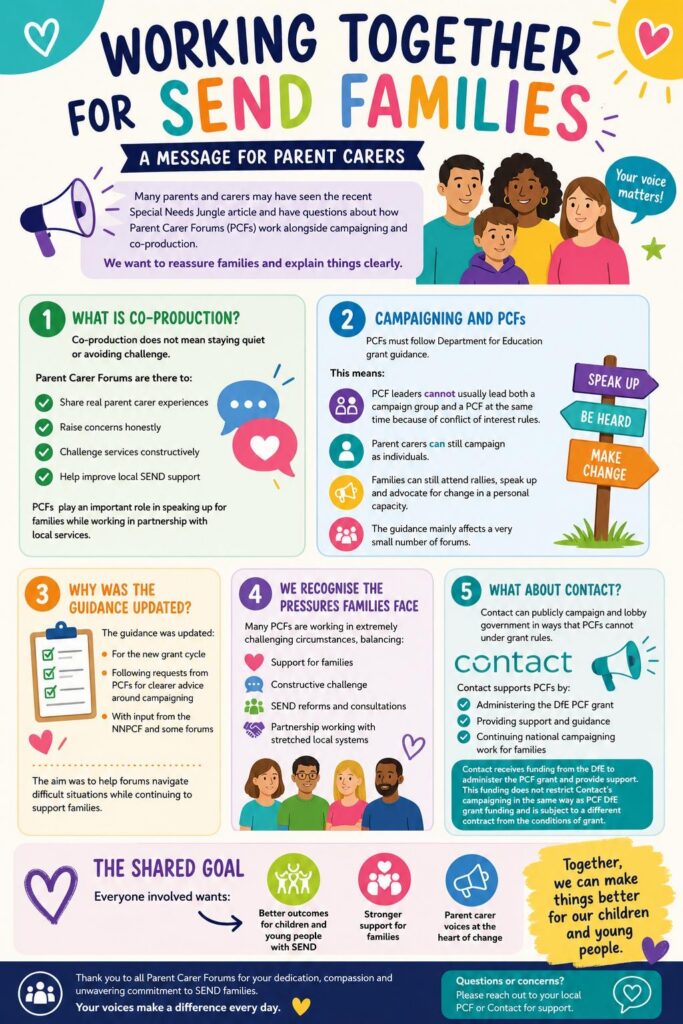
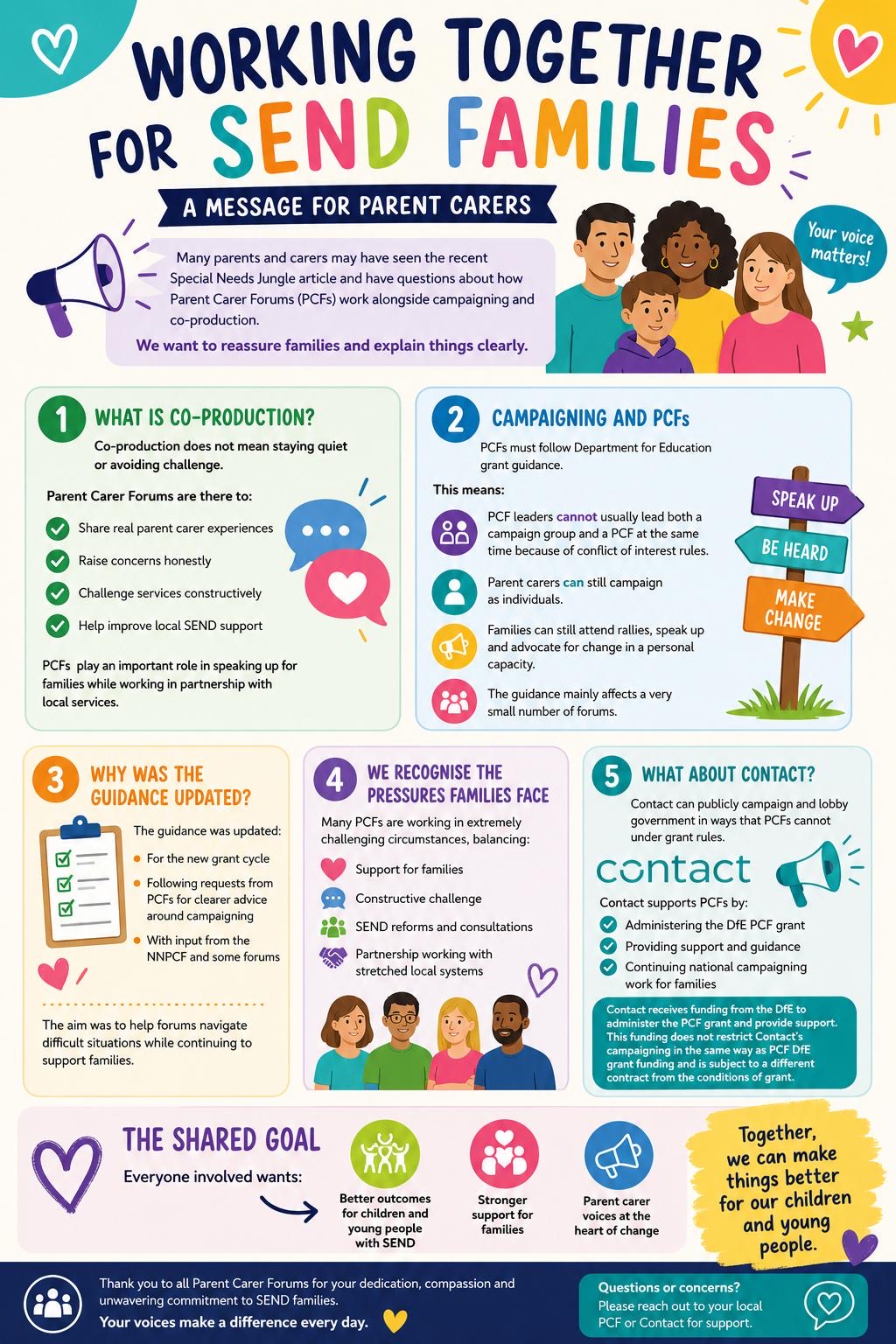
Visual Summary of the Guidance
Thank you to Hackney SEND Parent Carer Forum (HSPCF) for sharing this image.
Last Updated June 2026
Do you have any thoughts about this page? Visit our How to feedback page to share them.
Looking for something else? You can find a full list of pages on our Parent Carer forum handbook contents page.
Related content
Contact Parent Carer Participation Advisers
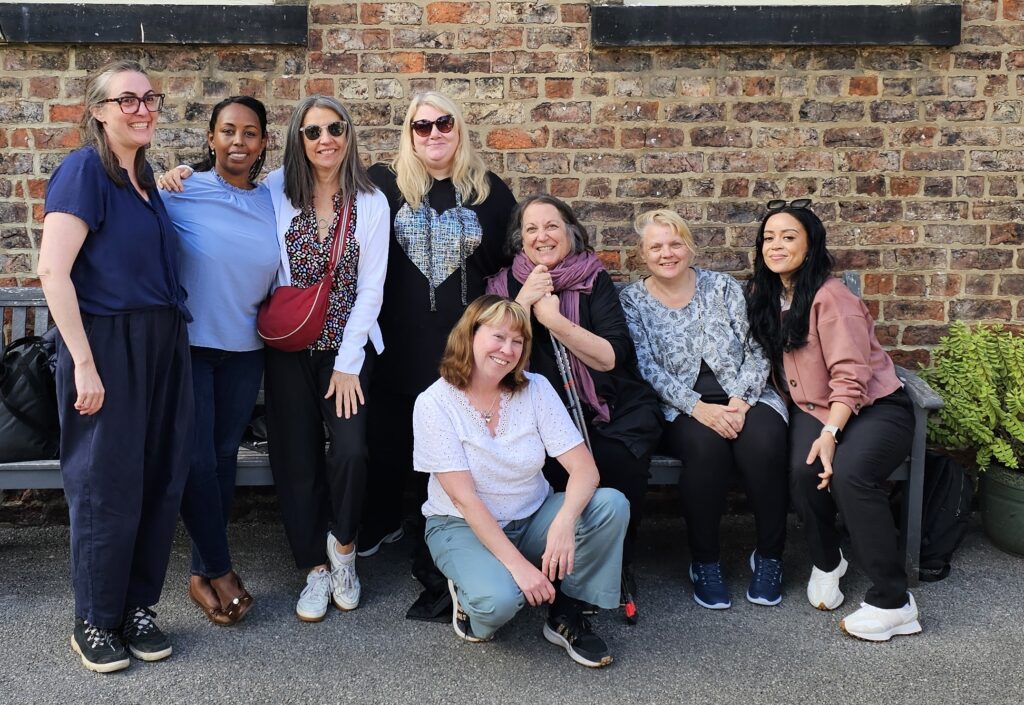
Parent Carer Participation Adviser's support the forum and provide a sounding board for the forum leadership. Find your forum's named adviser here.
Read more
Grants and monitoring
Important information on grants and monitoring for parent carer forums.
Read more
What all forums have in common
Forums have a unique role: they represent the views and experiences of families with children and young people with special educational needs…
Read more
Conflicts of Interest
Conflicts of interest can happen for forums and it is import to understand how to manage these.
Read more Participation and co-production
The purpose of parent carer forums is to work in partnership, collaboration, or co-production with local services.
Read more