We want to say a big thank you to everyone who nominated a friend or family member in the Contact Awards 2025.
That’s a total of 320 people making over 400 nominations!
Our nominations form has now closed. Our panel will now be shortlisting entries, and we’ll let you know who’s made our final. Those shortlisted under each category will be invited to an exciting gala awards evening in Parliament in November, where the winners will be announced.
Our categories are:
Parent Carer Award – Recognising the amazing things parent carers do to ensure their disabled children can take part in everyday life.
Change Maker Award – For an individual, family or a group of parents who have campaigned or worked together to make life better for other families in their community.
Proudest Moment Award – Recognising the challenges your disabled child has overcome that fill you with pride and make you smile.
Friendship First Award – Celebrating those wonderful friends who make your life as a parent carer better just by being in it!
Grandparent Award – Recognising all the wonderful and everyday things grandparents do for their family.
Sibling Award – Celebrating the often unseen but great things that siblings do for their disabled brothers and sisters, or that help make mum and dad’s lives just that little bit easier.
Contact has joined forces with climate and arts partners to bring a series of woodland workshops to outdoor venues across Yorkshire throughout July and August.
Don’t miss these FREE events designed for parents and your children to explore a fairer, more sustainable future.
The 2-hour sessions are relaxed, inclusive, and full of opportunities to connect, create and have your say about the future you want.
Sign up here and see workshop dates and locations.
What to expect:
Join us and take part in forest school activities for families like making sculptures from woodland materials, foraging and making swings – and making a difference together, by creating a message together to share with decision-makers.
No experience needed, just bring your ideas, your kids, and your imagination! Free refreshments will be available alongside space to meet other local families.
A Future for All is an arts-led project putting families, especially those often left out of climate conversations, at the heart of change.
Run in partnership with Hope for the Future, Rowan Environmental Arts (REA) and Parents for Future – through immersive theatre and climate advocacy workshops, we’re creating space for parent carers to be heard and lead the climate and nature conversation.
Reserve your spot here and join us for a magical afternoon of fun, connection, and community action.
If you have any questions, contact Hope for the Future on [email protected] We’d love to see you there!
The Government has launched its Best Start in Life Strategy, which aims to drive up the accessibility of early years education in England and boost children’s life chances.
Investments of £1.5 billion in early years services under the government’s new plans will help increase inclusion, offer more accessible family services in all local authority areas in England through Best Start Family Hubs, and make childcare easier to find.
Contact welcomes plans to strengthen inclusive practice across early years settings and services, along with the commitment to increase funding for providers to support children with SEND. Currently, many parents are turned away from nurseries and settings because they do not have the resources or training to support their child’s needs. The Government’s strategy to invest in inclusion and early intervention comes at a critical time for families.
Contact is pleased to see plans for every Family Hub to have a children and family services professional specifically trained in supporting parents of children with additional needs. And we welcome the commitment to parental engagement in decision making in how Family Hub services are delivered.
Contact’s Early Years lead, Mary Mulvey-Oates, says: “This is great news for families of young children with additional needs. Too often, families struggle to get the support they need for their disabled or neurodivergent child at an early age. Making funding easier for settings to access will help parent carers to feel welcomed and supported in their child’s early days, so they get the right care early in their journey and have the same chances as other children to thrive and learn through play.”
Concerns over ‘school readiness’ targets
However, Contact warned that the focus on meeting a target threshold for 75% of all reception-age children to be ‘ready for school’ may miss those children who are disabled or unlikely to meet the target, which could lead to children who need the most support being overlooked. Contact regularly hears from parents of young children who want more support to meet their child’s needs and not to have to fight for help. Parents want to see schools strengthening their links with early years settings, so they are prepared to support each child. The focus should be on creating readiness in the system—not expecting children to be ‘school ready’ on their own.
It’s vital that the Government listens to parent carers to ensure the changes planned really do enhance the lives of younger children with additional needs, who stand to gain so much when they get the right support early in their lives.
Contact’s FREE early years workshops for parents in England
The Early Years SEND Partnership, funded by the Department of Education, is running more events and training this year to support parents of young children with SEND. As part of this, Contact is offering more of our FREE Brighter Beginnings workshops for families with children aged 0-5 with SEND, covering topics like toilet training, speech, and behaviour. Explore the workshops and book your place.
These workshops are for families in England only – we’re sorry if this means you miss out.
With forecasters anticipating temperatures of up to 31 °over the next few days, it’s important for parents, carers, and schools to take extra care to protect disabled children, who may struggle with the heat and keeping hydrated due to medical conditions, medications, or sensory issues.
What schools and early years settings should do
Schools have a legal obligation and duty of care to ensure that all pupils, including those with complex needs or EHCPs, are kept safe and supported, this includes during hot weather. Government guidance for England recommends schools and settings implement the following measures:
Pre-cool buildings by opening windows overnight or early morning, then closing them when outside temperatures rise.
Shade windows using blinds or curtains (while maintaining ventilation).
Turn off electrical equipment and lights not in use to reduce internal heat.
Use mechanical, oscillating fans when indoor temperature is below 35 °C, but avoid if hotter, as fans may worsen matters.
Limit outdoor activities, in particular when temperatures exceed 30 °C.
Relax uniformrules to allow loose, light-coloured clothing, and removal of blazers and jumpers.
Ensure children wear wide-brim hats and apply broad-spectrum sunscreen (SPF 30+, UVA-rated) when outside, reapplying every 2 hours and after swimming or towelling.
Provide plenty of cool drinking water, encouraging more fluid intake than usual.
In addition schools should also:
Adjust school timings, move lessons or breaks to cooler parts of the day.
Use cooler classrooms, rearranged to avoid direct sun exposure.
Increase cross-ventilation by opening doors and windows where safe to do so.
Practical tips for families
Use cooling sprays, or cold flannels at home.
Keep rooms shaded and well-ventilated and use frozen water bottles in front of fans.
Encourage fluid intake via fun cups, syringes, straws, or water-rich foods.
If your child has an EHCP, this is also an opportunity to request a temporary or permanent reasonable adjustment, citing this government guidance, should your child suffer in the heat due to medication they take, a medical condition that they have or sensory difficulties they may experience.
Watch for signs of heat stress, exhaustion, and heatstroke. Provide immediate response by moving vulnerable children to cooler areas, sponge spraying, applying cold packs to neck/armpits, and if needed, calling NHS 111 or 999.
You can also sign up to Weather-Health Alerts via UKHSA and the Met Office for actionable heat alerts.
For more information about how to cope in a heatwave:
Mum of autistic child expresses her gratitude to Contact after winning £1,000 through the weekly lottery, a cause she joined to give back for the invaluable support she received during a challenging time.
Kelly first discovered Contact after struggling to navigate the complex processes of securing an Education, Health and Care Plan (EHC Plan) and Disability Living Allowance (DLA) following her daughter’s autism diagnosis. She said:
“I wouldn’t have had the success with my ECH Plan and DLA applications if it wasn’t for the invaluable help and information from Contact. The EHC Plan is as it should be, and my little lady is in an amazing specialist school!”
Wanting to give back, Kelly decided to join Contact’s charity lottery as a way to support other parents of children with special educational needs and disabilities (SEND). Little did she know, she would end up winning the £1,000 prize!
She received the surprise phone call while returning from a family holiday. She told us:
“I would urge anyone to sign up for the lottery as it helps support real parents like me. We have so many challenges and processes to learn, and many, many new acronyms!
It can be a lonely place being a SEND parent. Contact offers parents like us that much-needed help and advice.”
Kelly’s daughter
We’re so pleased Kelly turned her entry into a win. And if you join us – you could be next!
New “neighbourhood teams” will provide care for disabled children/those with complex health needs under plans unveiled by the government.
Under proposals set out last week in the new NHS 10-year plan, GPs and paediatricians will lead mental health professionals, health visitors and community workers to run local clinics.
The Plan pledges:
“We will ensure Neighbourhood Health Services work in partnership with family hubs, schools, nurseries, and colleges to offer timely support to children, young people and their families, including those with SEND. Start for Life services will be extended to the whole conception to age five range, enabling additional health visitor and speech and language support for children and their families.”
Contact’s view: A welcome model but sustained investment is vital
Contact welcomes the new healthcare model for children. But sustained investment in the children’s specialist workforce is vital for the new teams making a real difference to families.
Contact’s health lead Amanda Elliot says:
“Neighbourhood teams could bring about integrated care for disabled children in the community, especially children languishing on long waiting lists. But the devil is in the delivery detail and in the way they are funded. Children are 25% of the population, yet account for only 11% of NHS expenditure. There is a huge shortage of doctors and therapists trained to work with our children.
“Children’s health services need a fairer share of health service funding. This is especially so for those with long term conditions, disabilities, and complex needs. Families need speedy access to experts to assess and diagnose their child’s condition and therapists and specialists who can help them thrive, especially in the early years.”
Delayed diagnoses in the early years means too many disabled children start school without anyone understanding their needs and without any support in place.
Amanda adds: “Families deserve better. They need clarity on how the new teams will work and how they will be funded. They need assurances that they will deliver better outcomes for their disabled child.”
What else is in the NHS 10-year plan?
The NHS 10-year plan sets out the government’s long-term priorities for making the NHS “fit for the future”. It proposes three main shifts in healthcare:
From analogue to digital, with more online and digital consultations.
From hospital to community, with healthcare delivered in the community led by GPs.
From sickness to prevention, tackling obesity, smoking, and “early intervention”.
The NHS Plan promises to expand the Early Language Support for Every Child (ELSEC) programme. The programme is currently working in some parts of the country.
The programme uses “entry level” therapists working in educational settings and with parents to support children aged two-11 with mild to moderate speech and language needs.
Nominations for the Contact Awards 2025 are on the rise, with 250 in to date! Thank you to everyone who has already nominated in one of our six award categories this year.
Over the next few weeks, we’ll be focusing on each award category.
This week its our Grandparent category
Children lucky enough to grow up knowing their grandparents mostly find it an enriching – and often fun! – relationship. Grandparents in turn have all the pleasure of being with children without the responsibilities of being a parent.
But many grandparents do take on extra responsibilities to support their child in their parenting role. Whether that’s helping with childcare and the school runs; providing emotional support and a listening ear; or offering wisdom and advice when parents are making decisions about their disabled child’s care.
Nominations close on 30 July 2025. Those shortlisted under each category will be invited to an exciting gala awards evening in Parliament in November, where the winners will be announced.
This is why Contact – as part of the Disabled Children’s Partnership (DCP) – are calling for MPs from every party to join us at a parliamentary drop-in event on Tuesday 15th July to represent disabled children and families in their constituencies. The event will give MPs the opportunity to hear directly from young people, parents from the Let Us Learn Too campaign and representatives from the DCP .
Disabled young people from across the country will be present to share their experiences of school and college.
Can you invite your MP to the event so disabled children and families in your area have a voice?
In the second reading of the Universal Credit and Personal Independence Payment Bill on Tuesday, the government made further last minute concessions to get the bill through. The Bill will now go forward for a third reading in Parliament.
Changes the government made to the Bill included removing altogether its proposed changes to Personal Independence Payment (PIP) rules. While this will come as a relief to many families, the Bill still includes plans to cut Universal Credit payments for many new claimants.
Below, we explain what impact families can expect the Bill to have.
What did the government remove from the Bill?
The government had planned to introduce a new “4 point rule” to the daily living component of PIP for new claimants. It has now scrapped this proposal – at least for the time being.
Instead, the government will carry out a wide-ranging review of PIP assessments before deciding what changes to make. It has committed to do this in collaboration with disabled people.
This review is not expected to finish until Autumn 2026. We will not know how PIP may change until after that.
What changes to Universal Credit are still going ahead?
The Bill still includes proposals to cut the amount of the Universal Credit health element (also known as the limited capability for work and work-related activity element or LCWRA element) for many new claimants. This change will come in from April 2026.
For some new claimants, this payment will be cut from £423 to £217 per month. This lower payment is also being frozen and will not increase with inflation for a four-year period.
Who will be protected from cuts to the Universal Credit health element?
The cuts will not affect disabled people who before 6 April 2026 have a Universal Credit award that includes an entitlement to the health element.
New claimants will also be protected if they either are terminally ill or meet severe conditions criteria. Claimants in these protected groups will continue to receive a health element of £423.27. This will increase with inflation as normal.
However, any new claimants who are not terminally ill and who do not meet the severe conditions criteria will receive a much lower health element payment of £217.26 per month. This payment will not increase with inflation between tax years 2026/27 and 2029/30.
Which new claimants are likely to meet the severe conditions criteria?
In order to fall under the severe conditions criteria, a new claimant needs to both:
Be assessed as having a limited capability for work and work-related activity (LCWRA)
And meet the following extra tests:
They have been diagnosed by an appropriately qualified healthcare professional in the course of the provision of NHS services.
Their condition will last for the rest of their life.
There is no realistic prospect of recovery of function.
Their level of function must mean they would “constantly” meet the tests to be treated as having LCWRA “on all occasions on which the claimant undertakes or attempts to undertake an activity.”
At this point in time, it‘s difficult to know exactly how Department for Work and Pensions (DWP) decision-makers interpreted this. But new claimants at risk of receiving lower payments will include anyone with a condition that could improve over time and many with fluctuating conditions.
What about the government’s proposal to scrap the Universal Credit health element for under 22s?
The cuts to the Universal Credit health element set out in the Bill will apply to new claimants who do not meet the severe conditions criteria, regardless of their age.
However, there is also a possibility that the government could scrap the Universal Credit health element altogether for under 22s. Whether this is likely to happen is not clear yet. This proposal to scrap the health element for under 22s is not part of the Bill currently going through Parliament.
Instead, the government is consulting on it separately. Responses to that consultation only closed on 30th June. It is likely to be weeks, if not months, before it becomes clear whether the government intends to proceed with this or scrap its proposal to target under 22s.
We’re delighted to have over 200 nominations for our Contact Awards 2025 so far! Thank you to everyone who has nominated in one of our six award categories this year so far.
Over the next few weeks, we’ll be focusing on each award category.
This week its our Proudest Moment category
This award is all about recognising the challenges your disabled child has overcome that fill you with pride and make you smile.
Jane said: “My disabled child is now 34. She has a job as a midday supervisor at a local special school, and she absolutely loves her role there.”
And Marzena shared: “My son’s achievement was finding his voice by not accepting everything. He is non-verbal with limited communication, but he stopped accepting any colour of bowl and now chooses by pointing to the one he wants. To some, it’s just a bowl, but for us, it’s the beginning of him finding his voice. I’m so proud of him for being himself.”
We’re sure you don’t really need any inspiration and have so many moments in which your child has made you proud to be their parent, grandparent, sibling or friend.
So now is your chance to give your child some extra recognition.
The changes announced should ensure that the welfare reforms in the Bill will not impact existing claimants. However, future claimants will still be affected, and many will see much lower financial support.
The main ‘concessions’ announced are below.
Personal Independence Payment
The new 4 point rule in the Personal Independence Payment (PIP) daily living component will apply from November 2026 to “new claims only”. This means that anyone who claims PIP before 26 November won’t be subject to the 4 point rule.
It also seems likely that the 4 point rule won’t apply to existing claimants who have a PIP review or renewal after that date. However, as yet the government has not made this 100% clear.
But the 4 point rule will still apply to all new PIP claims made from November 2026. This includes existing child DLA claimants who will turn 16 and move onto PIP from DLA at some point after 26 October.
In her letter to Labour MPs, Liz Kendal, Minister for Work and Pensions, has also said that the government intends to bring forward a review of PIP assessments. This will be “co-produced with disabled people and the organisations that represent them”.
The government will also bring forward a package of measures to support disabled people into work.
The Universal Credit limited capability for work and work-related activity (LCWRA) element
The government has abandoned its plans to freeze payments of the Universal Credit LCWRA element – also known as the health element – for existing claimants.
Instead, existing claimants will qualify for a payment of £423.27 per month, which will increase each year with inflation. This will also apply to any new claimants who meet severe conditions criteria.
However, for Universal Credit claimants who first qualify for the LCWRA element after 6 April 2026 and who do not meet severe conditions criteria, the government plans to go ahead with its proposal to cut the LCWRA element to £217.26 per month. The government will then freeze this rate for four years.
The government is also still actively considering scrapping the LCWRA element altogether for young disabled people aged under 22. This proposal is being considered under a Green Paper consultation, which is quite separate to the Bill going through Parliament.
Contact’s reponse to these concessions
Derek Sinclair, senior adviser in Contact’s Family Finance Team, said:
“Last week’s announcements will be a relief to existing claimants. However, it does nothing to help future claimants, including disabled children not currently old enough to claim adult disability benefits.
“We face being left with an unfair two-tier system. Future claimants will find it harder to qualify for financial support, and the benefits paid to many will be substantially lower.
“The government should scrap its current plans until it has first carried out a proper consultation with disabled people and their carers.”
The main change, which we’re also campaigning against, is to limit payments of the Universal Credit health element to adults aged 22 and over. If you are limited for time, we urge you to answer question 11 on this topic.
Anna Bird, Chief Executive at Contact and Madeleine Cassidy, Chief Executive at IPSEA said: “It’s unsurprising that there has been a rise in the number of EHC plans because it is currently the only reliable way to secure support in school for a child with special educational needs. The latest data shows the system needs rapid intervention, but getting rid of EHCPs is not the answer. Education, Health and Care (EHC) plans are a vital part of the SEND system and must be protected. They provide legally enforceable rights to support for children and young people, and we are clear that the Government’s forthcoming White Paper must not erode these legal rights. But making SEN support a stronger part of a schools’ duties will ensure more children can take part in school without necessarily first going through the legal process of getting an EHC plan.
“If we strengthen the offer of SEN support – such as brain breaks and some forms of smaller group work, support at playtime and speech and language therapy – some children may not require an EHC plan to get the support they need. It would also begin to restore families’ confidence in the education system. While this approach will require investment in resources and training, research shows this early intervention produces cost savings further down the line, as well as being the best option for children, who shouldn’t have to fail at school before they receive the support they need.
“What we’re proposing is simple and achievable. Contact and IPSEA have drafted an amendment to the Children and Families Act that could make a meaningful difference right now. If the government aims to make mainstream education more inclusive, the first step must be strengthening the legal duties around SEN support.”
The government has announced plans for all newborns in England to undergo whole genome sequencing within the next 10 years, as part of a £650 million investment into DNA technology and personalised healthcare.
This marks a significant shift in the way rare and genetic conditions are identified. And it could be life-changing for thousands of families across the UK.
What is whole genome sequencing and what difference will it make?
Currently, the NHS newborn screening programme tests for just nine conditions using a heel-prick blood test.
However, there are over 7,000 known rare genetic conditions, many of which go undetected for years. For families of children with rare, undiagnosed conditions, the diagnostic journey can be long, traumatic, and isolating.
Whole genome sequencing has the potential to screen for hundreds of conditions at birth. This will enable earlier diagnoses, faster access to treatment, and more targeted support.
This is a huge step forward for families living with rare conditions. Too often, families tell us they’ve had to fight for years to get answers. Earlier diagnosis means fewer invasive tests, less uncertainty, and more time to plan for the future.
Health Secretary Wes Streeting described the programme as a key part of a shift in the NHS towards predicting and preventing illness, rather than waiting to treat it.
“Genomics presents us with the opportunity to leapfrog disease, so we’re in front of it rather than reacting to it,” he told the Telegraph.
Contact’s view – programme must come alongside genetic counselling
Contact welcomes this investment. But we also urge policymakers to ensure the rollout is ethical, equitable, and accompanied by clear support pathways for families who may receive unexpected or complex results.
As this rolls out, genetic counselling must play a central role. Receiving unexpected or complex genetic results can be emotionally overwhelming for families, especially when conditions have uncertain outcomes or no current treatments. Genetic counsellors provide critical support. They can help families understand what the results mean, explore options, and make informed decisions about care and next steps. Without this support, families risk being left confused, distressed, or facing life-changing news without the guidance they need.
For this programme to truly benefit families, they need fully-funded genetic counselling that’s widely available and integrated from the very start. Genome sequencing can offer hope, but it also comes with emotional and practical challenges. Families must not be left to navigate this alone.
Next steps
We’ll be watching developments closely to ensure that the development and delivery of this plan fully involves families of disabled and medically-complex children.
Nominations are coming in thick and fast for our Contact Awards 2025. Thank you to everyone who has nominated in one of our six award categories this year so far.
Over the next few weeks, we’ll be focusing on each award category.
This week its our Friendship First category
This is a new category for us. We know how important friendship is as part of the support network of parents caring for a disabled child. So we’ve introduced this category to acknowledge the friend who’s made your life better, just by being in it.
Do you have a friend that’s there when you need them and doesn’t judge?
Or is there someone in your life who knows just when to say the right thing, sticks by you through difficult times, and is there to celebrate you and your child’s achievements?
Nominate them today and tell us all about why they are such a special friend.
Friendship first in one of six categories you can nominate people for. The others are:
Parent Carer Award
We want to hear about you or someone you know and the amazing things they do to make sure their disabled child and family can take part in everyday life.
Change Maker Award
Nominate an individual, family or a group of parents who have campaigned or worked together to make life better for other families with disabled children in their community.
Proudest Moment Award
Big or small, this is your opportunity to tell us about the challenges your disabled child has overcome that fill you with pride and makes you smile.
Friendship First Award
Tell us how your friend makes your life better as a parent carer just by being in it.
Grandparent Award
Your opportunity to tell us about all the wonderful and everyday things grandparents do for your family.
Sibling Award
Tell us about the often unseen but great things siblings do for their disabled brothers and sisters or that help make mum and dad’s lives just that little bit easier.
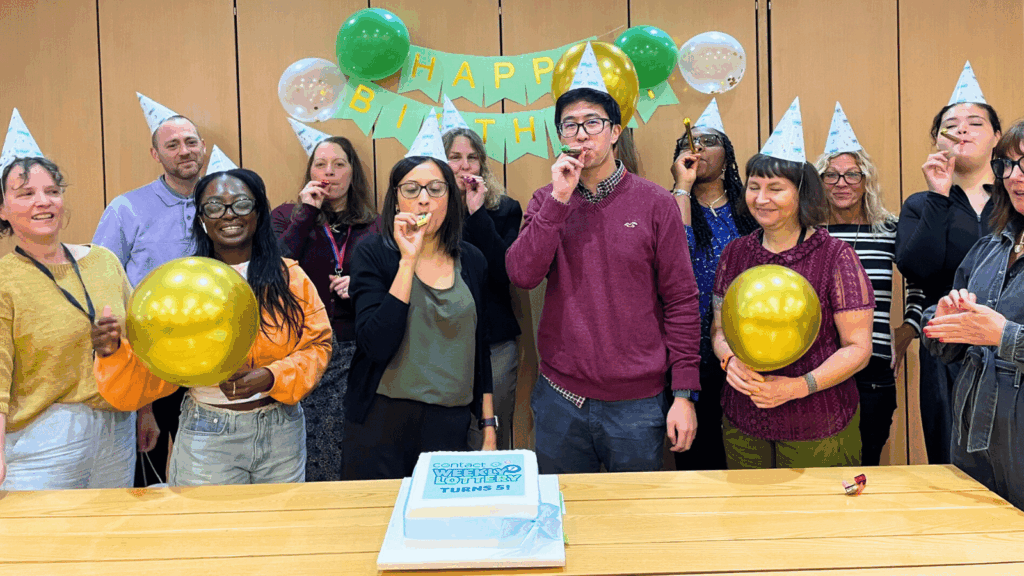
The Contact Weekly Lottery is turning 5, but you’re the one getting a present!
We’re giving away 5 free entries to celebrate our lottery’s fifth birthday. This means you’ll have 5 extra chances to bag one of our cash prizes, including our amazing £10,000 jackpot – all while helping families with disabled children flourish.
Simply sign up by Friday 31 July and we’ll add 5 free entries to your first draw once we receive your first direct debit payment.
Entries cost just £1 a week, and your ticket will help fund Contact’s life-saving advice and support services that families of children with additional needs rely on.
And if you think you don’t stand a chance, think again… Just last month, we had the pleasure of telling parent carer Kimberley that she had won £1,000. She joined our lottery to give back to families like hers, and now she’ll get to treat her three SEND boys to a much-deserved holiday with her winnings.
Emma’s story wasn’t much different: as a mum of two autistic sons, little did she know that her generosity in wanting to help families like hers through our lottery would turn into a huge £10,000 jackpot!
Kimberley and Emma are just two of hundreds of parent carers who have won big in the Contact Weekly Lottery.
By joining the Contact Weekly Lottery, you’ll help us make a difference to the thousands of families who turn to us each year for the vital advice and support they need to give their disabled children the best chances in life.
Among the proposals the government is seeking views on is cutting Universal Credit healthcare payments for under 22s. We’re campaigning against this change.
Also in the consultation are plans to raise the age at which children move from Disability Living Allowance (DLA) to Personal Independence Payment (PIP) from 16 to 18. This would apply to the age at which new claimants are able to apply for PIP, too. The government says it wants to align adult disability benefits with other support that becomes available at 18. It also wants to ease the pressure on young people of going through PIP assessments.
Thanks to those who took part in our Facebook poll, sharing what you thought should happen. Overwhelmingly, most of you agreed with the government’s proposal to raise the age of PIP eligibility to 18.
Contact’s view on raising PIP eligibility to 18
Contact will be responding to the consultation. Our recommendation is that disabled young people moving from DLA should have the option of claiming PIP at 18 rather than 16, but only if they choose to. We believe disabled children should have the flexibility to either claim PIP at 16, or choose to delay this for up to two years.
Our view is that there is no optimum age for moving onto adult disability benefits from DLA. Every family is different. The majority of young people are eligible for higher payments under PIP than DLA and may wish to claim at 16. But research also shows that up to 13% of children on DLA fail to claim for PIP at 16. We know the process will be too challenging for some families at this age.
This is the system that applies in Scotland. Disabled children on Child Disability Payment can choose to claim Adult Disability Payment at any time from 16 up to 18. (They can even apply later, but this will result in a gap in payments). We think this system is working well.
Last year, Contact secured a three-year grant from the National Lottery Community Fund (NLCF) to launch a new project across Wales.
Called ‘Building Resilience’, it aims to reach and support families with disabled and additional needs children across the whole of Wales, especially those who haven’t connected with us before.
With two new members of staff joining us, the Contact Cymru team have been busy developing links with communities, running workshops, events and drop-ins, and finding new ways to share information and support. And we’re really pleased that as our first year comes to an end, we’ve reached and supported nearly 600 families across 19 Local Authorities!
Highlights from Year 1
We ran lots of workshops on topics like stress, anxiety, sleep, sensory needs, and money management. Some of these were online and some were in-person, including three wellbeing programmes to help parent carers cope with stress.
We partnered up with experts to run webinars on topics such as benefits, wills and trusts.
And we set up a new online drop-in service for parent carers. These take place on the first and third Thursdays of every month from 11:00-12:00 during term time, and are a welcoming and safe space to listen or talk about experiences.
We continue to support families with enquiries by email and phone.
While we’re proud of the first year, and will continue to run and build on all the services above, we know there’s still much more to do. Too many families still don’t know their rights, what support is out there, or where to turn in a crisis.
We’re already planning for the year ahead. We want to:
Reach even more families in rural and isolated areas
Make our events and information sessions even more accessible
Work with more professionals and community groups
Share family voices with those in power to push for change
We’ve got more exciting events and projects in the pipeline for Year 2, including inclusive disability sports events this summer, funded by the Albert Gubay Charitable Trust, and a large-scale event with Wrexham AFC. Watch this space!
As one parent carer told us:
“I just wish I knew earlier how important this support would be, in order to give me the strength to keep going at the times when I’ve waivered and thought I can’t keep going anymore.”
We’re so grateful to the families and organisations who’ve helped us in this first year and to the National Lottery Community Fund for their support. Diolch pawb!
Uchafbwyntiau o Flwyddyn 1 o’n rhaglen Adeiladu Gwydnwch yng Nghymru – a beth nesaf.
Y llynedd, sicrhaodd Contact grant tair blynedd gan Gronfa Gymunedol y Loteri Genedlaethol (NLCF) i lansio prosiect newydd ledled Cymru.
O’r enw ‘Adeiladu Gwydnwch’, ei nod yw cyrraedd a chefnogi teuluoedd â phlant anabl ac anghenion ychwanegol ledled Cymru gyfan, yn enwedig y rhai nad ydynt wedi cysylltu â ni o’r blaen.
Gyda dau aelod newydd o staff yn cael eu hychwanegu, mae tîm Contact Cymru wedi bod yn brysur yn datblygu cysylltiadau â chymunedau ledled Cymru, yn cynnal gweithdai, digwyddiadau a sesiynau galw heibio, ac yn dod o hyd i ffyrdd newydd o rannu gwybodaeth a chefnogaeth. Ac rydym yn falch iawn, wrth i’n blwyddyn gyntaf ddod i ben, ein bod wedi cyrraedd a chefnogi bron i 600 o deuluoedd ar draws 19 Awdurdod Lleol!
Uchafbwyntiau o Flwyddyn 1
Fe wnaethon ni gynnal llawer o weithdai ar bynciau fel straen, pryder, cwsg, anghenion synhwyraidd, a rheoli arian. Roedd rhai o’r rhain ar-lein a rhai yn bersonol, gan gynnwys tair rhaglen lles i helpu rhieni sy’n ofalwyr i ymdopi â straen.
Fe wnaethon ni gydweithio ag arbenigwyr i gynnal gweminarau ar bynciau fel budd-daliadau, ewyllysiau ac ymddiriedolaethau.
Fe wnaethon ni greu gwasanaeth cymorth ffôn newydd, yn gyfan gwbl ar gyfer gofalwyr rhieni sy’n byw yng Nghymru.
Er ein bod yn falch o’r flwyddyn gyntaf, a byddwn yn parhau i redeg ac adeiladu ar yr holl wasanaethau uchod, rydym yn gwybod bod llawer mwy i’w wneud o hyd. Mae gormod o deuluoedd yn dal i beidio â gwybod eu hawliau, pa gefnogaeth sydd ar gael, neu ble i droi mewn argyfwng.
Rydym eisoes yn cynllunio ar gyfer y flwyddyn i ddod. Rydym am:
• Cyrraedd hyd yn oed mwy o deuluoedd mewn ardaloedd gwledig ac ynysig
• Gwneud ein digwyddiadau a’n sesiynau gwybodaeth hyd yn oed yn fwy hygyrch
• Gweithio gyda mwy o weithwyr proffesiynol a grwpiau gwaelodol
• Rhannu lleisiau teuluoedd gyda’r rhai sydd mewn grym i wthio am newid
Mae gennym fwy o ddigwyddiadau a phrosiectau cyffrous ar y gweill ar gyfer Blwyddyn 2, gan gynnwys digwyddiadau chwaraeon anabledd cynhwysol yr haf hwn, a ariennir gan Ymddiriedolaeth Elusennol Albert Gubay, a digwyddiad ar raddfa fawr gyda Chlwb Pêl-droed Wrecsam. Cadwch lygad allan am hyn!
Fel y dywedodd un rhiant-ofalwyr wrthym:
“Byddwn i’n dymuno gwybod yn gynharach pa mor bwysig fyddai’r gefnogaeth hon, er mwyn rhoi’r nerth i mi barhau ar yr adegau pan rydw i wedi rhoi’r gorau iddi ac wedi meddwl na allaf barhau mwyach.”
Rydym mor ddiolchgar i’r teuluoedd a’r sefydliadau sydd wedi ein helpu yn y flwyddyn gyntaf hon ac i Gronfa Gymunedol y Loteri Genedlaethol am eu cefnogaeth. Diolch pawb!
Get the latest SEND updates, benefits advice, practical help caring for your child, plus free workshops and family events in our weekly email newsletter.
(Make sure you select ‘News updates’)