Most children and young people will now be back at school or college. For some disabled children, that means back to school transport.
School transport, provided by the local authority (or the education authority in Northern Ireland), can be the glue that helps hold things together for many families. But when it goes wrong, things can easily fall apart. And we know many families are starting this new term without the right transport support.
Our advice on school transport
Local authorities/the education authority have different travel arrangements they provide for eligible children and young people.
There are different eligibility rules across the UK, which can include looking at the nature of distance of route and individual needs.
If you are unhappy with a local authority decision on school transport, either because they have decided your son or daughter is not eligible, or you think that the transport offered is not suitable, you might want to follow your local authority’s appeals procedure for transport decisions. The local authority publishes this alongside the transport policy.
More information and advice
Things are hard – with many cash-strapped authorities having to review what transport options they have on offer for families, especially post 16, often leaving them with nothing.
If you are facing difficulties with school/college transport and need some advice, contact our helpline.
The first two debates, led by Sarah Dyke and Alistair Strathern, focused on SEND in Somerset, Herts and Central Bedfordshire. The final debate, held by Richard Burgon, was on SEND provision across England.
What did we learn from these debates?
There is a large appetite for change. Nearly 50 MPs applied to speak in one debate, a number rarely seen in Westminster Hall. Richard Burgon’s statement, that “the special educational needs and disability system has gone beyond crisis and is in emergency”, is evidently a sentiment many share.
The main issues MPs discussed included:
Lack of funding for councils, NHS and schools.
The need to build capacity and expertise in the mainstream system so that more children can access the universal and targeted support they need.
Safety valve agreements need to end.
The postcode lottery in funding and the quality of support that children experience across the country.
The adversarial system that leaves far too many families battling an appeals system to secure the support children need.
SEND pupils have had to take time out of school due to a lack of proper provision.
The behaviourist and attendance-focused approach to education.
The importance of early identification of SEN so that support can be provided quickly.
The government’s response
The current Schools and SEND Minister, Catherine McKinnell, said: “I can scarcely see a system that is so broken or in such desperate need of reform. That is why we are absolutely determined to fix it, and we have started work already. It is a priority for this department to fix our SEND system, but we know that we cannot do it alone”.
Contact welcomes the minister’s commitment to work with the sector, parents, schools, councils and expert staff to address the emergency in the SEN System.
The minister was keen to stress that the government “are absolutely committed to ensuring that every child’s entitlement to have the best education possible, in their local area and where they need it, can be delivered under our system”. We are concerned that there seems to be little detail on how they are going to achieve this.
We call on the government to implement our 3 SEN Asks and address the most challenging issues in the SEN system.
Two weeks of Paralympic action comes to an end this weekend, with Team GB currently second in the medal table with a whopping total of 75.
What have been your family’s favourite moments so far? Tell us over on our Facebook page.
The Paralympics is an important event in raising awareness of a range of disabilities. Above all, it inspires disabled children up and down the country to take part in sport.
But as part of the Disabled Children’s Partnership (DCP), we’re warning that disabled children are missing out on physical activity by a lack of facilities, resource and staff.
DCP research found that just a quarter of disabled children have the support required to enjoy hobbies outside of school. In many cases this leaves them “incredibly isolated”.
Contact CEO and Chair of the DCP Anna Bird told the i newspaper:
“Without the proper facilities, resources and skilled staff to participate in races or team games, that magic moment of inspiration will be lost, leaving children unable to enjoy the social, mental and physical benefits that sport brings.
“Thirty minutes of activity a day is just not enough. We need a culture change where physical exercise is seen as an essential part of a disabled child’s education and life, rather than an optional extra.”
We want to see activities like wheelchair basketball and boccia – a Paralympic ball sport – in mainstream schools and community centres.
We have sent a briefing to all MPs, outlining the issues based on what we hear from families on our helpline, Facebook group and local parent carer forums. Together with families, we have also set out ways the system can be improved.
Tuesday 3 September from 4:00pm on SEND services in Somerset – held by Sarah Dyke MP.
Wednesday 4 September from 4:00pm on SEND provision in Hertfordshire and Central Bedfordshire – held by Alistair Strathern MP.
Thursday 5 September 3:00pm Westminster Hall debate on SEND provision – held Richard Burgon MP for Leeds East.
Watch the debates live here on Parliamentlive.tv. Look for the events taking place in Westminster Hall.
What will the government say at the debates?
At the debates, there will be an opportunity for the new ministers in the Department for Education to answer questions from MPs.
We hope the ministers will say something about improving accountability in the system. This is the number one thing parents have told us they want the government to tackle.
We want to know how satisfied you are with these services and what impact using these services had. Did you feel better informed? Did it help you discover what action to take next to get the help you need? And would you tell others about the service?
Your feedback is really important to us. Your responses will help shape the direction of our services in the future, so please make sure you tell us what’s not working, too.
The survey is completely anonymous and will take around 10 minutes to complete.
WhatsApp Channels are one-way broadcasts, allowing organisations like ours to share news to our networks, privately, in many people’s go-to messaging app.
Your details remain completely confidential – neither Contact nor other members can see your profile, photo or number. And while people can react (anonymously) to stories, they cannot post messages.
You can choose whether to turn channel notifications on or not.
Where can I find WhatsApp Channels?
You’ll find WhatsApp Channels in the ‘updates’ tab of your app. Once you’ve subscribed to our channel, we’ll appear in this tab, and you’ll receive our latest stories as soon as we’ve published them.
It’s back – Contact’s Counting the Costs survey. It’s a chance for families across the UK to have your voice heard about the financial impact of having disabled children.
The survey looks at everything from extra costs to a parent carer’s capacity to take part in paid work.
The survey includes questions on your energy costs, the impact of unsuitable housing and your experience of getting adaptations.
There are questions on the costs of assessments, equipment and therapies. There are also questions on the extra costs of having a child out of school due to their additional needs.
We have listened to your financial concerns, through our helpline and in our private Facebook group, as well as during workshops and focus groups, and updated our survey with the latest issues.
Your responses will help us campaign for stronger financial support from UK governments and energy companies. The findings will also help us fundraise so we can provide more advice.
In the past we have successfully campaigned for better financial support, including:
Cost of living payments and help towards energy bill.
On Friday 26 June, Contact Northern Ireland hosted a special celebration event in Dungannon, Northern Ireland, that brought together a diverse group of parent carers, professionals, and representatives from local and national organisations.
The event marked the conclusion of Contact NI’s three-year ‘Preparing for Transitions’ project, funded by the National Lottery and delivered in partnership with Carers NI. The project supported parent carers of disabled young people as they navigated the transition from educational settings to adult life.
This involved the delivery of a programme of workshops and peer support sessions in schools and community venues. Contact’s Transition Outreach workers led the project, liaising closely with parents, schools and support services to provide tailored and complex support.
Among the attendees at the celebration event were representatives from organisations including Sense NI, Cedar Foundation, and Next Step Transitions. Representatives from the Department of Health’s Strategic Planning and Performance Group, the Learning Disability Unit, and the NHS’s Southern Trust were present. SENCOs and teachers from partner schools came along too.
Key speakers
Attendees heard from a number of speakers throughout the event.
Susan Walls, Contact’s Head of Programmes in Northern Ireland, opened the day. Susan spoke about the importance of the partnerships formed throughout the project and the collective achievements.
Participants then heard from Emma McAleer. Emma is a young person involved in some of the project workshops, talking to parent carers about her experience of the transition process. She described her own inspirational journey from education to independent adult life. This included travelling, volunteering, theatre performing, dog walking and two gold medals at the Ireland Special Olympics!
Other keynote speakers included Jessica Conway, a parent carer who had participated in the project, and Shaunagh Duffin, SENCO at Sperrinview School in Dungannon, one of the project’s partner schools.
Dr Helga Ogden from Outcomes Imp presented an evaluation of the project following the commissioning of an independent report.
Dr Ogden highlighted the excellent feedback from the parent carers and schools involved. Parent carers had really valued the information and support during a critical period in their children’s lives. All the schools reported that it had enhanced their existing provision. Recommendations looked at how the project could be expanded and scaled-up within Northern Ireland and possibly beyond.
Susan Walls, Head of Programmes in Northern Ireland said: “It was a fantastic event. We were delighted to have so many parent carers, professionals and organisations join us to celebrate the commitment and partnership working of everyone involved. We were grateful that representatives from the Department of Health attended the event, and we will be following up with them to keep building the momentum around transitions planning in Northern Ireland.”
For more information about Contact’s work in Northern Ireland, please visit the Contact NI webpage.
Many disabled children and youngsters with additional needs are still without a school place before the start of the school year.
This might be because a child is waiting for a suitable school place. Or they might be waiting for the right support to be put in place, through an Education, Health and Care (EHC) plan or equivalent.
Sadly this is the case every year. And with support in schools for children with additional needs under increasing pressure, there are more in this situation than ever. Just this week came news that 60 children in Northern Ireland with special educational needs have no school to go to in September.
Angie Fenn, Contact’s Head of Advice, said:
“Children are returning to school this week in Scotland and the start of September in England, Wales and Northern Ireland. It’s very stressful for families whose children don’t have a school place for the start of the year.
“We would encourage them to get in touch to understand your child’s rights and where to go next to push for the place your child is entitled to.”
The lack of accountability is now a common phase in the battle to fix the special educational needs and disability (SEND) system in England (and no doubt elsewhere in the UK).
Most of the current mechanisms for accountability (complaints to schools/local authorities, tribunals, judicial review) are reliant on proactive parents to seek redress and complain following wrongful decisions. Many parents say they don’t have the time, energy or confidence to challenge decisions.
In a recent focus group, parent carers identified the root cause of the failure of the education system as the government’s refusal to hold local authorities to account. When asked if they had to identify one issue for the government to prioritise and act on, they said accountability. They described the current accountability system as purposefully complex, convoluted and adversarial.
As a parent of a disabled child, you are entitled to certain services that can help you, your child and your family.
This can include help with the personal care of your child; short breaks and holidays; or adaptations for the home.
Your local authority has a duty to provide these services to families that need them. In order to work out whether a disabled child and their family does need them, it carries out assessments. These are called needs assessments and carers assessments.
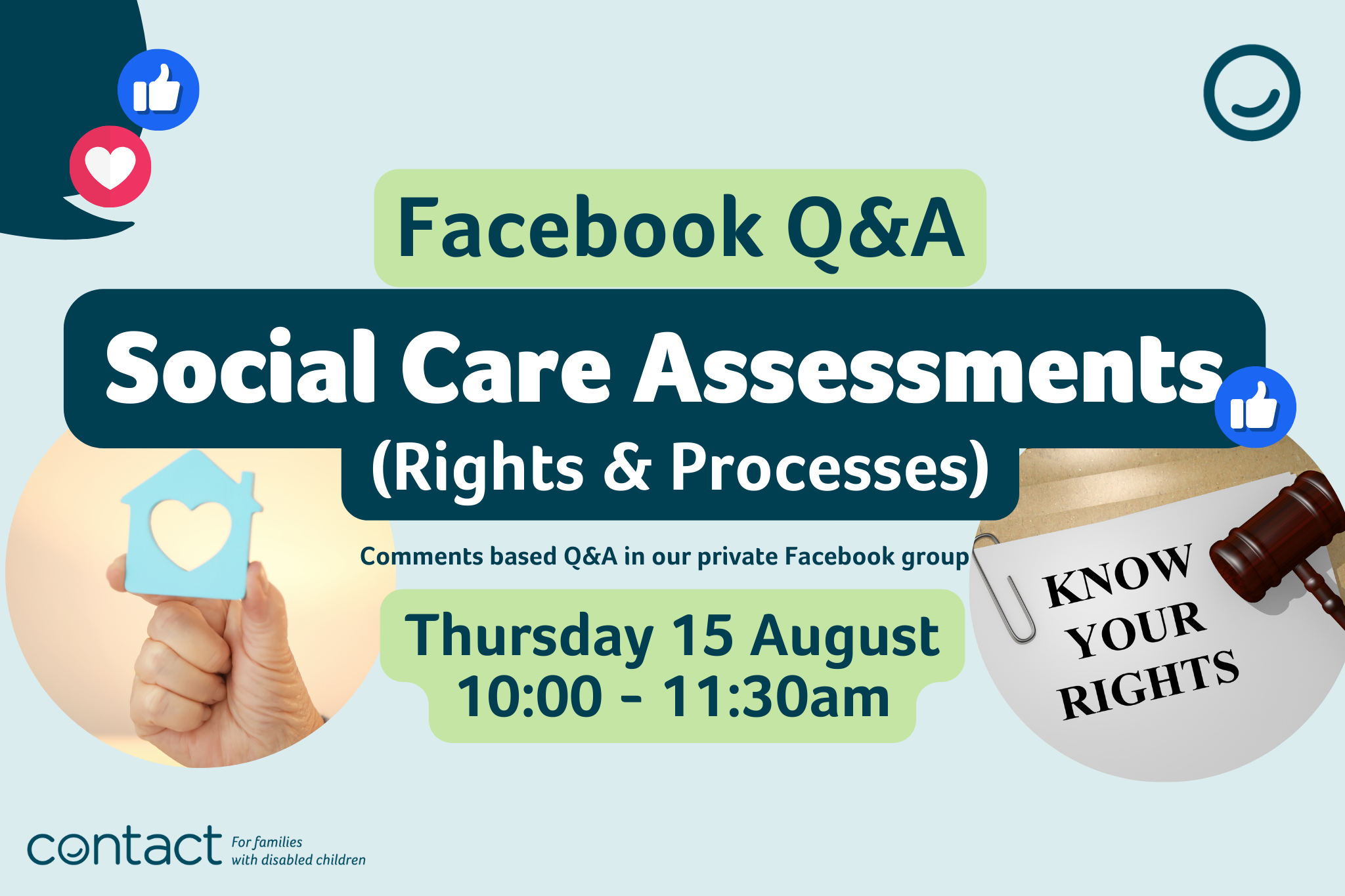
Join our Facebook Q&A to get the advice you’re looking for
We have information on our website on the links above. But to answer any particular questions you might have, we’re running a special Facebook Q&A with our helpline advisers.
You will have seen and perhaps even witnessed escalating acts of violence in Liverpool, Bristol, Manchester, Hull, Belfast, Stoke and other cities across the UK this weekend.
We wanted to reach out and acknowledge that many of the families we support are being affected by these events and feel unsafe, fearful and vulnerable in their communities as a result of these disgraceful and violent actions. At Contact please be assured that we are here for every family that needs us.
We also wanted to share some resources about how to talk to children about scary events and what’s happening in the UK right now:
The government has recently announced that it will form a new Child Poverty Unit to address rising numbers of children living in poverty and low-income households.
The new unit will bring together government officials and external experts to create a strategy for reducing child poverty.
The Education Secretary Briget Phillipson MP and Work & Pensions Secretary Liz Kendall MP will lead the unit.
Our Head of Policy Una Summerson says:
“The creation of a Child Poverty Unit is welcome. But it must look at the disproportional impact poverty and extra costs has on disabled children and their families.
“Our research has found that a third of families with disabled children have extra disability costs of over £300 per month. Disabled households are often limited in their opportunities for work due to caring responsibilities. And essentials like food and energy often cost more, due to specialist diets and life-saving machinary needed 24/7.
“In the last year, Contact’s family finances team increased household incomes on average by £5,918 per eligible family. We urge families with disabled children to seek out our support to make sure they are not missing out.”
Simple fixes to reduce child poverty
Earlier this year, we set our roadmap for the new government, including measures to reduce child poverty. There are some simple fixes to Universal Credit that would make an immediate difference to the incomes of some of the most disabled young people in education, hospital and those with looked-after status.
We would like to see reforms to Carer’s Allowance (such as lifting the earnings limit). And the government could release £210 million of savings currently locked away from 80,000 disabled young people in Child Trust Funds. These measured would have a big impact on reducing child poverty.
Contact’s policy officer, Imogen Steele has given give her assessment of the ISOS Partnership report (England) published today.
The report, commissioned by the Local Government Association and County Council Network, sets out ideas for the future of the special educational needs system in England. You may have already read the excellent analysis by Special Needs Jungle and others.
As someone who was interviewed by the ISOS partnership for this report, I don’t feel like I was listened to at all. As a disabled individual who had to rely on the law to get my schools and teachers to even bother to try to teach me, this report has really disappointed me.
Diminish disabled children’s rights
The overall aim of creating a system that is inclusive to all students, where a plan of support that is linked to funding – an Education, Health and Care Plan (EHCP) – won’t be needed for the majority is good.
However, the proposal seems vague, lacking in detail and idealistic. Of greater concern are some of the report’s more controversial proposals such as changing the SEN legal framework and removing the SEND Tribunal which will simply diminish disabled children’s rights in education.
Restricting access to EHC plans
At Contact we are deeply concerned that some of the recommendations in the ISOS report will dilute disabled children’s rights in education. The report proposes to restrict access to Education, Heath and Social Care Needs Assessments, limit Education, Health and Social Care Plans ‘for the minority of children’ and diminishes parental rights to choose where their disabled child goes to school. This is a vital right as parents with disabled children are the experts on their child’s needs and where they will be best met.
SEND Tribunals
Perhaps most disturbing of all is the report’s suggestion of abolishing the SEND Tribunal – the court where parents can appeal against the decisions made in relation to their child’s Special Educational Needs. The report suggests that the tribunal will be replaced by an independent practitioner body with no judicial powers. These proposals will leave disabled children with diminished rights in education. And their families’ ability to challenge wrongful decisions via appeals will disappear.
Taking away families’ legal rights
Contact’s CEO Anna Bird and others across the disability sector have reacted to the ISOS report with the following statement.
“Taking away families’ legal rights would only risk more children and their families being failed. This is because these rights are an essential safeguard when nothing else has worked. What Government should do is give schools the right skills and enough money to be able to support the 1.7 million children in England with special educational needs. Until they do that, thousands of children will fail to learn and many will be unable to go to school at all.”
Access to therapists
There are some positive recommendation in the report such as:
A “Core offer” of targeted, multi-disciplinary support that all education settings can access without children requiring a statutory plan
Focus on transition into adult services (“Destinations and Progression Service”)
System-wide workforce strategy
What’s needed
Contact like to see the government enhance support for disabled pupils in mainstream schools. This can be achieved by boosting funding, legal entitlements and access to specialists. This will make disabled pupils feel welcome and included in the school environment. In the long-term, this will reduce the need for education, health and care (EHC) plans
In response, the Education Secretary Bridget Phillipson pledged that the new government would fix the “broken system. ” But warned change would not be quick. She went on to say:
“We will restore parents’ trust that their child will get the support they need in mainstream school, if that is the right place for them. And that there will always be a place in special schools for children with the most complex needs.”
Struggling to get their hands on vital support
Katie Ghose, from the Disabled Children’s Partnership said:.
“It mirrors our own research that families with disabled children are in a desperate situation – they are struggling to get their hands on support. This means their children are missing out on education and not getting access to the vital therapies they need to thrive,”
“The desperate situation of families with disabled children needs all the attention that we can give it. It’s good to see this new research but it’s shocking to see that half of parents are having to resort to lengthy legal battles to get the support that their disabled children needs.”
Families feel seen
Anna Bird, CEO of Contact said on X (Twitter):
“I really hope families feel seen today. There are some powerful messages in today’s coverage of failures of SEND support about the colossal waste of children’s talent and potential. Good and right that Bridget Phillipson MP response leads with the need to build trust and listen.”
ITV’s focus on education for children and young people with additional needs comes at the same time as a report commissioned by the Local Government Association and the County Councils Network which sets out recommendations for reforming the education system for children with special educational needs and includes some worrying proposals that would take away legal rights for disabled pupils.
And now Andrew has set up a Facebook campaign group called Unlock Our Savings – Child Trust Funds & JISAs for disabled young people. We’d love you to join us in it.
The Unlock Our Savings group will help us to share information accessing Child Trust Funds and Junior ISAs. It will also help us reach more people who are affected by this unfair situation.
Many voices are stronger than one. We hope the group will be a way for us all to demand action from the new government.
Reasons to join
Hera are three reason to join:
Share tips on accessing savings held in Child Trust Funds via the finance industry process. More providers are using a simpler way of releasing funds. Parent carer Angie recently asked the NatWest to release her son’s savings. They did so quickly and simply and how her son has £3,500 to enjoy (a mini campaign win!).
Get campaign updates and news about events on topics such as Lasting Power of Attorney, Court of Protection and more.
Be part of a community with a shared goal to unlock savings held in Child Trust Funds /Junior ISAs.
Please share the group with your contacts. If your child attends a special school or specialist services, maybe you could share on their social media too.
Our research tells us that there are many families who don’t know that this is a potential issue for them. We’d love to reach as many people as we can!
Contact is delighted to announce that the Free School Meals campaign, set up by parent carer Natalie Hay, has taken top prize in the Disability category at this year’s Charity Awards, the longest-running and most prestigious awards scheme in the charity sector.
Contact was recognised for our work supporting and amplifying the parent-led campaign to ensure eligible disabled children don’t miss out on their free school meal.
Together with parent campaigner Natalie Hay and her son Matteo, we were honoured to be invited to a black-tie ceremony at the Royal Lancaster Hotel in London, hosted by broadcaster, commentator and writer Baroness Ayesha Hazarika. There we were presented with a trophy alongside the nine other category winners.
Working collaboratively
Anna Bird, chief executive at Contact, said: “We are very proud to win this award, which is testament to the hard work of the Contact campaigns team and our ethos of working collaboratively with parent carers.
“Campaign leader, Natalie Hay saw discrimination taking place and decided to take a stand on behalf of all parent carers. That is the strength of the parent carer community. We were honoured to work alongside Natalie and other parent carers to effect change and ensure that eligible disabled children don’t miss out on the free school meal they are entitled to.”
Proud of this prize
Matt Nolan, chief executive of Civil Society Media which organises the Charity Awards, congratulated Contact on winning the highly-coveted award. He said: “For 24 years, the Charity Awards has been shining a spotlight on the vital and inspiring work that UK charities carry out right across the country. In 2024, the sector is contending with soaring costs, rising demand and shrinking donations, yet the resilience, ambition and innovation in these applications continues to impress and inspire us. In a year of record entries, Contact should be hugely proud of this prize.”
Contact’s research found that 164,000 disabled children were missing out on their free school meal due to their disability or sensory needs, or because they are unable to attend school due to illness or waiting for a suitable school place.
The law is clear that they should receive an alternative such as a food vouchers in lieu of the meal, yet thousands weren’t.
Parent Natalie Hay led the campaign and fundraised to mount a legal challenge to stop disabled children missing out on free school meals, and Contact joined her fight. Together we successfully convinced the government to admit that its current practice discriminated against those who couldn’t make use of the school meals. The government committed to update its guidance making clear schools have a duty to provide a reasonable adjustment such as a supermarket voucher. The guidance was published in March 2024.
If all families who are eligible take advantage of the vouchers, the gain to those families would be around £93m.
We are very grateful to Natalie Hay, Ian Byrne MP and solicitors Rook, Irwin and Sweeney for supporting the campaign. We couldn’t have achieved the win without them.
If your child is missing out on their free school meal
We have template letters to help those missing out on a free meal and want to claim vouchers instead.
School summer holidays have started in Scotland and are on the horizon in England, Wales and Northern Ireland.
We have updated our holiday web pages recently which include information about early bird sessions, carer passes, leisure discounts and much more.
We recently held a Facebook Q&A for parents looking for help and advice about activities, childcare and holidays during the summer break. Almost 50 parents asked questions during the hour-long session.
The top two questions were:
What accessible activities are there locally?
For families in England a good place to start is to look at your council’s Local Offer. It will include the support and facilities families can find in their area for children and young people who have special educational needs (SEN) and disabilities.
In Scotland, Wales and Northern Ireland most councils have information on their website about playschemes and clubs locally for children with additional needs.
What are the best places to go to for help with funding towards holidays and play schemes?
Many charities can help families with this, ranging from small local charities to large national organisations such as the Family Fund – who often help with holidays. Our Grants webpage has information and tips about searching for a grant, as well as our own downloadable grants list with a summary of grant-giving charities and trusts.
Equipment to help you and your child enjoy being out and about
If you are looking for fantastic products to help you get out about during the holidays our Fledglings shop has everything you could need. Swim wear, ear defenders, changing mats are all available and more.
The charity Kids in Museums last week revealed the 18 museums, galleries and heritage sites in the UK shortlisted for an award. They are recognised for being welcoming, fun and accessible venues. Why not try them out this summer?
Best Accessible Museum
Cooper Art Gallery Barnsley
Streetlife Museum, Hull
Wakefield Museum
In the Best Accessible Museum category, the shortlisted venues use innovative ways to welcome families with children who have additional needs, including: exhibitions devoted to sharing stories of deaf, disabled and neurodivergent people, Makaton Monday video features on social media, weekly relaxed openings and sensory materials to support visits.
Best Small Museum
Dylan Thomas Centre, Swansea
Museum of the Order of St John, London
National Civil War Centre, Newark
Nothe Fort, Weymouth
Story Museum, Oxford
Best Medium Museum
Discover Children’s Story Centre, London
Museum of the Home, London
Museum of Making, Derby
Turner Contemporary, Margate
Best Large Museum
National Galleries Scotland – Modern One, Edinburgh
Get the latest SEND updates, benefits advice, practical help caring for your child, plus free workshops and family events in our weekly email newsletter.
(Make sure you select ‘News updates’)