Around 27,000 children on specialist dental waiting lists
Recent NHS figures showed that in January around 27,000 children were on waiting lists for specialist dental care, assessments or procedures.
The report paints a depressing picture of ‘dental deserts’ in England with no NHS dentistry. More than 3,000 dentists have left NHS since the covid pandemic. 1 in 5 people are not registered with an NHS dentist and 1 in 10 have resorted to doing their own dental work.
The government not yet published its promised recovery plan for NHS dentistry.
New NHS Integrated Care Boards (ICBs) in England are now responsible for commissioning NHS dental care, including community dental services for children who cannot use high street dentists.
Last year Contact worked with NHS England to shape new framework for dental services for autistic and learning-disabled children in residential schools, promised in the NHS Long Term plan.
Contact continues to press better dental services for all disabled children.
The report calls for mandatory training in Special Educational Needs and Disabilities (SEND) for all early years’ practitioners. It also recommends that sources of funding for additional SEND support must also be made easier and quicker for providers to access.
The cross-party MPs who form the Education Committee recommend the government:
Address the huge delays in the funding which helps early years settings support children with SEND – the SEN Inclusion Fund (SENIF) – and to review the application processes for providers.
Ensure that SENIF issue funding that is truly reflective of the cost of delivering specialised care for children with SEN
Increase the Early Years Pupil Premium (EYPP) to match that in primary schools and widening the eligibility criteria so that more children from very low-income families can access much needed extra support for any special educational needs.
Today’s report follows an inquiry by the Education Committee examining why childcare and early years’ education has become so expensive and the workforce issues facing the early years sector.
Giving evidence at the inquiry Contact’s Early Years lead, Mary Mulvey-Oates told MPs that having a well-trained early years workforce delivering early interventions can help create positive discussions with a child’s family about disability that focus on their strengths and opportunities.
She also drove home to the committee the difficulties parents experience finding a suitable nursery place and called for “greater simplicity and clarity” for parents and providers to access SEN inclusion funding.
Have your say on the government’s proposals for early years funding for under 2s
Last March the government announced that working parents of children aged between 9 months and three years in England will be eligible for 30 hours of free childcare a week, for 38 weeks a year. This will be rolled out in phases with the plan that from April 2024, working parents of two-year-olds will be eligible for 15 hours of free childcare. From September 2024, this will extend to working parents of children aged between nine months and two years.
The committee, which scrutinises the value for money of government projects, estimates that more than £1.7billion is sitting in accounts waiting to be accessed. At least 80,000 of those accounts are owned by young people with a learning disability who lack mental capacity.
Their report backs up what Contact and campaigners have been saying about the Court of Protection process needed when a disabled youngster lacks mental capacity to access savings – it’s difficult, time consuming, and costly.
“The money will mean so much to Harry – but at the same time the bureaucracy, cost, and overall impact of the legal implications is huge. I saved for my son, like I did for his brother – the whole system is wrong if it deprives Harry of what is rightfully his.”
Contact has joined parent campaigners, legal and financial firms campaigning to unlock £210 million of savings in Child Trust Funds for 80,000 disabled youngsters. To date nearly 2000 of our supporters have written to their MP calling for a simplified process to help release savings.
“All we’re asking is for the government to come up with a simple process. None of us want fraudulent activity to take place. But you don’t necessarily need such a heavy duty process.”
As of this week more than £58 million of savings in Child Trust Funds has been locked away from disabled youngsters.
Martin Lewis speaks out
Martin Lewis, the financial expert, has recently raised his concerns about the issue. He agrees that the Government has so far ‘failed to meaningfully act’ to help young people locked out of their savings. He wrote to Children’s Minister calling for action, you can read her response in his blog: https://www.moneysavingexpert.com/news/2023/07/martin-lewis-minister-responds-child-trust-funds/
What do MPs say should be done?
The Public Accounts Committee report makes a number of recommendations, including calling on the government to set out what action they are taking to help the families of young people who lack mental capacity to access their Child Trust Funds without excessive bureaucracy and cost.
It also says government should do more to find and contact young people who have not claimed their Child Trust Fund.
We are calling on the government to increase the scope of the DWP Appointee Scheme to cover Child Trust Funds and Junior ISAs up to £5,000.
This would bring England and Wales in line with Scotland, where an Access to Funds scheme makes it easier and cheaper for young people who lack mental capacity to access their savings.
If your child lacks mental capacity to manage their own money talk to your provider. Some providers including One Family and Foresters Financial will consider each situation on a case-by-case basis, applying a process that mirrors the DWP’s appointee paperwork requirements to enable parents to access accounts using documentation that they already hold.
On Friday 14 July, the Contact Weekly Lottery had two more £1,000 winners – Stacey from Kettering and Cheryl from North Shields and they are both parent carers!
Stacey and Cheryl matched five numbers and won big – just in time for the school holidays.
“My son has disabilities which are hard to manage in many social settings, and there are no SEND holiday clubs near me, so this money will pay for activities that we otherwise wouldn’t have been able to do.”
Cheryl from North Shields
We spoke to Cheryl to tell her the good news who said: “Thank you so very much for this amazing news! Hard to believe I have won £1000…never have I won anything like this! Amazing considering I’ve only been playing for just over one year!! Fantastic windfall, especially with the school holidays approaching! This money will make some happy summer memories for my two children. My son has disabilities which are hard to manage in many social settings. There are no SEND holiday clubs near me, so this money will pay for activities that we otherwise wouldn’t have been able to do. Contact lottery is so worthwhile, knowing I am also contributing to such a cause close to us all in our community. Genuinely over the moon.”
And when we told Stacey she was the winner of £1,000 she said:
“The school SENCO recommended looking to Contact for advice and information, and I did. I came across the Contact Lottery thinking I have nothing to lose but families have something to gain. I did it – and here I am a winner of £1,000 just before summer holidays! It’s absolutely amazing!
I hope more families join because it’s great giving something back and be in with a chance of winning.”
Stacey from Kettering
Last chance to get a free entry into our upcoming draw!
If you haven’t played our lottery yet, you’re in luck because we’re celebrating its third birthday in July by giving all new players one free entry!
It’s your chance to be the next player to win the jackpot while funding our vital services to help other families like yours.
Simply sign up by the 31 July, and we’ll add a free entry to your first draw once your initial direct debit payment has been processed.
The Contact Weekly Lottery has over 200 winners every month and we’ve just had four parent carers take home £1,000 each in less than a month. If you join us, you could be next!
Play Contact’s Weekly Lottery for as little as £1 a week and have a chance to win up to £10,000, all while helping us make a difference to thousands of families with disabled children in the UK.
Congratulations to Stacey and Cheryl and good luck to all our wonderful players in the next draw!
Promotion T&Cs: From 5 -31 July 2023, new supporters who sign up for the Contact Weekly Lottery will receive one complimentary entry. To be eligible, you must sign up for the lottery and be included in the draw. Your first draw will take place once your direct debit has been set up and the first payment has been made. Each supporter is entitled to a maximum of one free entry. Please note that no lottery numbers will be provided for the complimentary entry.
Today, our Change Makers Jasmin and Lauran speak out in the Metro newspaper about the lack of holiday clubs for disabled children this summer.
‘Holiday clubs are generally markerted towards children more broadly as opposed to disabled children. It’s generally assumed that all children are the same, and the staff-to-child ratio reflects that.
‘School holidays are really overwhelming and it makes me sad and angry because my daughter is entitled to play. She is entitled to be herself, she is still a child. She’s just a child that has different needs.
Change Maker Lauren shares concerns in Metro Newspaper
The Metro follows on from the launch of our report, Loneliest Summer on BBC News last Friday which showed 9 in 10 families haven’t been able to find any suitable childcare this summer for their disabled children.
Many disabled children need structure and routine to maintain sensory regulation which helps reduce anxiety and challenging behaviour. When structure is absent, for example in the summer holidays, disabled children’s needs may increase not just in the home but also upon their return to school.
Parent carers based in London and the Midlands are invited to join one of our two free online workshops providing you with tips and tools for supporting children with autism during the summer holidays.
Book your free place today. You don’t need a diagnosis for your child in order to attend.
About these workshops
Commissioned by NHS England’s Workforce, Training and Education Team, these workshops are part of the Autism Central Peer Education Programme. This new programme aims to offer families and carers of autistic people high-quality and accessible autism information, education and coaching and is co-delivered by autistic people, families and carers. Contact and Ambitious about Autism are the London and Midlands Regional Hub partners for the programme.
At Contact, we wouldn’t be able to do what we do without the insight and support of parent carers just like you. We are now looking for two new people to join our board of trustees and play a crucial role in steering our fantastic charity.
With our new CEO, Anna Bird, at the helm, this is a brilliant time to join our Board and make a real impact.
We’re particularly looking for:
A trustee with skills in fundraising.
A trustee based in Northern Ireland to support our work there.
Watch our vice chair of trustees, Angela, talk about why she volunteers for us:
Interested in applying?
If you are a parent carer and think you could have the skills and qualities we’re looking for, we’d love for you to apply!
You can also read a full transcript of the session, which includes some quick links to all the questions that were answered.
Our Child Trust Funds and Mental Capacity Live Q&A
Around 100 parent carers joined us live on Monday to hear our expert panel interview with Myra from Foresters Financial and Phillip from Renaissance Legal.
Contact’s Policy & Campaigns Director Una Summerson quizzed Myra and Phillip for an hour on an issue arising for thousands of families, whereby young people turning 18 who lack mental capacity are becoming locked out of their savings accounts.
Topics covered in the Q&A
During the interview, Phillip and Myra shared expert insights on:
What options are available to young people and parent carers.
What is the Court of Protection and which documents you need to use it.
Handy tips to think about when completing forms.
Whether being an appointee is sufficient.
What alternative processes some providers are using.
What steps to take and when.
Which other savings accounts this issue can affect.
Why they (and we) think that the process needs to be less complicated for families.
A challenging process to navigate
Phillip from Renaissance Legal told us that they have been campaigning since 2016 to make the process of accessing Child Trust Funds more straightforward for families.
“We are trying to encourage the government to change the law. We want a simpler process for families to access Child Trust Funds where the child doesn’t have mental capacity, without going through the Court of Protection”.
Myra from Foresters told Una that she had “enormous sympathies” for families finding themselves in the situation of having a young person unable to access their own savings and having to face applying to the Court of Protection. She said that Foresters were working with families on a case-by-case basis. While families may still have to apply to the Court of Protection, Foresters would look at each case individually.
During the session, parents shared comments about their knowledge and experiences of trying to access their child’s trust fund account. Parents were frustrated that being a benefits appointee is not sufficient for accessing Child Trust Fund accounts. And they shared concerns about the ongoing complexity of the Court of Protection process.
All the participants encouraged families to speak with their Child Trust Fund provider in the first instance if this affects you.
Take action on our Child Trust Fund campaigns
We are supporting parent Andrew Turner in his parent-led Child Trust Fund campaign, asking the Government to make urgent changes.
Take action to unlocking savings for disabled children by emailing your MP.
Parent and carers of autistic children who are based in London or in the Midlands are invited to join our free workshop about Autism and Employment next week. You don’t need a diagnosis for your child in order to attend.
This workshop has been developed to help parent carers understand some of the challenges autistic people face when looking for employment opportunities.
You’ll hear more about social communication barriers, stigmas, and misconceptions. And you’ll also discover some tips and strategies to help you support your autistic child and young person on their journey to meaningful employment.
If you live in London
Our free workshop for London families takes place on Tuesday 27 June, between 2-3pm. This workshop has now taken place.
If you live in the Midlands
For families based in the Midlands you’re invited to join us on Thursday 29 June between 2-3pm. Book your free place.
About these workshops
Commissioned by NHS England’s Workforce, Training and Education Team, these workshops are part of the Autism Central Peer Education Programme. This new programme aims to offer families and carers of autistic people high-quality and accessible autism information, education and coaching and is co-delivered by autistic people, families and carers.
Contact and Ambitious about Autism are the London and Midlands Regional Hub partners for the programme.
The BBC is shining a light on the extra unfairness for those with £6,000+ savings in Child Trust Funds who will receive a reduction in Universal Credit payments, even though they can’t access their savings. A ‘double whammy’ for Change Makers Claire and her son Ryan from Newcastle-upon-Tyne, who spoke out to highlight the situation.
Teddy Nyahasha, CEO of Child Trust Fund provider One Family is part of the parent-led campaign group. He believes making families go to court to access their child’s savings infringes on his duty to the consumer. His company has released £3.6m from 1,000 accounts without involving the Court of Protection. This why it’s really important that families speak to their provider first.
Our Head of Campaigns Una Summerson also appeared in a film shown on BBC Morning Live at 9.25 today. Una spoke about the unfairness of 80,000 Child Trust Fund savings accounts being locked to those who lack capacity. She appeared alongside Change Maker Maria and her son Ryan from Crawley.
Why we are campaigning
Tens of thousands of disabled teenagers have a Child Trust Fund savings account. The average account value is estimated to be around £2,000.
However, some young people are unable to manage their money as they lack mental capacity. This means their parents have to apply through the Court of Protection to access their savings on their behalf. This is a lengthy, costly and complex process, which many families are not willing to go through.
We are campaigning for a simplified process for families to access their child’s money in these cases.
Una Summerson said: “More and more disabled young people are being locked out of their Child Trust Fund savings each day. This is often money that their parents and grandparents have saved for their future. It’s truly shocking that they can’t enjoy the benefit of that money.
“The average account value is estimated to be around £2,000. Some are lucky to have more, and they face a double whammy of unfairness. They can’t enjoy their savings and also face a reduction in the financial support they could receive via Universal Credit.
“We need a solution to this urgently. There is an already established way of parents managing the money of children who lack capacity through the DWP appointee scheme.”
How do I find my Child Trust Fund provider?
Find you Child Trust Fund provider before your child turns 18 using the government website. You’ll need basic information like their National Insurance number. Then speak to your provider about how to access the savings.
If your child is 18 years old or over, you won’t be able to get this information without their consent. And if they are unable to give consent because they do not have mental capacity, you will need the Court of Protection order to investigate and report to them, so you can get access.
What should I do if you live in Scotland?
You can access funds held in Child Trust Funds or Junior Individual Savings Account (JISA’s) through the Access to Funds Scheme (Scotland). Before making an application, you should contact the Access to Funds team on 01324 677140. Or you can email [email protected] to discuss your individual circumstances
You’ll be able to ask questions directly to Child Trust Fund experts Philip Warford, managing director of Renaissance Legal, and Myra O’Neill, head of customer services at Foresters Financial.
5-11 June is Carers Week – a week that shines a spotlight on the vital role unpaid carers play in our communities.
Recent research shows that that unpaid carers – including parent carers – are providing more hours of care now than they were 10 years ago. Reduced support services such as respite care, physiotherapy, occupational and speech and language therapy, as well as mental health services means parent carers have been left to do more often complex care in their homes themselves and less able to combine work and caring.
Parent carers are at the heart of everything we do at Contact
Free School Meals: Supporting a parent-led campaign to offer food vouchers or other reasonable adjustments to eligible disabled children who are unfairly missing out on the free school meals.
Voluntary carers will soon have the right to take up to one week of unpaid leave a year to fulfil their caring responsibilities.
The Carer’s Leave Act 2023, which received Royal Assent last week, grants the new entitlement to all employees, regardless of how long they’ve been working for a company.
Unpaid carers – which includes anyone providing or arranging care for a relative or dependent – will be able to take the unpaid leave in half or full days.
The government expects the legislation to come into force in 2024. The Act applies in England, Scotland and Wales, but not Northern Ireland, where employment law is devolved.
What are my current rights to unpaid leave?
Parents have the right to up to four weeks’ parental leave a year to care for their children. This is usually unpaid, though some employers have more generous provisions.
To be eligible for parental leave, you must have been working for a company for at least one year. You must also give at least 21 days’ notice for any leave you take.
Employees are also entitled to time off for dependents to deal with any immediate situations.
Our DinoDay Stomp & Roar Challenge has started, and we have hundreds of families across the UK taking on 19 activities this month to help us transform the lives of disabled children and their families.
Thank you to all the roar-some families taking part
It’s the first time we’ve run a challenge for DinoDay and the response has blown us away. Many of the families taking part have disabled children themselves and are doing a whole host of fun activities – from visiting 19 parks and trying 19 new foods to scooting 19k.
The challenge has raised a whopping £9k so far, and we’re hoping to reach £20k by the end of June – can you help us get there?
It’s not too late to join the fun!
There’s still time to get involved in DinoDay this June and be part of #TeamDinoDay.
All you have to do is choose a family-friendly activity to take on – it’s totally up to you what you do, as long as the number 19 is involved!
You’ll get a free DinoDay t-shirt for your mini-roarer and an activity tracker when you sign up. We’ve already sent out hundreds of t-shirts, so we have run out of the smaller sizes, but why not get a larger t-shirt they can wear for many DinoDays to come!
1,500 people have joined our DinoDay Facebook group and are busy sharing their challenges in a friendly and supportive environment.
Get in touch
For more information about DinoDay or to ask any questions you may have about fundraising for Contact please email [email protected] or read our DinoDay FAQs.
Minister Nick Gibb MP confirmed that maintained schools and academies have a duty under the Education Act 1996 to provide nutritious, free meals to pupils to eligible pupils wherever they receive education. This applies both in school and at home.
“The Department expects schools to act reasonably in ensuring that their food provision accounts for medical, dietary, and cultural needs,” he added. “Parents are advised to speak to their local authority to consider suitable alternatives in line with the guidance on long term illnesses.”
Here are three reasons why you might want to use our free school meal template email:
1. You don’t know where to start or how to ask for a reasonable adjustment to ensure your child can get their free school meals entitlement.
2. It works! The letter is based on what the law says (some parents have even received backdated vouchers as a result).
3. You can send them knowing that other parents up and down the country, in your position, are sending them too.
If you have successfully used our template letter to get an alternative to a free school meal for your disabled child, we’d love to hear from you. We want to tell your story and use the schools that are acting in line with their equality duties as examples to those schools still refusing to make reasonable adjustments. Get in touch by emailing [email protected] or [email protected]
As part of the next stage of the campaign, we are interested in hearing from parents with young children missing out on free meals in England. Please get in touch if your child meets the following criteria:
They are going into reception in September or are currently in reception or Y1.
They already have a formal Education Otherwise Than At School (EOTAS) package in place.
They are not on the school roll with medical home tuition (not elective education).
Please get in touch if you meet these criteria. You can remain anonymous if you wish.
Join the campaign
If your child has been missing out on their free school meals, join the campaign group today by becoming a member of the parent-led campaign Facebook Group. There are now 1,800 parent carers in the group.
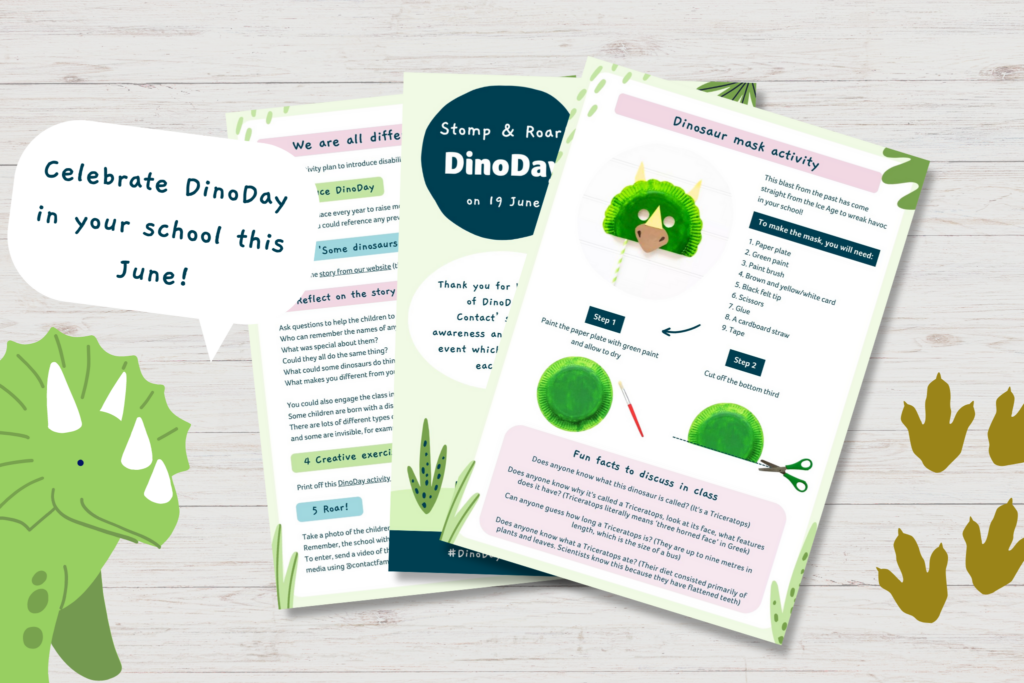
Contact’s annual awareness and fundraising event – DinoDay – is coming up on 19 June.
Alongside our exciting Stomp & Roar fundraising challenge, we’re also inviting primary schools to get involved by encouraging their pupils to wear ‘Dinosaur green’ on any day in June for a suggested donation of £1 per child.
Get. Set. Roar!!!!
Getting involved couldn’t be simpler. Schools can download our DinoDay information pack for schools filled with teaching resources, fun dino-themed activities, and lesson plans about disability and inclusion to help make DinoDay a roaring success!
The money raised will help Contact be there for even more families with disabled children who need our life-changing information, advice and support.
Have you joined our Stomp & Roar DinoDay challenge yet?
Register your interest in becoming part of #TeamDinoDay and we’ll send you a free t-shirt and activity tracker to stick on your fridge!
Walk 19 miles, draw 19 dinosaurs or visit the park 19 times – whatever you choose to do as part of our DinoDay Challenge is up to you – as long as the number 19 is involved! Then ask your friends and family to sponsor you so we can support more disabled children and their families.
For more information about DinoDay or to ask any questions you may have about fundraising for Contact please email [email protected] or read our DinoDay FAQs.
The ideas you have come up with to take part in our DinoDay Facebook Challenge this year are simply incredible!
From walking around the local duck pond 19 times, doing 19 laps of the living room pretending to be a dinosaur and visiting 19 new places to painting dinosaurs on 19 rocks to leave around town for your children to find later, going for 19 short walks, drawing 19 dinosaurs and baking a batch of 19 delicious dino-shaped biscuits.
Over 180 of you have already set up your own DinoDay Facebook Challenge and more than 1,200 have joined our DinoDay Facebook group and are already busy sharing ideas, photos – and generally having fun and supporting each other.
Why not give it a Tri-ceratops?
There’s still plenty of time to get involved in DinoDay this June and be part of #TeamDinoDay. All you have to do is:
Choose a family-friendly activity to take on this June – it’s totally up to you what you do, as long as the number 19 is involved!
We have been overwhelmed by everyone’s support to help disabled children access their own savings before it’s too late.
A huge thank you to over 1200 supporters who have taken action on the Child Trust Fund campaign writing to their MP to raise awareness and call for change.
Tens of thousands of disabled teenagers have a Child Trust Fund savings account, with the average account value estimated to be around £2,000. However, families of young people who are unable to manage their money as they lack mental capacity have to apply through the Court of Protection to access their savings. This is a lengthy, costly and complex undertaking.
We have been receiving your MP responses and will reply to those in the coming weeks. We will highlight our concerns about the government’s proposals to address the issue.
Government proposals won’t work for majority
Una Summerson, Head of Campaigns at Contact, said: “The government says it plans to digitise and streamline the Court of Protection process. But we are concerned this does not go far enough and that no timescales have been given. In addition most of the families we support do not want deputyship, which comes with added responsibility, cost and administration. That’s why we are calling on the government to give families an alternative way of accessing their savings.”
Parent campaigner Andrew Turner added: “There is already a tried and tested way for families to manage their child’s money – the DWP appointee scheme. Many parents are entrusted by this scheme to manage benefits in excess of the savings held in the Child Trust Fund account. That’s why it makes perfect sense to expand the scope of the scheme to cover Child Trust Funds and Junior ISAs.”
Savings lost each week
Andrew has today launched a lost benefit calculator to illustrate the amount of savings being lost each week as more and more Child Trust Fund accounts of young people with learning disabilities are locked. We hope it will act as an incentive to the government to act now before it’s too late.
John Roberts, dad to Joseph aged 18, is still waiting for a response from his MP.
“Like many parents of children with learning disabilities who have turned 18, we are stuck with what to do with the Child Trust Fund we created when our son was born as part of the CTF initiative set up by Gordon Brown.
“Joseph is unable to manage his own financial affairs and is therefore unable to gain access to the money in his CTF, which is held at HSBC. I understand that the only way to gain access to those funds is for either my wife or I to obtain financial deputyship on his behalf. This currently has an application cost of £371, plus £494 if the court decides the case needs a hearing. There is also an annual general supervision fee of £320 (reduced to £35 for minimal supervision), plus a £100 assessment fee for a new deputy. The process is complicated and we have been advised that it is better to apply with a lawyer, for which the lowest fee we have been quoted is £1600.
“For most people in our situation the complexity of this process is appalling and the cost totally prohibitive as it is likely most CTF’s will not contain sufficient funds to cover the above costs.
“My parents have been paying money into their grandchildren’s CTFs every year as a birthday present. Our daughter will be able to access those funds to pay for whatever she chooses when she turns 18 in three years time. Unfortunately, Joseph can’t, and currently no-one can access the funds unless we apply for deputyship. Joseph has no other assets and is unlikely to have any, other than his disability allowances (DLA/Mobility/PIP) during his life, so financial deputyship, and the on-going costs associated with it, will only ever be needed for this one transaction.
“Surely we can find a solution to ensure that we do not penalise our most vulnerable young people.”
19 June is DinoDay, our annual fundraising event to raise vital funds so we can be there for even more UK families with disabled children.
This year, we’d love as many of you as possible to be part of #TeamDinoDay, and it couldn’t be easier.
Simply:
Choose a family-friendly activity to take on this June. It could be visiting the park 19 times. It could be drawing 19 dinosaurs, walking 19 miles over the month, or doing 19 star jumps. Big or small, the activity you choose is totally up to you – as long as the number 19 is involved!
When you complete our registration form, you’ll get a free child’s DinoDay t-shirt and printed activity tracker to make sure your challenge is a roaring success!
When you register, you’ll also be invited to join our DinoDay Stomp and Roar Facebook Group.
There, you can meet other families taking part and find helpful tips and ideas of things to do. And you’ll also find some dinosaur-related activities to do!
Could you ask your child’s primary school to get involved in DinoDay?
By taking on the DinoDay Challenge and raising funds for Contact, you’ll be helping us continue to transform the lives of families with disabled children with our vital services and information.
With Contact’s help, successfully challenged the government through the courts to make things fairer for families with disabled children.
The money you raise this June will also help us campaign to tackle the inequalities that families with disabled children face, like we did for Mathieson’s family and the thousands of others.
Get the latest SEND updates, benefits advice, practical help caring for your child, plus free workshops and family events in our weekly email newsletter.
(Make sure you select ‘News updates’)