In 2022, for the first time, fewer than half of all EHCPs were issued within the statutory minimum of 20 weeks due to a surge in demand.
These tribunals were brought by parent carers disputing council decisions about their child’s support needs in education, including assessing and issuing an EHC plan and about the contents of the plan.
Emotional and financial strain
Contact, a leading member of DCP, hears from many families going through the tribunal process.
Michele Cefai, Head of Communications at Contact, said: “The tribunal process puts tremendous strain on families, both emotionally and financially. And the wait for support can lead to increased difficulties for children and young people, including deteriorating mental and physical health, which can lead to persistent absence from school.
“Local authorities lose the vast majority of tribunal cases, so there needs to be a recognition that parents know their child best. This money would be better used providing support to children with special educational needs.”
DCP is calling for:
Government to ringfence resources for early information, advice and support for parents navigating the system.
Better training for local council staff so they make the right, lawful decisions first time.
Human rights lawyers have written a free school meals guide and four template letters to help families whose disabled child is eligible for free school meals, but can’t access them in the standard way.
Who are the resources for?
Many eligible disabled children are unfairly missing out on a free lunch because they can’t attend school or are unable to eat the meal provided due to dietary or sensory needs.
You can use these letters to ask your child’s school to provide an alternative, such as a supermarket voucher.
The four letters cover:
Children who are in an independent/non-maintained school.
Children with have Education Otherwise Than At School (EOTAS).
Children on roll at a state-maintained school, academy or free school and eligible because they are in Reception, Year 1 or Year 2.
Children who are financially eligible for free school meals and on roll at a state-maintained school, academy or free school.
You can highlight your particular situation in our online flow chart. You’ll be directed to the correct template letter to use. The letters include important information including who to send the letter to at the school or local authority.
Please note: these letters were written for those living in England. We will be writing letters for children living in other parts of the UK, and they will be available soon.
Written by human rights lawyers
Public law human rights lawyers Alex Rook, Rosie Campbell and Katie Sinclair from Rook Irwin Sweeney and Steve Broach from 39 Essex Chambers wrote the free school meals guide and template letters.
Parent and founder of the free school meals campaign Natalie Hay independently raised funds through a crowdfunding website to enable the legal team to do this.
Imogen Steele, Contact’s Policy Lead on free school meals, said: “A third of eligible disabled children are missing out on free school meals, worth £570 a year. This number will grow as free school meal schemes expand to more pupils across the country this year.
“We are calling for swift action from the government to update its guidance to ensure this discrimination is stopped. In the meantime, we must ensure as many disabled children as possible get the school lunch they are entitled to. The letters and guide are a great tool for making that happen.”
Free school meals webinar recording
As part of the campaign Contact hosted a webinar featuring lawyers Alex Rook, Steve Broach and campaign founder Natalie Hay. The webinar is available to watch back here.
The law around Free School Meals (FSM) and the duties on public bodies to make reasonable adjustments.
What to do if your child cannot access a free lunch at school or college because of their disability or sensory needs.
Learn about new legal resources to help you ask your school or college to make a reasonable adjustment such as a food voucher.
There will also be an opportunity to ask questions.
Who should attend the webinar?
You should join if you are:
A parent of a child eligible for free school meals
Parents of children with an education package funded by the council often called a EOTAS or those without a school place.
Schools and councils may also find the webinar useful as we know that many educational settings are unaware of the law around making reasonable adjustments.
Unable to join the webinar on 19th September?
If you can’t make it, don’t worry. The session will be available to watch on our YouTube channel.
The government’s Disability Action Plan sets out “concerted actions” each government department is planning in 2023-24.
The plan includes:
£14.5 million investment to make national parks, trails, forests, and coastlines more accessible.
33 more special free schools and training for 5,000 early year special educational needs co-ordinators (SENCOs).
Publication of an accessibility audit of all railway stations by the end of 2024.
There are also plans to allow carers to ask for flexible working from day one of their employment.
Ministers say the public consultation represents the listening stage in planning. The consultation is a chance for you to tell them if those plans will be helpful.
Contact will submit a formal response to the consultation. We want to hear your views on whether the plans will help improve life for your disabled child.
You can contribute to Contact’s response by emailing [email protected].
We would especially like to hear from any parent who relies on assisted technology (AT) and who would like to join an online government consultation event on 2 September.
Assisted Technology includes any device that supports disabled child to engage in daily life. It includes ramps and motorised wheelchairs, cochlear implants and assisted communication devices.
So we were delighted to hear that Unity Mutual are helping parents access savings in Child Trust Funds on behalf of disabled youngsters who lack mental capacity to manage their money.
Helen from Sheffield got in touch with us to say:
“After reading Contact’s advice about Child Trust Funds, I contacted my son’s provider, Unity Mutual. They asked me to fill out a form and to see a copy f DWP appointee certificate. The whole process took 12 days from start to finish. We can now use some of these savings to get a wheelchair accessible sand table and toys as well as a sensory wall toy which my son will love.”
We’d encourage other parents to do what Helen did and contact their Child Trust Fund provider about accessing savings.
Unity Mutual joins One Family, Foresters, and Columbia Threadneedle who have put in place a scheme that saves families from having to go through the stressful complexity of applying to the Court of Protection to access savings.
If you have started the Court of Protection process to access a Child Trust Funds and would be willing to talk about your experience to the media, please get in touch with our head of campaigns [email protected]
We know that schools can provide routine and structure for many children with additional needs. When this routine stops, for example in the school holidays, some children can find the change hard to manage.
To help, we’ve put together 10 top tips to help take some of the stress out of the holidays ahead:
Mark up key dates for your family this summer on a calendar to help your child understand what’s coming up. Include things like days out, days you are working, days your child will be at childcare or a playscheme, any holidays away – and the day school starts again. Crossing the days off will show your child that school is getting closer.
Use photographs and other visuals to show your child daily routines. For example the Tom Tag range in our Fledglings shop uses symbols to show a series of separate tasks or the steps involved in a task that are part of a routine for a whole range of different situations.
Social stories can be a great way to help your child what’s happening this summer holiday.
Find some free activities. Look out for places where kids can eat for free and family days out as well as museums, libraries, parks, BBC online games, craft activities at home. Maybe you have a local children’s centre or toy library. Look out for autism-friendly attractions by checking accessibility guidelines.
Don’t over-plan activities – you and your child will be exhausted! It’s important to allow for down-time.
Get out early and take a packed lunch and snacks!
When you are out and about don’t forget to bring a bag of distractions and spare clothes.
Don’t forget to take emergency contact information with you.
If you live in the Midlands or London and have an autistic child check out the free parent workshops we have coming up including support strategies for the summer holidays.
Take action on the lack of holiday childcare for families with disabled children
The committee, which scrutinises the value for money of government projects, estimates that more than £1.7billion is sitting in accounts waiting to be accessed. At least 80,000 of those accounts are owned by young people with a learning disability who lack mental capacity.
Their report backs up what Contact and campaigners have been saying about the Court of Protection process needed when a disabled youngster lacks mental capacity to access savings – it’s difficult, time consuming, and costly.
“The money will mean so much to Harry – but at the same time the bureaucracy, cost, and overall impact of the legal implications is huge. I saved for my son, like I did for his brother – the whole system is wrong if it deprives Harry of what is rightfully his.”
Contact has joined parent campaigners, legal and financial firms campaigning to unlock £210 million of savings in Child Trust Funds for 80,000 disabled youngsters. To date nearly 2000 of our supporters have written to their MP calling for a simplified process to help release savings.
“All we’re asking is for the government to come up with a simple process. None of us want fraudulent activity to take place. But you don’t necessarily need such a heavy duty process.”
As of this week more than £58 million of savings in Child Trust Funds has been locked away from disabled youngsters.
Martin Lewis speaks out
Martin Lewis, the financial expert, has recently raised his concerns about the issue. He agrees that the Government has so far ‘failed to meaningfully act’ to help young people locked out of their savings. He wrote to Children’s Minister calling for action, you can read her response in his blog: https://www.moneysavingexpert.com/news/2023/07/martin-lewis-minister-responds-child-trust-funds/
What do MPs say should be done?
The Public Accounts Committee report makes a number of recommendations, including calling on the government to set out what action they are taking to help the families of young people who lack mental capacity to access their Child Trust Funds without excessive bureaucracy and cost.
It also says government should do more to find and contact young people who have not claimed their Child Trust Fund.
We are calling on the government to increase the scope of the DWP Appointee Scheme to cover Child Trust Funds and Junior ISAs up to £5,000.
This would bring England and Wales in line with Scotland, where an Access to Funds scheme makes it easier and cheaper for young people who lack mental capacity to access their savings.
If your child lacks mental capacity to manage their own money talk to your provider. Some providers including One Family and Foresters Financial will consider each situation on a case-by-case basis, applying a process that mirrors the DWP’s appointee paperwork requirements to enable parents to access accounts using documentation that they already hold.
Today, our Change Makers Jasmin and Lauran speak out in the Metro newspaper about the lack of holiday clubs for disabled children this summer.
‘Holiday clubs are generally markerted towards children more broadly as opposed to disabled children. It’s generally assumed that all children are the same, and the staff-to-child ratio reflects that.
‘School holidays are really overwhelming and it makes me sad and angry because my daughter is entitled to play. She is entitled to be herself, she is still a child. She’s just a child that has different needs.
Change Maker Lauren shares concerns in Metro Newspaper
The Metro follows on from the launch of our report, Loneliest Summer on BBC News last Friday which showed 9 in 10 families haven’t been able to find any suitable childcare this summer for their disabled children.
BBC News have exclusively revealed our new findings that show nine out of 10 families have been unable to find a suitable holiday club or activity for their disabled child this summer.
The majority of families with disabled children (81%) would like a holiday club for their disabled child during the six-week break. 40% so they can work, and 77% so their child can socialise with other children.
But just 10% have found something suitable. Only 4% of everyone surveyed said they’d found something for the days and hours they need.
78% parents feeling stressed and anxious this summer
Almost 1,800 parents caring for 2,000 disabled children responded to the online survey between 17 June- 3 July 2023.
Other key findings include:
78% of parents feel stressed and anxious due to lack of holiday clubs this summer.
34% of parents don’t work because of a lack of childcare including holiday clubs.
One in five say that the holiday clubs they have identified are oversubscribed.
Over a third of families report that holiday club providers cannot meet their child’s needs.
For those parents in paid employment, 19% will have to reduce the hours they work during the six-week summer break.
The lack of holiday clubs is particularly hard for families with disabled children who have no informal childcare arrangements. Playdates are just not an option. 27% of families did say they would be tag-teaming with their partner or extended family. But for children with high care needs, family and friends can’t step in.
In addition, disabled children need structure and routine to maintain sensory regulation, which helps reduce anxiety and challenging behaviour. When structure is absent, disabled children’s needs may increase not just in the home, but also upon their return to school.
Disabled children left behind yet again
Anna Bird, Chair of the Disabled Children’s Partnership and Chief Executive of Contact, said:
“The lack of available and suitable holiday clubs for disabled children this summer is piling increased pressure on families. Many parents say they are dreading the holidays and feel a sense of despair. The consequences for disabled children, including isolation, lack of social contact and routine, will make the return to school much harder.
“The government has made childcare one of its key priorities, but disabled children are being left behind yet again. Workforce issues, ratios and lack of special educational needs training all make it harder for disabled children to access holiday clubs and childcare.
“We need urgent action to address this so families with disabled children can look forward to holidays rather than dread them.”
Specific disability provision, workforce reform and training needed
Disabled Children’s Partnership and Contact are calling on all UK governments and local councils to:
Prioritise provision of holiday clubs and childcare for disabled children and their families. For example, ensure at least 15% of activities funded by the Holiday Activities and Food (HAF) programme and their equivalent in the nations are specifically for disabled children. We know from our research that many disabled children are not able to take advantage of government schemes to help families with childcare,including the free hours and the HAF programme in England.
Address workforce issues, ratios of staff to children and special educational needs training. This will ensure disabled children are able to benefit from holiday clubs and childcare.
Provide training on reasonable adjustment for providers. We want good communication, inclusive and welcoming attitudes and a willingness to take small steps to make the activity or experience inclusive. Providers should take parents’ views on board to make this happen.
“We get no time together as a family – it doesn’t seem fair”
Our Change Maker Jasmin Manley from Cheshire, said: “My little boy, Max, is five-years-old and has an undiagnosed genetic disorder. He has complex needs and requires help with most day-to-day tasks.
“He started school last September at a local specialist school, so last summer was the first long holiday we had. We soon found out that the SEN holiday clubs wouldn’t do personal care like nappy changes. We assumed there would be some sort of holiday club running at the school for working parents like they have in mainstream. But there wasn’t anything. And the short breaks that we access only run during term time. There was nothing at all for a complex needs child like Max. And it’s exactly the same this year.”
“Me and my partner are having to to take time off work to care for Max, which means we get no time together as a family. And Max won’t get the chance to have fun with children his own age. I don’t understand how we’re expected to work to pay tax but also care for a child 24/7 in the school holidays.
“I wish there was a service that provided even the smallest bit of childcare in the holidays for children with complex needs. It just doesn’t seem fair.”
This follows Contact’s School Transport Inquiry, which found half of local school transport policies we reviewed contain unlawful statements. The Secretary of State for Education at the time agreed to improve the statutory guidance to stop this practice.
This campaign success was widely welcomed by the parents, parent carer forums, and other charities.
How has the statutory guidance changed?
While legislation on home to school transport has not changed, we hope the revised guidance will better support local authorities in meeting their statutory duties and help parents understand their rights.
Working together with the DfE, we have sought to improve the guidance by:
Revising the wording and structure of the guidance to ensure it is as clear, concise and easy to understand as possible.
Including examples of how the statutory duties apply in practice. For example, the section on journey times includes an example of a local authority reconsidering a route change where there is significant impact on disabled children.
Adding a home to school transport policy checklist that local authorities can use when drafting their own policies.
Our view on the updated guidance
We welcome the section on benefits and allowance. This makes clear that being eligible for Disability Living Allowance (DLA) or having access to a Motability vehicle is not relevant to a disabled child’s eligibility for free travel to school (except as evidence of their disability). We are also pleased about the clarification that mileage allowances must cover two return journeys a day for parents.
The specific section on behaviour and children with SEND is a welcome addition. Our helpline team get many enquiries where children have had transport withdrawn for behaviour linked to a disability, with no reasonable adjustments put in place.
In the independent travel training section, it is useful to have clarification that the local authority must not withdraw transport if a parent refuses permission or a young person is unable to complete the training.
However, some significant concerns remain. One example is in the section on accompaniment, where the onus is put on parents of teenagers to accompany them on foot or to arrange someone else to do that.
We will monitor the implementation of this revised guidance and continue to campaign on school transport.
Which children are eligible for free school transport.
What sort of transport can be provided.
How to apply for school transport.
How to challenge a school transport decision.
Your child’s rights post-16.
Independent travel training.
Join our school transport Q&A on 3 August
Join us on Thursday 3 August between 10 – 11:30am for a special Q&A about school transport for families in England.
This session will be held in our closed (private) Facebook group, when you can ask our education experts any questions you may have about securing school transport for your child or challenging existing arrangements.
Do you have any childcare or activities planned for your child? Is it what you wanted and needed? Positive experiences or difficulties encountered, we’d love to hear from you. We will use the results to raise awareness of the situation and push for change.
The survey will take between 5-10 minutes to complete. You have until Sunday 2nd July to complete the survey.
Looking for information about holidays and activities for disabled children?
5-11 June is Carers Week – a week that shines a spotlight on the vital role unpaid carers play in our communities.
Recent research shows that that unpaid carers – including parent carers – are providing more hours of care now than they were 10 years ago. Reduced support services such as respite care, physiotherapy, occupational and speech and language therapy, as well as mental health services means parent carers have been left to do more often complex care in their homes themselves and less able to combine work and caring.
Parent carers are at the heart of everything we do at Contact
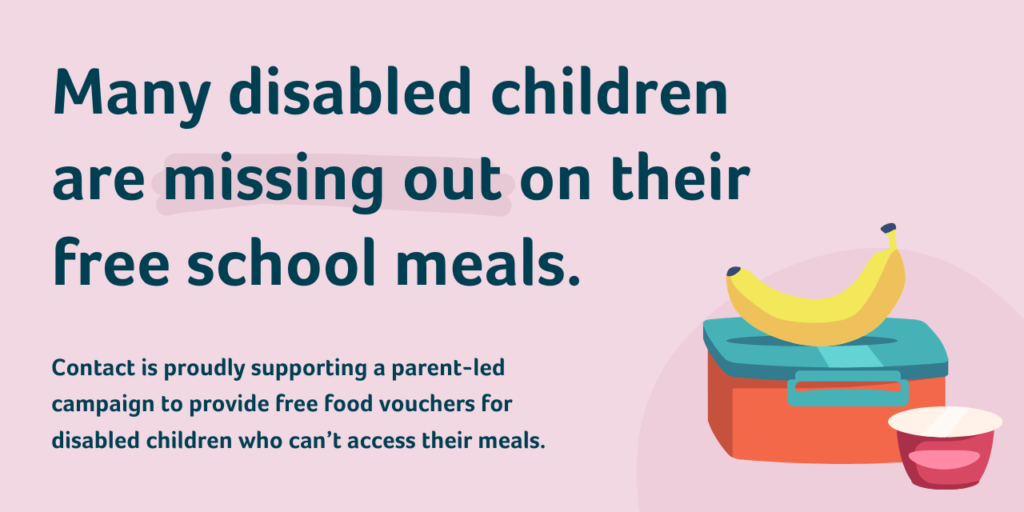
Free School Meals: Supporting a parent-led campaign to offer food vouchers or other reasonable adjustments to eligible disabled children who are unfairly missing out on the free school meals.
We have been overwhelmed by everyone’s support to help disabled children access their own savings before it’s too late.
A huge thank you to over 1200 supporters who have taken action on the Child Trust Fund campaign writing to their MP to raise awareness and call for change.
Tens of thousands of disabled teenagers have a Child Trust Fund savings account, with the average account value estimated to be around £2,000. However, families of young people who are unable to manage their money as they lack mental capacity have to apply through the Court of Protection to access their savings. This is a lengthy, costly and complex undertaking.
We have been receiving your MP responses and will reply to those in the coming weeks. We will highlight our concerns about the government’s proposals to address the issue.
Government proposals won’t work for majority
Una Summerson, Head of Campaigns at Contact, said: “The government says it plans to digitise and streamline the Court of Protection process. But we are concerned this does not go far enough and that no timescales have been given. In addition most of the families we support do not want deputyship, which comes with added responsibility, cost and administration. That’s why we are calling on the government to give families an alternative way of accessing their savings.”
Parent campaigner Andrew Turner added: “There is already a tried and tested way for families to manage their child’s money – the DWP appointee scheme. Many parents are entrusted by this scheme to manage benefits in excess of the savings held in the Child Trust Fund account. That’s why it makes perfect sense to expand the scope of the scheme to cover Child Trust Funds and Junior ISAs.”
Savings lost each week
Andrew has today launched a lost benefit calculator to illustrate the amount of savings being lost each week as more and more Child Trust Fund accounts of young people with learning disabilities are locked. We hope it will act as an incentive to the government to act now before it’s too late.
John Roberts, dad to Joseph aged 18, is still waiting for a response from his MP.
“Like many parents of children with learning disabilities who have turned 18, we are stuck with what to do with the Child Trust Fund we created when our son was born as part of the CTF initiative set up by Gordon Brown.
“Joseph is unable to manage his own financial affairs and is therefore unable to gain access to the money in his CTF, which is held at HSBC. I understand that the only way to gain access to those funds is for either my wife or I to obtain financial deputyship on his behalf. This currently has an application cost of £371, plus £494 if the court decides the case needs a hearing. There is also an annual general supervision fee of £320 (reduced to £35 for minimal supervision), plus a £100 assessment fee for a new deputy. The process is complicated and we have been advised that it is better to apply with a lawyer, for which the lowest fee we have been quoted is £1600.
“For most people in our situation the complexity of this process is appalling and the cost totally prohibitive as it is likely most CTF’s will not contain sufficient funds to cover the above costs.
“My parents have been paying money into their grandchildren’s CTFs every year as a birthday present. Our daughter will be able to access those funds to pay for whatever she chooses when she turns 18 in three years time. Unfortunately, Joseph can’t, and currently no-one can access the funds unless we apply for deputyship. Joseph has no other assets and is unlikely to have any, other than his disability allowances (DLA/Mobility/PIP) during his life, so financial deputyship, and the on-going costs associated with it, will only ever be needed for this one transaction.
“Surely we can find a solution to ensure that we do not penalise our most vulnerable young people.”
New figures exclusively revealed by the BBC show that 80,683 disabled young people in England and Wales will miss out on Child Trust Fund savings worth £209,801,255.
Parent campaigner Andrew Turner, working with Contact, has calculated the total loss of money to disabled young people who lack mental capacity over the course of the Child Trust Fund scheme maturity. Over 20,000 accounts have already been locked with £48 million of savings in them. The average account has £2,280 in it and the losses will grow during the next six years.
While non-disabled youngsters are enjoying the benefits of their savings which they can access on their 18th birthday, many with a learning disability cannot.
Due to Mental Capacity rules, the families of young people with learning disabilities unable to manage their money, have to apply through the court of protection to access their Child Trust Funds. This is a lengthy, costly and complex process.
Parent campaigner, Andrew Turner, said: “The scale of this issue is truly shocking. Hundreds of millions of pounds of savings for disabled young people could be locked away for good. Many families will not have the capacity or funds to use the Court of Protection process and the savings of young disabled people will be locked away forever. The government must act to avoid thousands of locked accounts in the coming years.”
Appointee scheme could allow safe access to Child Trust Funds
Andrew Turner, together with Contact and Child Trust Fund providers are calling on the government to:
Increase the scope of the Department for Work and Pensions (DWP) Appointee Scheme to cover Child Trust Funds and Junior ISAs up to £5,000. This would bring England and Wales in line with Scotland where it is easier and cheaper for young people with a learning disability to access their savings.
Publish a detailed plan with timescales of how they propose to simplify the court of protection process immediately.
Una Summerson, Head of Campaigns at disability charity Contact, said: “During this cost of living crisis it is more important than ever that disabled young people can access their own money. Preparing for adulthood is a challenging time. Forcing families to go through a complex court process at the same time is adding too much pressure.
“We are urging families with disabled teenagers to find out who their Child Trust Fund provider is, before their child turns 18. They can use the government website to find out. Then speak to the provider or bank about your situation. There are some providers such as One Family and Foresters who are helping young disabled people to access their Child Trust Fund savings without going through the court of protection process.”
Andrew Turner added: “Back in September 2020 my disabled son Mikey was locked out of his Child Trust Fund. He simply wanted to buy an adapted bike with his money and his life-limiting condition meant that time was of the essence. The Child Trust Fund was his only financial asset, which made it special. Nobody warned us we would need to go to court when the account matured. When we took advice we were told it would be easier and cheaper for us to wait until Mikey died when we could use a simpler process to reclaim the money. It was deeply upsetting. Three years later, this situation has not changed and more accounts are locked. That’s why the government must resolve this issue urgently.”
Find out more about Contact’s Change Makers – our programme that puts parent carers at the heart of our policy and campaigns work.
What to do if you have a Child Trust Fund
If your child is under 18 years old, you can find out if they have a Child Trust Fund using the government website here: Child Trust Fund: Find a Child Trust Fund – GOV.UK (www.gov.uk). Then speak to your Child Trust Fund provider about your situation. There are some providers such as One Family and Foresters Financial who are helping young disabled people to access their Child Trust Fund savings without going through the court of protection process (using the DWP appointee scheme as a safeguard).
If your child is over 18 years old, you will not be able to get this information without their consent. If they are unable to give consent because they do not have mental capacity, you will need an order from the Court of Protection to investigate and report to them, so you can be given access. Find out more: Child Trust Fund: What happens when your child is 18 – GOV.UK (www.gov.uk)
Research carried out by Contact reveals that a third of eligible disabled children are unable to access their free school meal due to medical and sensory reasons.
As a result, families are missing out on the equivalent of £570 a year of financial help. This comes at a time when every penny counts, causing some families to get into debt, increasing stress and making children feel left out.
85% families feel pressure on weekly budgets
1,500 families with disabled children eligible for free school meals took part in our free school meals survey about. In total, 471 (33%) told us their children can’t access their free school meal for a variety of reasons:
45% told us they can’t eat due to dietary requirements or sensory processing difficulties.
22% said it was because their child is off school due to a long-term illness or medical condition.
15% said their child can’t eat in the canteen due to sensory needs.
85% of families said missing out on free school meals increased pressure on their weekly budgets. When asked about impact:
67% experienced more stress as a result.
22% got into debt or had to borrow money.
21% reported it made their child feel left.
Of those children missing out, 28% have never been able to access their free school meal. 32% have not been able to access them for two or more years. Almost half (49%) of families are paying £20 a week providing meals or packed lunches to replace the free school meals their disabled child is entitled to.
Disabled children facing disadvantage and discrimination
Kirsty, mum to Tyler, 12, who is autistic and has a related mental health condition, said: “A small bit of free school meals funding can be an incredible lifeline for people in my situation, even more so with the cost of living crisis. I’m a full time carer to my son who is home 24/7. I did not choose for him to be out of school or to give up my career.
“It really highlights the disability discrimination that is happening on a daily basis. Tyler has not had a free school meal for around 130 weeks. This would add up to £1,950. This is a huge amount of money for a family and could have made a big difference over the last four years.”
“Many UK families with disabled children are having to provide a school lunch when it should be free. They are being unfairly disadvantaged and put at greater risk of experiencing food poverty.
“There is a drive to expand free school meals in Scotland, Wales and London, as they are known to improve a child’s achievement and wellbeing as well as help towards family finances. But there is a group of children ALREADY eligible who are missing out.
“That’s why we are campaigning alongside affected parents for schools and councils around the UK to offer an alternative, such as a supermarket voucher, so disabled youngsters have access just like their non-disabled friends.”
Una Summerson, Contact’s Head of Campaigns
Contact supports campaign for alternatives and reasonable adjustments
Our research found that some parents have successfully argued for a food voucher instead of a cooked meal in school. They used the law that says that schools should make reasonable adjustments for disabled people so that they don’t face disadvantage.
That’s why we’re calling for the government to update national guidance to make this clear to schools and councils.
Natalie Hay, parent campaigner, said: “When my son got Chronic Fatigue Syndrome as a result of Lyme disease, I had to give up work as a teacher. Despite being entitled to free school meals, my son never got them, apart from during lockdown.
“When every child was learning from home during pandemic lockdowns, reasonable adjustments were made. Every child got help. When disabled children are learning from home or are unable to eat the school meal due to sensory or dietary needs, no reasonable adjustments are made. Barely any get help. This needs to change.”
“I set up an online campaign group, which now has 1500 parent carer members seeking free school meals for their eligible child. Some of these parents have two children with a disability and are on Universal Credit. Others are so busy caring for their child they do not have the time and energy to fight this discrimination.
On Wednesday, Chancellor Jeremy Hunt will present his Budget Statement to parliament.
With anticipated changes to Universal Credit and with charities calling for renewed cost of living support, Contact is clear that the Chancellor must provide targeted support to families with disabled children.
Stop Universal Credit cuts
The Chancellor is expected to announce that Universal Credit claimants will be able to claim more towards childcare.
If you work and pay for registered childcare costs, you might currently receive an extra allowance covering 85 per cent of your childcare costs up to a maximum of £646.35. This total is expected to rise by several hundred pounds.
In addition, Universal Credit claimants will receive this help upfront.
We would welcome any additional help towards childcare for disabled children. Our Counting the Costs research found that 33% of parents had to quit a job due to the costs and lack of suitable childcare. 27% were forced to work fewer hours.
But the Chancellor must also commit to an increase in the child disability addition under Universal Credit.
Many families with disabled children claiming Universal Credit from legacy benefits will be worse off by more than £1,800 a year. This is because the lower child disability addition under Universal Credit is far less generous than the equivalent payment on the benefits it is replacing.
We know the government plans to start managed migration this year. This will mean families on legacy benefits will be asked to claim Universal Credit. Many could face this huge cut in benefit during a cost of living crisis.
So it’s vitally important that Chancellor Jeremy Hunt increases the child disability addition in Wednesday’s budget.
Targeted energy support for families
The Chancellor is expected to maintain the energy price guarantee of £2,500 from April 2023, instead of raising it to £3,000.
We think the Chancellor must go further and offer targeted support to households that need it most, including families with disabled children.
Households with seriously ill and disabled children are paying on average £1,596 extra a year to run vital equipment. More than a third of families with disabled children are cutting back on this life-saving electrical equipment as costs soar.
Una Summerson, head of campaigns at Contact, said: “While the energy price guarantee helped in the short term, we have long argued for targeted support. A social tariff for energy is the best way to do this.”
Action on Carer’s Allowance
We are calling on the government to increase the Carer’s Allowance earnings limit to £199.50 per week. This is the value of 21 hours at the National Living Wage.
At the moment, carers earning even 1p over the existing £132 limit (after making certain deductions) lose all of their Carer’s Allowance.
The government says it wants to encourage people back into work. This simple measure would allow carers to work and earn more without losing their entitlement to this vital benefit.
We want the government to increase the rate of Carer’s Allowance itself so that carers get the financial support they need and deserve.
Sign up to our latest news and updates
Subscribe to our e-newsletters to keep up-to-date with our response to the Budget when it’s announced this Wednesday.
Ahead of next week’s Spring Budget, Contact is working with other charities and campaigners calling on the government to introduce a social tariff to help families with disabled children with their energy bills.
A social tariff is targeted financial help for those that need it most. We have joined with campaigners calling for an energy social tariff for those on a low incomes, households with disabled people and carers. Eligible households would get discounted bills or cash payments towards energy costs.
Social tariffs are already used for broadband and are used successfully for energy in other countries.
Soaring energy costs have hit disabled households hard
Una Summerson, Head of Campaigns at Contact, said: “Contact’s Out of Energy survey found that households with seriously ill and disabled children are paying on average £1,596 extra a year to run vital equipment like ventilators, adjustable beds, ceiling track hoists, wheelchair chargers and suction pumps. This is on top of needing to do more washing due to continence issues or requiring more heating due to conditions affecting mobility. Because of these unavoidable extra costs, soaring energy prices have hit families with disabled children hard. Those prices will not drop for some time yet so the government must act to help those who need it most.
“While the energy price guarantee helped in the short term, we have long argued for targeted support. A social tariff for energy is the best way to do this.”
Una Summerson added: “We know from calls to our helpline that sky high energy bills are putting intolerable pressure on family finances and wellbeing. The government has an opportunity in next week’s budget to give help and hope to those who have been struggling the most with increased energy prices over the last year.”
Help us to campaign
We are looking for families to tell their stories of the impact of energy costs. Do you face astronomical bills because you need electrical equipment for the care of your child? Get in touch [email protected] or telephone 07599 930 090.
Get the latest SEND updates, benefits advice, practical help caring for your child, plus free workshops and family events in our weekly email newsletter.
(Make sure you select ‘News updates’)