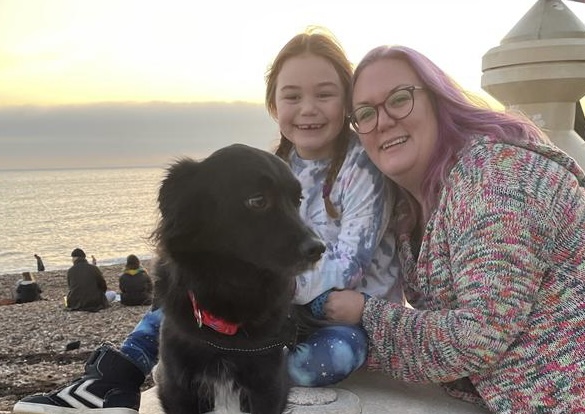
The Contact Weekly Lottery was launched two and a half years ago to help fund our vital support services for families with disabled children. Since then, we’ve had 2,254 winners and given away £33,305 in prizes!
We only have a small number of players compared to other charity lotteries, but incredibly, we now have the pleasure of telling around 50 lucky people every single week that they’ve won a prize.
What makes our lottery so special is that most of our £1,000 and £10,000 winners have been parent carers. They tell us they play to help support other families like theirs.
It couldn’t have come at a better time for parent carer Rebecca, who won £1,000 in November.
“Being a parent of a child with disabilities, the money will help us out as we’ve lost the use of our car and have no way of getting another.”
Rebecca, our £1,000 winner from Farnborough
Another one of our highlights from 2022 was our £10,000 winner back in August. Marie from Birmingham has two children with autism and wanted to help families like hers. When we called to tell her the good news, she couldn’t believe it was real!
“Knowing the money I pay each month can help so many families with disabled children is overwhelming.”
News today that free school meals will be given to all London primary schools next year shows the importance of ensuring eligible disabled children don’t miss out.
Una Summerson, Head of Campaigns at Contact, said: “The scheme in London has been launched to reduce cost of living difficulties at the same time as improving educational attainment for all children. It really does highlight the importance of free school meals.
“And yet there are hundreds of disabled children across the UK who are missing out. Some are not in school because they are waiting for a suitable place, others are unable to attend school due to mental health problems. And some are on special diets not catered for at school. We should be doing everything to help them and their families. That’s why we are supporting a parent-led campaign calling for food vouchers to be given to eligible disabled children unable to access free school meals.”
Missing out: Danielle’s story
Danielle has two children who are both eligible for free school meals but are unable to access them.
Thea, aged 7, has ARFID, Autism and ADHD. ARFID stands for Avoidant/restrictive food Intake Disorder – it’s a relatively new term for a condition where people avoid certain foods and eat small quantities. She also has a dairy allergy. Thea has a very limited diet, in fact she has eaten the same food every day for over 4 years. This means that she can’t eat school dinners and has a packed lunch every day.
Mum Danielle and daughter Thea
Danielle’s son is 10-years-old and is autistic. He is currently under alternative provision and has not accessed education since June last year due to autistic burnout. Due to his absence from school he has been unable to have school dinners and no vouchers have been issued as a replacement.
Can’t access due to their disabilities
Danielle said: “I am a single mum and a parent carer. I am unable to work due to caring for my son, who is now at home 24/7. I have asked the school who in turn asked the local authority to issue me with vouchers to replace the meals that my son and daughter can’t access due to their disabilities. So far they have refused, despite giving out vouchers during lockdown. £30 a week in vouchers would help me greatly and it seems unfair that we are shut out from this help through no fault of our own.”
There are lots of reasons why a disabled child might not be able to take advantage of a free school meal including:
Not being in physical attendance at school due to a long-term medical condition.
In attendance but cannot eat the meals provided due to dietary requirements or sensory processing difficulties.
Home learning while waiting for a school placement.
Child’s needs cannot be met in a school setting and so is home learning or have Education Otherwise Than At School (EOTAS).
Una Summerson added: “We want local authorities to fulfil their obligation to offer disabled children who are unable to access a free meal in the regular way at school, an alternative in the form of a supermarket voucher.
“Currently a free school meal is valued at £3 per day. There are 190 days in a school year, so that’s £570 of financial help over the course of a year that some disabled children are missing out on.”
Strep A (formally called Group A Streptococcus or GAS) is a common type of bacteria often found on the skin or in the throat.
As the cold weather continues into February, notifications of serious cases of Strep A – while still very rare – remain relatively high. The majority of cases of “invasive” Strep A (iGAS) are in the over 45s.
Disabled children are not necessarily more at risk of catching Strep A. Children with weaker immune systems and low muscle tone can be more susceptible to infection from winter bacteria and viruses.
For this reason, it’s always good to know about the early signs and symptoms of illnesses like Strep A.
Early each year, we look back on the work we’ve done in the following 12 months and the impact we think we’ve made.
This helps us ensure we’re doing as much as we can to support families with disabled children. And it helps us demonstrate to our generous funders the difference their support makes.
We’ve just finished reviewing our statistics for 2022 and want to share them with you.
In 2022, our By Your Side project supported 1,054 parents in and out of hospital, including through information stands and coffee mornings.
Over 10,000 helpline calls
Our helpline team responded to 10,512 enquiries. This includes 1,015 benefits enquiries and 366 in-depth call-backs by the Family Finances helpline.
Additionally our teams in the regions, nations, By Your Side and London teams attended to 4,533 enquiries/1:1 appointments. This includes 1,049Listening Ear appointments.
New ONS census data out this week has found that there has been a large increase in the number of disabled girls aged 10 to 14 and 15 to 19 years of age. Between 2011 and 2021 the numbers rose from 6.8% to 12.2% in England and 7.1% to 13.3% in Wales.
Contact thinks this is due to a combination of factors including later diagnosis in girls for autistic spectrum conditions, plus a greater awareness of autism. As well as the fact that girls are more likely to have mental health problems in their teen years, as shown by various studies.
More likely to mask
Amanda Elliot, Contact’s Health Lead, said: “Autistic girls are more likely to mask – many going undetected in primary school because in early years there’s a lot of parallel rather than socially interactive play and they can be academically able. And the early years system and professionals are not as good at recognising the signs of autism in younger girls.
Unacceptable waiting times
“Difficulties start to emerge with the increase in hormones at the same time as more academic and social demands. There needs to be better diagnosis of autism in the early years to ensure children, both girls and boys, get the help they need as early as possible. Waiting times for diagnosis for autism also need addressing urgently as some are waiting an unacceptable length of time.
“We know that there is a rise in post 18 diagnoses, which we believe is because it is much easier to get an adult autism diagnosis that a child diagnosis – far fewer barriers.”
Help is available
We have information about getting a diagnosis and what support is available without diagnosis.
And you can find out more about CAMHS (Child and Adolescent Mental Health Services) on our dedicated web page.
Last week, the National Education Union (NEU) announced seven days of industrial action in February and March across England and Wales.
Many families will be wondering what this means for their children. So below we try to cover the key facts you need to know.
When are teachers striking?
The NEU has said that teachers will strike on the following days:
1 February: All schools in England and Wales
14 February: All schools in Wales
28 February: North and north-west England, Yorkshire and Humber
1 March: East Midlands, West Midlands, and the NEU’s eastern region
2 March: South-east and south-west England, and London
15 and 16 March: All schools in England and Wales
In Scotland, teachers are currently taking part in 16 days of strikes. This has affected some primary and secondary schools, with more strike days planned in the coming weeks.
Does this affect all teachers?
No. Only teachers who are members of the NEU can strike.
In addition, the National Association of Head Teachers in England did not vote to take industrial action.
This means that the impact of the strikes on schools will vary.
Will my child’s school close?
This depends on the resources each school has on strike days.
In England, the decision to close the school lies with the headteacher. In Wales, the headteacher decides in consultation with the local authority. And in Scotland, local councils decide whether to keep the school open.
Look out for correspondence from your children’s schools about whether they plan to close the school when industrial action is taking place.
And where this happens, the advice is that schools prioritise places for vulnerable children and young people and children of critical workers.
Again, we would advise you to look out for communication from your children’s schools about what their plans are. All schools will be impacted differently. They will be able to say what level of attendance they can accommodate.
Can I remove my child from school during strike days?
School attendance remains mandatory on strike days, so long as the school remains open.
Can I take time off to look after my child?
You can take time off work to deal with an emergency relating to a dependant, and you might be entitled to parental leave to care for your child.
We’re happy to be supporting a parent-led campaign calling for food vouchers for eligible disabled children unable to access free meals at school.
About the campaign
Natalie Hay, a parent carer, started this campaign after realising that many disabled children eligible for free school meals are unable to access them.
Why can’t some disabled children access free school meals?
There are a variety of reasons why some disabled children might not be able to access meals at school.
These include:
When a child is not in physical attendance at school due to a long-term medical condition.
When a child attends school but cannot eat the meals provided due to dietary requirements or sensory processing difficulties.
When a child is home learning because they are waiting for a school placement.
When a school setting can’t meet a child’s needs, so they are home learning or have Education Otherwise Than At School (EOTAS).
Why is this such an issue?
These families with disabled children are being disadvantaged. They have to provide a school lunch when it should be free.
“When every child was learning from home during pandemic lockdowns reasonable adjustments were made. Every child was helped.
When disabled children are learning from home, no reasonable adjustments are made and barely any are helped.
This needs to change.”
Parent Natalie Hay
Contact backs parliamentary bill
Tomorrow, the second reading of Zarah Sultana MP’s private members Free Schools Meals (Primary School) Bill takes place in Parliament.
This provides an opportunity to raise awareness of the current inequality in free school meal access for disabled children.
The Bill has a wider aim to extend eligibility for free school meals to all children in state primary schools. Contact has sent a briefing note regarding the current difficulties disabled children are facing.
We are hopeful that MPs will raise this issue in the debate tomorrow.
Get involved in the campaign
If your child has missed out on their free school meal, please join the parent-led Facebook group to support this campaign.
You can also email your local MP about the issue. Please email [email protected] for a template email.
GB’s first-ever Paralympian badminton champion, Dan Bethell, is determined to use his success to inspire other children with disabilities to embrace the benefits of sport – and has asked us to help him spread the word!
Dan, who won an incredible silver medal in the Tokyo 2020 Paralympic Games, has right-sided hemiplegia.
He says: “HemiHelp, part of the Contact family, is an amazing charity which gave myself and my family lots of support and information over the years. With their help, I want to get the word out to the next generation of Paralympians: sport has the power to positively change people’s lives, no matter what your circumstances.”
Take a look at our information about sports and fitness bodies across the UK which provide opportunities for children, young people and adults with disabilities.
If your child has been inspired by Dan’s badminton success, there’s a series of disability Para-badminton festivals taking place across the country right now – why not try it out?
Take a look at our Holidays, Play and Leisure page which provides some information about what play, leisure, and short breaks options may be available, and where to find more information. It also has information about arranging holidays for disabled children and details of organisations which provide grants for these types of activities.
Cameron, who had both Cystic Fibrosis and Duchenne Muscular Dystrophy, sadly passed away when he was five years old after spending nearly three of those years in hospital.
Every year on 19 June, we celebrate Cameron’s birthday alongside his family with our annual fundraising event, Dinosaur Day, because Cameron loved dinosaurs – his favourite being a green triceratops called Troy.
Why was the Stop the DLA Takeaway in Hospital campaign so important?
Contact supported the Mathieson family’s long and ultimately successful landmark legal challenge that went all the way to the Supreme Court in July 2015.
Because of the Mathieson family’s determination, and with the help of our campaign, hundreds of families with the most disabled and poorly children are no longer denied financial help when they need it most.
What have we achieved thanks to Cameron and his family?
A new law was introduced on 29 June 2016 meaning that no child in hospital would have their DLA suspended if they are in hospital for 84 days (or 28 days if aged 16 or 17 on PIP).
In addition, where a child first makes a claim for DLA when they are in hospital, they no longer have to wait until they are discharged home before those payments can start.
This law continues to benefit hundreds of children and families every year and is definitely something to celebrate on Cameron’s birthday.
Claiming DLA can be tricky, so we are inviting you to a special Q&A over in our closed (private) Facebook group. Join us there on Thursday 24 June between 10am – 12 noon.
Scottish Social Security Secretary Shirley-Anne Somerville has confirmed that new claims for Disability Living Allowance (DLA) in Scotland will start to be replaced by a devolved benefit, Disability Assistance for Children and Young People from Summer 2020.
In her statement Ms Somerville also confirmed that this new benefit will be paid until age 18 rather than 16, and that children on the highest rate care component of the new benefit will also be entitled to Winter Heating Assistance – a £200 lump sum towards their heating costs.
The timetable for moving existing DLA claimants in Scotland onto the new benefit is not yet clear. However, Ms Somerville made clear that DLA claimants will not be required to make a new claim to move onto the new benefit. Instead the Social Security Scotland intends to work with the Department for Work and Pensions to arrange for transfers to happen automatically.
Detailed information about how else the new Scottish benefit might differ from DLA is not yet available.
A timetable for the roll out of other disability and carers benefits in Scotland was also set out:
Winter 2020 – Disability Assistance for Older People to replace Attendance Allowance.
Early 2021 – Disability Assistance for Working Age People to replace Personal Independence Payment.
End of 2021 – Scottish Carer’s Allowance introduced.
During 2020 the Scottish government will also introduce an extra payment for Scottish carers who look after more than one disabled child.
Susan Walls, Manager of Contact in Scotland, said: “We are pleased to see the Scottish Government’s recognition of the extra costs that families face when raising a disabled children, with the announcement of £200 Winter Heating Assistance for those on the highest rate care component of the new Disability Assistance for Children and Young People from Summer 2020.
“Our Counting the Costs research found that one of the highest extra costs for families is heating. There are many health conditions and disabilities which require the heating to be on 24/7, so financial assistance towards heating bills is really positive.”
The families we support describe Disability Living Allowance (DLA) as life changing. DLA helps families meet the extra costs of having a disabled child, and its withdrawal from children in hospital meant that many families were left in extreme financial hardship.
Our research has shown, however, that there is a lot of confusion about who is entitled to DLA, and as a result many families miss out on the vital benefit. In this article we look at some of the main reasons parents assume their child is not eligible for DLA.
Myth 1: My child needs a diagnosis before I can claim DLA
You can claim DLA so long as it is clear that there is some underlying condition – whether physical, mental or behavioural – as a result of which your child needs extra care or help in getting around. You don’t have to wait for the condition to be diagnosed.
Myth 2: My child’s disability won’t count for DLA
Both components of DLA are paid at different rates depending on your child’s care needs or mobility difficulties. Disabled children with greater needs are likely to be on the highest rates. A child with fewer needs might still qualify for DLA at lower rates.
Myth 3: I can’t claim DLA for my child because my earnings are too high / I’m working
DLA is not means-tested. It doesn’t matter whether you have earnings or any savings or whether you are working or not. The only thing that matters is whether your child has greater needs than other children of the same age.
Myth 4: Children with learning disabilities and autism spectrum disorders cannot get higher mobility rate under DLA
Even if your child has no physical problems with walking, they might still qualify for the higher rate if their behaviour is very difficult to deal with. See our parent guide on the higher mobility rate [PDF].
Myth 5: I can’t claim DLA because my child is very young
It can be harder to claim for a young child because all infants need a high level of care. However, if your child needs a different type of care, or care more often, than other infants, you have a good chance of an award.
DLA care component can be paid from age 3 months and from birth if terminally ill. The mobility component can only be paid from age 3.
Myth 6: There is no point in claiming DLA, as the money will be deducted from my other benefits
DLA is never deducted from other benefits you get, and it is always ignored as income. In fact getting DLA can trigger extra amounts in other benefits you claim – see our DLA page for more information.
Myth 7: There’s no one to help me fill out the DLA claim form
Our research found that once parents had read our DLA web pages, including our page on completing the DLA form, and our DLA parent guide, most felt able to complete the DLA claim form themselves.
If you do get stuck, ring our freephone helpline on 0808 808 3555 and we can try to put you in touch with local help to complete the form.
Update in October 2020: The extra amount you’d get a week is now £92, up from £84.
The recent news that 28,000 families are to receive extra child tax credit has prompted questions from parents about the effect these extra payments might have on other ‘means-tested’ benefits.
When an award of Disability Living Allowance (DLA) is made for a child you should tell the Tax Credit Office. They will add an extra element – the disabled child element – to your tax credit award no matter what rate or component of DLA has been awarded. A second ‘severely disabled child element’ will also be added if the DLA award is for the highest rate of care.
Will these extra amounts affect my other benefits?
Although your income has increased by up to £84 per week, this should have no effect on the amount of Income Support, Housing Benefit and any other ‘income- based’ benefits that you receive.
For Income Support, Child Tax Credit is ignored as income, but for Housing Benefit the rules are not as straight forward. This is because tax credits are treated as income for Housing Benefit, so, generally speaking, the more tax credits you get, the less Housing Benefit you are entitled to, and the more you have to pay towards your rent.
However, when the increase in tax credits is due to the extra disability elements, Housing Benefit includes a disabled child premium (and severely disabled child premium if highest rate of care of DLA) in the calculation, which cancels out the extra Child Tax Credit elements. This means that your Housing Benefit award should not change.
It’s important to tell Housing Benefit about your DLA award
Housing Benefit will only do this if they know about the award of DLA for your child. The Tax Credit Office automatically tells Housing Benefit when there is any increase to your Tax Credit award, but don’t tell them it’s because of a DLA award.
If I get a backdated payment of Child Tax Credit, will this affect my other benefits?
If you get a lump sum payment for arrears of Child Tax Credit, this is ignored by Housing Benefit and other ‘means-tested’ benefits for 52 weeks. It will have no effect on your Housing Benefit or other benefits if, when added to any other savings or capital you may have, your total savings are £6,000 or less.
More advice on benefits
If you would like more individual advice on Housing Benefit or the capital limits for ‘means-tested’ benefits, our specialist welfare rights team can help. Please call our freephone helpline on 0808 808 3555 for a telephone call back appointment.
On Wednesday the Mathieson family made history as the Supreme Court unanimously ruled that the regulations that took benefit payments from their son Cameron when he was in hospital for over 84 days was a violation of his human rights.
Cameron’s dad Craig Mathieson has made a statement about the judgment, and we wanted to share it with everyone who has supported our Stop the DLA Takeaway in Hospital campaign.
“We are grateful to the Supreme Court for such a wonderful legacy for our beautiful boy. He would have been honoured that so many people will benefit from him having been here.
“This has very much been a team effort and who would never have been possible without the tireless dedication of Mitchell Wolf at Scott-Moncrieff and associates, and Steve Broach, Jude Butting and Ian Wise QC from Monckton Chambers. Their hard work and integrity is truly humbling and their support means more than I can say.
“We are also indebted to Contact a Family and the Children’s Trust without whose evidence we could not have shown Cameron’s case was the rule rather than the exception. Their work for families is fuelled by the most incredible energy and dedication.
“As a family we are delighted and humbled that because of our little boy so many like him are a step closer to being treated fairly according to the reality of their situation. Thank you all for your support and encouragement.”
Related information
Sign our Stop the DLA Takeaway petition to make sure the government acts on the judgement.
The Mathieson family have made history as the decision on their landmark case means this is the first time ever that the Supreme Court has found for a claimant in a social security case.
The Supreme Court has unanimously ruled that taking away Disability Living Allowance (DLA) from a disabled child after he had been in hospital for more than 84 days is in breach of his human rights and unlawful.
The ruling announced today, 8 July, will have a significant impact on the estimated 500 families with severely disabled children who spend extended time in hospital undergoing treatment.
As a result of today’s Supreme Court ruling, Contact a Family and The Children’s Trust are calling for the government to urgently act on the court’s decision and scrap the unfair rule once and for all.
Call on the government to act on court’s decision
In a joint statement Amanda Batten, CEO of Contact a Family and Dalton Leong, CEO of The Children’s Trust, said:
“Today’s Supreme Court judgement is absolutely incredible and a groundbreaking victory for the Mathieson family who have fought tirelessly on behalf of some of the most severely disabled children in the UK who require hospital treatment.
“We now call on the government to urgently act on today’s judgement and scrap this unfair rule once and for all. Families affected by the rule should seek advice about using this judgement to ask that their DLA payments restart.
“We would like to extend our gratitude and heartfelt thanks to the Mathieson family who have fought tirelessly, not for their own benefit, but for the other hundreds of families affected each year.”
Over 6,000 people have already added their names to the petition, which shows how many people want to see an end to this unfair ruling once and for all.
The landmark Mathieson case
In a landmark case heard at the Supreme Court last March, the Mathieson family from Warrington challenged the Department for Work and Pensions (DWP) regulations that took DLA away from their severely disabled and hospitalised son.
Cameron Mathieson spent more than two years in hospital with cystic fibrosis and muscular dystrophy. His family argued that they acted as full time carers until the five year old’s death, in October 2012.
The government argues that DLA is stopped when a child spends 84 days or over in hospital because their care needs are fully met free of charge by the NHS.
However research carried out by Contact a Family and The Children’s Trust, who have been supporting the Mathiesons, shows that of the families affected by the rule that we surveyed:
99 per cent said they provide more or the same level of care when their child is in hospital compared to when at home
93 per cent said that their costs relating to their child’s disability increase when their child is in hospital.
Related information
If you’re able to, please consider making a donation to allow us to continue our life-changing campaign work.
Every year the our helpline talks to a number of parents who are missing out on at least £65 per week because they haven’t told the tax credits office that their child is getting Disability Living Allowance (DLA).
Many families simply aren’t aware that their child tax credit payments are higher if you have a child on DLA. This is because you qualify for an extra payment called the disabled child element of tax credits. This is worth an extra £65 per week for each child who qualifies.
What is the disabled child element?
The disabled child element is an extra amount that is added into your child tax credits award. It is worth an extra £65 per week for each child in your family who qualifies.
Who qualifies for the disabled child element?
You should be getting a disabled child element included in your child tax credit award for each child who is either on DLA or Personal Independence Payment (PIP) or who is registered blind.
If a child gets the highest rate of the DLA care component (or the daily living component of PIP at the enhanced rate) you also get a further £26 per week – a payment known as the severely disabled child element.
How do I make sure that I get the disabled child element?
The problem is that the Tax Credits Office won’t know that you should be getting the disabled child element unless you have told them that your child is on DLA or PIP. If you haven’t already let them know, you should do this as soon as possible by telephoning them on 0345 300 3900.
Similarly if your child’s existing award is increased to the highest rate of the care component (or the enhanced rate of daily living under PIP) you need to make sure you tell them in order to get the severely disabled child element.
Your tax credit decision award letters should tell you whether your award includes a disabled child and a severely disabled child element.
Are these extra elements backdated?
Once you tell the Tax Credits Office about your child’s DLA or PIP award, they will increase your payments. However they will only normally backdate the extra payments for a month from the date you first tell them.
The only exception to this is if you tell Tax Credits within one month of getting the DLA/PIP decision. If you do that then the extra tax credits payments will be backdated in line with the DLA/PIP award.
What happens if I get Universal Credit rather than tax credits?
If you get Universal Credit, make sure that you have told the office paying you this benefit if any of the children that you are claiming for are getting DLA or PIP. You will get an additional universal credit payment called the disabled child addition for each dependent child you have on DLA or PIP.
Getting further advice
If you already get DLA and tax credits but aren’t sure if your tax credits award includes a disabled child element call our free helpline for further advice.
As part of our Counting the Costs campaign to stop families going without the basics like food and heating, we’re encouraging parents to find out about the benefits they might be entitled to.
Disability Living Allowance (DLA) helps cover the extra costs that result from having a disability and is the main benefit for disabled children. Getting DLA can also lead to an increase in other benefits or help you qualify for other entitlements.
DLA and Carer’s Allowance
If your child receives the middle or the highest rate of the DLA care component, you may be able to get Carer’s Allowance if you meet certain other tests. Find out more on our Carer’s Allowance page.
DLA and tax credits
Child Tax Credit is assessed more generously when a child receives DLA. This is because families will qualify for an extra disability element (and a severe disability element if your child has been awarded the highest rate DLA care component). This means your tax credits should increase by at least £60 per week. You get an extra disability element for each child in your family who gets DLA.
If you have been claiming IS since before 2004, your award may still include amounts for your children as an alternative to you getting tax credits.
If this applies to you then getting DLA means an extra disabled child premium (or enhanced disability premium if your child gets the highest rate of the care component) is added to your IS payments. You will need to let the office dealing with the IS claim know about the DLA award. Read our DLA parent guide [PDF], page 37, to find out more.
Help with rent and council tax
If you get Housing Benefit or support with council tax, getting DLA for your child may lead to extra benefit if you are not already getting your rent and council tax met in full. Both Housing Benefit and support with council tax are means-tested so any award will depend on your other income and circumstances. Read our DLA parent guide [PDF], page 37, to find out more.
DLA and the Bedroom Tax
If your housing benefit is being restricted under the Bedroom Tax or local housing allowance rules, getting DLA care component for your child may help.
Your housing benefit payments will be reassessed to treat you as needing an individual bedroom for any child whose disabilities prevent them from sharing AND who gets DLA care component at the middle or higher rate. This means you may get more help with your rent. See our Bedroom Tax page.
DLA and Universal Credit
If you receive Universal Credit and a child who is included in your Universal Credit claim gets DLA, you will qualify for extra Universal Credit payments. Visit our Universal Credit page.
Exemption from benefit cap
If you have a dependent child (that is, a child aged under 16, or aged 16-19 if they are still treated as part of your family for benefit claims) who is in receipt of DLA, you will be exempt from the ‘benefit cap’ which restricts the total amount of benefit payments that an out of work family can receive to £500 per week.
Other entitlements
If your child is awarded the highest rate of the DLA mobility component:
you should qualify for a Blue Badge for parking
you can lease a care through the Mobility Scheme (as long as there are 12 months left of the DLA award)
you may be exempt from paying Vehicle Excise Duty.
As part of our Counting the Costs campaign to stop families going without the basics like food and heating, we’re encouraging parents to find out about the benefits they might be entitled to.
Over the last month we’ve been focussing on Disability Living Allowance (DLA), the main benefit for children and adults with a condition or disability. Many families are missing out on this vital source of support because of confusion about who is eligible for the benefit.
Now, to accompany our recent DLA myth-busting news story, our benefits expert Derek Sinclair has made a podcast about some of the misconceptions that are preventing parents from claiming DLA. In the recording Derek explains when a child might be eligible for DLA and what factors should not stop you making a claim.
We know that parents like to digest information in different ways, so we hope the podcast offers another way for you to find out whether your child might be entitled to claim.
The families we support describe DLA as life changing. DLA helps families meet the extra costs of having a disabled child, and its withdrawal from children in hospital meant that many families were left in extreme financial hardship.
Our research has shown, however, that there is a lot of confusion about who is entitled to DLA, and as a result many families miss out on the vital benefit. In this article we look at some of the main reasons parents assume their child is not eligible for DLA.
Myth 1: My child needs a diagnosis before I can claim DLA
You can claim DLA so long as it is clear that there is some underlying condition – whether physical, mental or behavioural – as a result of which your child needs extra care or help in getting around. You don’t have to wait for the condition to be diagnosed.
Myth 2: My child’s disability won’t count for DLA
Both components of DLA are paid at different rates depending on your child’s care needs or mobility difficulties. Disabled children with greater needs are likely to be on the highest rates. A child with fewer needs might still qualify for DLA at lower rates.
Myth 3: I can’t claim DLA for my child because my earnings are too high / I’m working
DLA is not means-tested. It doesn’t matter whether you have earnings or any savings or whether you are working or not. The only thing that matters is whether your child has greater needs than other children of the same age.
Myth 4: Children with learning disabilities and autism spectrum disorders cannot get higher mobility rate under DLA
Even if your child has no physical problems with walking, they might still qualify for the higher rate if their behaviour is very difficult to deal with. See our parent guide on the higher mobility rate [PDF].
Myth 5: I can’t claim DLA because my child is very young
It can be harder to claim for a young child because all infants need a high level of care. However, if your child needs a different type of care, or care more often, than other infants, you have a good chance of an award.
DLA care component can be paid from age 3 months and from birth if terminally ill. The mobility component can only be paid from age 3.
Myth 6: There is no point in claiming DLA, as the money will be deducted from my other benefits
DLA is never deducted from other benefits you get, and it is always ignored as income. In fact getting DLA can trigger extra amounts in other benefits you claim – see our DLA page for more information.
Myth 7: There’s no one to help me fill out the DLA claim form
Our research found that once parents had read our DLA web pages and our DLA parent guide, most felt able to complete the DLA claim form themselves.
If you do get stuck, ring our freephone helpline on 0808 808 3555 and we can try to put you in touch with local help to complete the form.
Get the latest SEND updates, benefits advice, practical help caring for your child, plus free workshops and family events in our weekly email newsletter.
(Make sure you select ‘News updates’)