Children and babies with certain health conditions can be more susceptible to common seasonal viral and bacterial infections and their body may struggle to fight off the illness. So as the party season starts and we’re mixing more with others, it’s important to be aware of the signs and symptoms of common winter viruses.
To help, we have lots of information about RSV (respiratory syncytial virus) and Strep A – two of the most common and contagious causes of coughs and colds in winter.
RSV (respiratory syncytial virus) and bronchiolitis
RSV may cause a cough or cold in children and adults, but in young children it is the main cause of bronchiolitis. In fact, it’s the most common cause of bronchiolitis in children under two.
Most cases of bronchiolitis are mild, and children recover without treatment within two to three weeks. Some children are more vulnerable to the virus and breathing problems, so it is important to look out for more serious problems.
Strep A (formally called Group A Streptococcus or iGAS) is a common type of bacteria often found on the skin or in the throat. The bacteria can cause many different infections. Some are mild, like ‘Strep throat’, and some are rarer but more serious, like invasive GAS infection (iGAS).
Flu is caused by a virus that can be a very unpleasant illness for children and lead to serious problems like bronchitis or pneumonia. Children also help to spread flu. The flu season starts in September and runs through the winter.
The flu vaccine is offered every year on the NHS to help prevent people from getting seriously ill from flu. Vaccinating your child protects them and others vulnerable to it. People with a learning disability are more likely to develop pneumonia if they get flu.
The Department for Work and Pensions (DWP) has started the process of asking people on tax credits and other means tested benefits to claim Universal Credit, even if they have had no change in circumstances. This process is known as ‘managed migration’ onto Universal Credit.
Each month, tens of thousands of claimants receive a managed migration notice telling them that their legacy benefits will stop and that they need to claim Universal Credit instead. However, you aren’t transferred onto Universal Credit automatically. Instead, you need to make a claim for Universal Credit and will have a deadline to do this by.
Make sure you’re not worse off on Universal Credit
Many families with a disabled child end up worse off under Universal Credit. And if you miss your final deadline, you won’t be eligible for any transitional protection to make up the difference. Transitional protection rules are supposed to ensure that families who would qualify for lower payments under Universal Credit receive top-up payments so that they are no worse off than before.
Advisers from our Family Finance Team are inviting you to ask any questions you have about managed migration to Universal Credit at a special Q&A session on Thursday30 November between 10am – 11.30 am on our Facebook page. Join us to find out how to make sure you’re not worse off when you claim Universal Credit.
To take part in the Q&A, you must be a member of our Facebook Group for parent carers. Simply request to join, make sure to answer the three membership questions when prompted, and one of our moderators will add you to our community.
At 10am on Thursday, our team will share a special Q&A post in the group where parent carers can ask their questions in writing in the comments. Our advisers will be on hand to answer any questions asked between 10am and 11:30am.
The Q&A session will be carried out in writing, so there’s no need to take the morning off to watch a livestream! Simply pop by the group anytime between 10-11:30am to leave a comment with your question, and then pop back later to see our reply.
Some questions are more complex and may take us a bit longer to answer, but don’t worry: we will reply to all questions asked between 10 and 11.30am.
Use the online Grants Search tool to look for organisations that may help to fund adaptations, products and services for your disabled child, or download our lists of charities who provide general grants and educational grants to families.
On Wednesday, Chancellor Jeremy Hunt set out the government’s plans for the economy in his Autumn Statement. Read our CEO’s response.
Below we outline some of the main benefit changes relevant to families with disabled children.
Benefit changes at a glance
The Chancellor announced:
Uprating working-age benefits and disability benefits next year in line with consumer price inflation of 6.7%.
Lifting the freeze on the local housing allowance, which caps benefit payments towards rent in the private sector. Local housing allowance will increase so it covers the cheapest 30% of properties in each area. This should mean more help with rent for private tenants on Universal Credit or Housing Benefit.
Confirming the introduction of a new ‘Back to Work Plan’. This will target jobseekers who ‘disengage’ via a stronger sanction regime and more intensive work coach support.
Expanding DWP programmes that support mental and physical health. This includes a new WorkWell service to support those at risk of entering long-term unemployment to either enter or return to the workplace.
Abolishing class 2 National Insurance contributions currently paid by self-employed people from April 2024, while allowing self-employed people to continue to access contributory benefits such as the state pension.
As part of a ‘crack down’ on benefit fraud and error, new powers will allow access to data held by third parties such as banks.
Response to consultation on proposed changes to the work capability assessment
The work capability assessment is a disability assessment the government uses to decide how much benefit disabled adults on certain benefits like Universal Credit and Employment and Support Allowance should receive. It also determines whether they should be look for work while claiming that benefit.
There are three possible outcomes of a work capability assessment:
You can be found fit to work.
You can be found to have a ‘limited capability for work’.
You can be found to have a ‘limited capability for work and work related activity’(LCWRA).
The government intends to scrap the work capability assessment and replace it with the Personal Independence Payment assessment. However, that change is not expected to take place until 2026/27 at the earliest.
In the meantime, the government intends making changes to the work capability assessment. This will see a reduction in the number of new claimants having a LCWRA. In responding to a consultation, the government has confirmed that it plans to make these changes from April 2025, for new claims only.
Understanding limited capability for work/and work-related activity (LCWRA)
If you have a limited capability for work, you don’t have to look for work, but you must still take part in work-related activities to get you more ready for work. For example, you may have to take part in training. Having a limited capability for work does not lead to any additional benefit payments.
However, if you have LCWRA, you won’t need to meet any work-related conditions like job seeking or training. You’re also eligible for an extra amount of benefit.
Changes the government is proposing
Substantial risk to health
The government plans to amend the rules that allow a disabled person to be treated as having a LCWRA where taking part in work-related activity would place them or others at ‘substantial risk’. These rules will become more restrictive.
Although yet to announce full details about how it will apply the new rules, the government says that it will protect those with physical health problems. This means that where being taking part in work-related activities would lead to a deterioration in your physical health, the government will protect you as someone at substantial risk.
Mobilising
It also plans to remove difficulties with mobilising from the list of activities used when deciding whether someone has a LCWRA. Currently those who cannot mobilise for more than 50m without pain or discomfort are one of the groups having a LCWRA.
The government claims that those with the most significant mobilising needs will not lose out as a result of this change. Instead, the substantial risk rules will treat them as having a LCWRA.
Difficulties in physically mobilising will still factor in deciding whether someone has a limited capability for work.
Getting around
In assessing whether someone has a limited capability for work, there will be a reduction in points awarded for difficulties in getting around without the help of another person, for example due to mental health problems.
Other changes consulted on
The government has decided that it will not proceed with proposed changes in how the work capability assessment deals with problems with incontinence or in engaging in social engagement.
Anna Bird, Chief Executive of disability charity Contact, said: “Now into a second year of sky-high costs for food, heating, rent and mortgages, families with disabled children say they face a constant battle to keep afloat. Disappointingly there was little in yesterday’s Autumn statement to alleviate the hardship many are experiencing.
“There was no targeted support and no commitment to a social tariff to help with families’ higher energy costs. Families with disabled children pay £1,600 a year more than other households for their energy, to run vital equipment like ventilators, adjustable beds, hoists and suction pumps. They now face a difficult winter without the support they desperately need.
“The Chancellor chose to focus on tax cuts rather than investing in public services that disabled children and their families depend on. Families are exhausted from filling gaps in support for physiotherapy, speech and language, as well as mental health services. Over the last 10 years support services have been cut back and families are left to do more, often complex care. This has devastating impacts on their wellbeing and their ability to be in paid employment.
“On top of this the lack of action on fixing the Carer’s Allowance earnings limit, is another blow to those families who would like to combine caring with paid employment.”
We will spell out what the Autumn Statement 2023 means for families with disabled children in more detail soon.
In the last 12 months there has been a 21% increase in calls to Contact’s helpline about exclusions of disabled children from schools. Of particular concern is that younger children with an additional need are facing exclusion – some aged just four and five.
Anna Bird, Chief Executive of disability charity Contact, said: “The impact of exclusion can be devastating on a disabled child. It makes them feel isolated and affects their confidence and attendance, as they don’t feel like they belong in the school environment. Parents are often unable to work.
Last resort
“Exclusion of a disabled child should only be used as a last resort. There is a legal requirement for schools to make reasonable adjustments for disabled children, such as providing a quiet space or teaching in a small group. We know that exclusions often happen due to lack of support.”
Disabled children have always been disproportionately affected by exclusions. But as schools struggle with budget cuts there is less access to specialists such as Speech and Language Therapists and Educational Psychologists. In addition there are fewer special school places and there are long waiting times for assessments. This has led to the situation getting worse.
There are lots of schools who do everything possible to avoid exclusion, ensuring children get assessed and using reasonable adjustments, such as providing a safe space or allowing the use of ear defenders.
Not following behaviour policy
But in some cases, schools aren’t following their own behaviour policy or government guidance. Some are excluding children illegally, asking a parent to collect their child at lunchtime because they are having a bad day or telling a child not to attend a particular activity.
It is feeding into the growing problem of persistent absence, as disabled children faced with seclusion and exclusion don’t feel they belong in the school environment. Absence rates for disabled pupils are significantly higher than their non-disabled peers.
Anna Bird added: “We’d like to see government invest more in SEN support in schools. There needs to be a strong focus on the specialist workforce and support is needed within schools to make disabled pupils feel welcome and included in the school environment.”
Is your child affected by exclusion or behaviour management at school?
Today, MPs debate the Kings Speech, which sets out the government’s plan for the year ahead. Opposition MPs are using the debate to highlight data that shows over two million children could be regularly missing school by 2025 if the number of pupils absent from classrooms continues at the current rate – one in four of all children currently at primary and secondary school.
Contact welcomes the focus on persistent absence and calls for greater understanding of children with special educational needs and disabilities (SEND) and why they feature so prevalently in persistent absence figures.
Unmet need
Una Summerson, Contact’s Head of Policy, said: “Absence rates for pupils with SEND are significantly higher than their peers. And they are rising, especially across special schools. This is often down to unmet need.
“Just under 40% of calls to Contact’s helpline come from parents who say the school or local authority is not providing the right support for their child. We also hear from parents that the school environment and culture is sometimes detrimental to their child’s needs.
“A focus on mental health is important, but we also need to look at other reasons that children with SEN may be absent. This includes medical reasons, a lack of support in school, delays in assessment for support, lack of suitable school places and disproportionate use of exclusion on children with SEND.”
There is also a disproportionate number of pupils with SEND who are home educated, with reported pressures to do so. Contact has long called for a compulsory register of children who are home educated.
Earlier this year Contact submitted evidence to a parliamentary inquiry on persistent absence. The committee’s report stated: “growing demand for mental health services and special educational needs support, as well as cost-of-living pressures, have compounded a problem that worsened following the Covid lockdowns but remains present”.
Advice for families whose children are absent from school
We have information for parents about absence from school for medical reasons, how to support children back to school after a period of absence and the use of fines for parents whose children are persistently absent.
We recently hosted a special Facebook Q&A session where parent carers could get our team’s advice about grants, home adaptations and other sources of financial support available to families with disabled children.
To help those who weren’t able to take part, we’ve rounded up below some of the top questions asked during the session — but the rest of the Q&A remains available to read over at our private Facebook Group for parent carers.
Is it difficult to get funding for a specialist bed for travelling if your child already has a specialist bed for everyday use?
It can indeed be difficult to get funding for two beds, but it is not just about two beds – it’s about the needs of the child or young person. People with disabilities are often isolated because of their needs and what it entails for them to go on holiday or sleep over at nan’s house like other children.
I would suggest you make a point about the necessity of having these beds in away days from home, explaining how the lack of it at particular locations affects your child’s wellbeing and you as their parent carer.
Statutory organisations may not readily fund this, but it’s worth asking either way. You can also use the online Grants Search tool or download our list of general grant-giving charities for information about organisations that may be able to help based on your circumstances. You may have to try more than one organisation for this, but it’s worth giving it a go!
Are there any grants to help with converting a loft into a bigger bedroom for my autistic teen? He is 6ft tall and has no room to play as his double bed takes up all the space.
You could submit a request for a Disabled Facilities Grant (or home improvement grant, if you live in Scotland) to use for the purpose of providing a safe space for your child. Most local authorities will ask for an assessment from an occupational therapist or social services to help them decide if the work is ‘necessary and appropriate’ to meet your disabled child’s needs. Take a look at our Home Adaptations webpage for more information about the application process, eligibility rules and timescales involved.
We’ve been told that a sensory shed and spa in the garden could help with my child’s needs, but my local authority said they’re not responsible for this. What can I do?
Am I correct in assuming that you are seeking planning permission from your local authority for building the sensory shed, as well as putting in a spa, as an initial step before requesting a Disabled Facilities Grant (DFG) to fund the work? If this is the case, you may not need such permission. You can request a DFG directly through a formal application.
A DFG is a mandatory grant. This means you must be given a grant if your local authority is satisfied that the work to your home is both ‘necessary and appropriate’ to meet your disabled child’s needs, and ‘reasonable and practicable’, considering the age and condition of the property.
If you have already formalised your DFG request and have received a decision in writing, you may wish to consider making a formal complaint about your local authority’s failure to progress your application.
Our council house has an upstairs bathroom that constantly floods. It’s a battle taking my disabled child to the toilet. Can I get help with converting our shed into a downstairs toilet for her?
I would advise that you contact your local authority’s social services team to request a Child in Need assessment for your child (or to ask for a review of her assessment, if she already had one) with a view of highlighting this ongoing situation. They may be able to support you with requesting planning permission to build in the shed, which could be funded by a Disabled Facilities Grant. Another alternative many be rehousing your family in order to meet your child’s needs.
In the meantime, you may wish to consider approaching grant-giving organisations that could help you meet other related needs – for example, with household items that may require frequent changing due to flooding issues. You can use the Grants Search tool on our website to see what help may be available, as well as download our list of grant-giving charities for a summary about what each organisation can help with.
Over the next few years, the Department for Work and Pensions (DWP) will ask all legacy benefits claimants to claim Universal Credit instead.
This part of the process of rolling out Universal Credit across the UK is called managed migration. Managed migration is itself being rolled out across the country in stages. It has already started for tax credits-only claimants in most places and will next apply to claimants of other legacy benefits.
Can I claim Universal Credit before the DWP asks me to?
The DWP has already introduced Universal Credit for new claims. This means legacy benefits claimants can make a new claim for Universal Credit before the DWP asks them to.
But be careful!
Some people are worse off under Universal Credit. The government has promised to transitionally protect some existing legacy benefits claimants who’ll receive less, but only if they moved onto Universal Credit via managed migration. For this reason, you should seek specialist advice before voluntarily claiming Universal Credit.
Why you need to know what the managed migration notice looks like
When the DWP asks you to move onto Universal Credit, they’ll send you a “migration notice” in writing that your legacy benefits will be ending and you need to claim Universal Credit instead.
We’ve heard from families who’ve received a Universal Credit information leaflet before this time and have mistakenly assumed this to be the migration notice. Problems then arise if they go onto claim Universal Credit voluntarily, because any loss in their award won’t be transitionally protected.
For this reason, it’s important you know what the migration notice looks like.
What to look out for
In the notice, you’ll receive a date three months from the date on your migration notice within which to make a claim for Universal Credit. This is known as your deadline day. You should therefore make sure what you’re looking at has a clear deadline date on it.
The bottom of the migration notice states, “This is a migration notice issued under regulation 44 of the Universal Credit (Transitional Provisions) Regulations 2014”, on each page.
Below is a picture of the front page of the migration notice:
The Department for Communities has confirmed that the process of asking existing means tested benefits claimants in Northern Ireland to move onto Universal Credit – known as managed migration – is starting this month.
Initially, this will only apply to claimants who only receive Child Tax Credit or Working Tax Credit and not any other means-tested benefits. The Department for Communities says that it will be randomly selecting ‘tax-credit-only claimants’ and sending them managed migration notices.
This will be happening in all Northern Ireland postcode areas.
What happens after I receive a managed migration notice?
You will not be moved onto Universal Credit automatically – instead, you will need to make a claim. You will be sent a letter telling you that your existing legacy benefits are ending and asking you to claim Universal Credit. This is known as a managed migration notice.
The notice you gives you a deadline by which you need to claim Universal Credit. This is normally at least 3 months from the date of your managed migration notice.
Your legacy benefit payments will stop on the date you claim Universal Credit, or on your deadline day if you haven’t lodged a claim for Universal Credit by then. If you haven’t claimed by your deadline day, you will have a further month within which to claim Universal Credit (although your legacy benefits will have already stopped). This is known as your final deadline.
So long as you claim by your final deadline, you will be eligible for transitional protection payments to make sure that you are no worse off on Universal Credit.
More information about moving onto Universal Credit
What are the “oversubscription criteria” schools use to offer places.
When to expect an offer.
What to do if you’re not happy with it.
Our webpage on finding the right school explains where you can find information about the schools you’re looking at, and what kind of questions to think about when making your choice.
Could your child have a pot of cash sat waiting to be claimed? We are here to help you find out.
What is a Child Trust Fund?
If your child was born between 1 September 2002 and 2 January 2011, the government gave you a voucher worth between £250 and £750 to encourage you to open a Child Trust Fund.
You could then add further savings to the account if you wished. The idea was that you’d invest these vouchers to build a nest egg for your child’s future.
No one would be able to access the savings until your child reached the age of 18.
What if I didn’t invest my child’s voucher?
Good news. If you were one of the 1.7 million parents who forgot to do anything with the voucher, the government invested the voucher on your child’s behalf.
Is it worth the hassle in tracking the account down?
We think so! There’s likely to be a minimum of £100-£500 in the account, and the average balance is £2,100.
I think I remember investing, but I’ve lost the details.
Even if you have lost the details, forgotten where the voucher was invested or simply did nothing with it, all is not lost. Visit Find a Child Trust Fund (www.gov.uk) to find your provider.
I now know the provider – what next?
If your child is 16 or older and has mental capacity, they can contact the provider themselves. They will not be able to access their savings until 18. If they are 18 and older, they can choose to spend or reinvest their savings.
What if my child is able to make decisions for themselves, but would like someone else to manage their finances?
If your child is under 18, speak with their Child Trust Fund account provider. Some have put in place a scheme, applied on a case-by-case basis, that avoids the need to apply to the Court of Protection.
If your child is 18 years old or over, you will not be able to speak to the provider without your child’s consent. And if your child is unable to give consent because they do not have mental capacity, you will need the Court of Protection order to access the funds on your child’s behalf.
Many families with disabled children in the UK are eligible for grants and other financial support schemes that can help towards the cost of household bills, health, education, transport, home adaptations, specialist equipment and other essential needs.
To help you find out more about these schemes and how to access them, our helpline advisers are hosting a special Q&A session on Wednesday 18 October between 10-11:30am over at Contact’s private Facebook Group for parent carers.
This will be a great chance to ask us anything about applying for grants, discounts and other sources of financial support for your family.
To take part in the Q&A, you must be a member of our Facebook Group for parent carers. Simply request to join, make sure to answer the three membership questions when prompted, and one of our moderators will add you to our community.
At 10am on Wednesday, our team will share a special Q&A post in the group where parent carers can ask their questions in writing in the comments. Our advisers will be on hand to answer any questions asked between 10am and 11:30am.
The Q&A session will will be carried out in writing, so there’s no need to take the morning off to watch a livestream! Simply pop by the group anytime between 10-11:30am to leave a comment with your question, and then pop back later to see our reply.
Some questions are more complex and may take us a bit longer to answer, but don’t worry: we will reply to all questions asked between 10 and 11.30am.
Use the online Grants Search tool to look for organisations that may help to fund adaptations, products and services for your disabled child, or download our lists of charities who provide general grants and educational grants to families.
Better off financially after a call to our helpline
One parent carer told our bi-annual information and advice feedback survey:
“Accessing the telephone appointment guided me through the minefield of moving two young people to adult benefits, which I was finding extremely stressful and daunting. We are now fully sorted with one, nearly there with the other and better off financially as a result. Thank you so much.”
Another parent carer said:
“I got advice on complex benefits applications for my sons and also gave me great advice to get Carer’s Allowance for me when I was refused for 20 months. It eventually came through.”
And a third parent carer said:
“You have helped me so much over the last year. I would never have been able to get Universal Credit to backdate payments for my son without your help.”
91% better informed after using our services
Our information and advice team help families tackle any issue to do with caring for a disabled child, from diagnosis to social care.
We helped one parent with their child’s education:
“I was put at ease after panicking about a meeting and changes to my child’s EHC plan. It is nice to speak it out!”
And another find support from other families:
“[Contact’s Facebook group] has helped me meet more families and feel part of a community that help each other.”
We run our bi-annual information and advice survey every March and September. Hearing from service users helps us measure the impact of our work and see how we can improve our support to thousands more families. Over 400 took part in our survey this September.
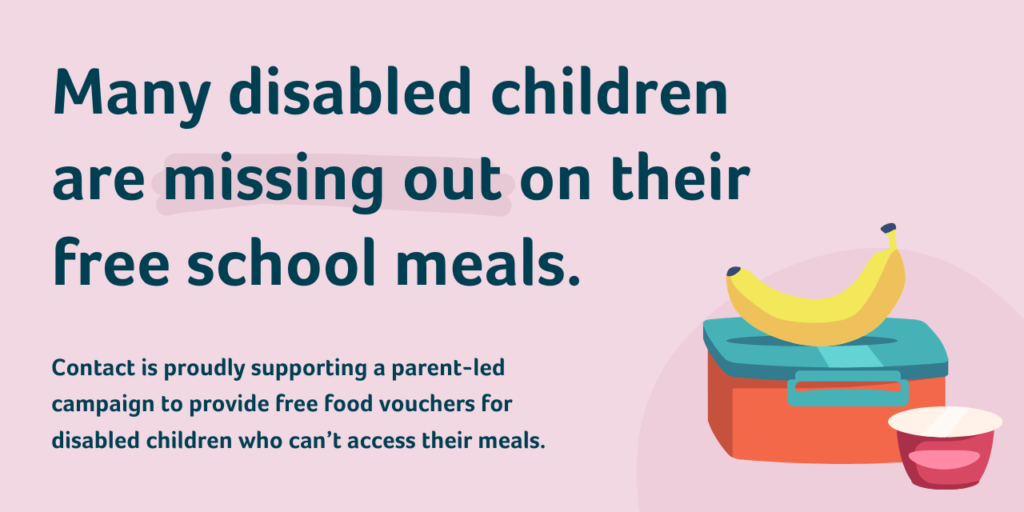
We have heard from lots of parents who have successfully used the free school meals template letters to request an alternative, such as a voucher, to their child’s free lunch.
More template letters available
And in response to requests from parents we have written more template letters to cover different situations where eligible children can’t access a free school meal due to their disability. These include:
If your child attends a state-maintained school, academy or free school; is missing out on free school meals because they have been expelled, and you want to ask the local authority to provide an alternative. (Template E)
If your child is not currently registered at an education setting because they are awaiting a placement in a specialist setting and you want to ask the local authority to provide an alternative. (Template F)
If you live in Scotland and your child is eligible for free school meals but isn’t receiving them because of their disability, and you want to ask the school to provide an alternative. (Template G)
These are in addition to the template letters A-D which we published last month.
We expect more template letters in the coming weeks for families in Northern Ireland and for those who have children aged 16+.
Your questions answered
During our recent Free School Meals webinar there were lots of questions from parent carers whose children can’t access their free lunch due to their disability.
The legal team were unable to answer questions about specific cases, but we have rounded up some general themes that emerged and have answered those for you.
If a child attends a non-maintained or independent school which is named in an EHCP, does that mean the local authority does have a duty to provide?
Councils have the power to provide a free school meal to an eligible child in a non-maintained or independent school under section 513 of the Education Act 1996. This means they have a choice whether to provide, which is different to a duty. If your child falls into this category and is eligible for free school meals but can’t access them, you can use template letter A to request one. If you can show that they are attending the independent or non-maintained school because it is the only setting able to meet their special education needs, this may help, but there is no guarantee.
If a child is in Year 2, but not eating school meals. Should they get vouchers if not SEN registered?
It depends if the reason your child is not eating meals is due or suspected to be due to a disability or medical condition which has yet to be diagnosed. If that is the case you can use template letter C to request that reasonable adjustments can be made. You will need to explain why the child is unable to eat the school meal, for instance due to a sensory or dietary need.
Is a child eligible for vouchers in holidays and in any school break during the year?
The holiday food voucher scheme is run by the Department of Work and Pensions through the Household Support Fund. However, councils decide how to run their fund so the provision available will differ depending on where you live. You can find out more about the fund here.
If a child is post 16 and attends part school, part college, but can’t access free school meals, are they eligible for an alternative?
We are currently working on a template letter for post 16 young people.
Q. Should a school backdate the free school meal vouchers to when my child was unable to get them.
A school doesn’t have a duty to backdate free school meals. We have heard from some parents that they have had vouchers backdated, but it is at the school’s discretion and they are not bound to.
Legal backing
Public law human rights lawyers Alex Rook, Rosie Campbell and Katie Sinclair from Rook Irwin Sweeney and Steve Broach from 39 Essex Chambers wrote the free school meals guide and template letters A-D. Parent and founder of the free school meals campaign Natalie Hay independently raised funds through a crowdfunding website to enable the legal team to do this.
Data shows that absence rates for pupils with SEND are significantly higher than their peers. And they are rising, especially across special schools. In particular, the rate of persistent absence in special schools was significantly higher than the overall absence rate. For the 2021-22 academic year, the rate of persistent absence in special schools was 40.4%. This compares to to the overall absence rate of 22.5%.
The Parliamentary Education Select Committee report found “growing demand for mental health services and special educational needs support, as well as cost-of-living pressures, have compounded a problem that worsened following the Covid lockdowns but remains present”.
MPs on the committee have recommended the introduction of an authorised mental health absence code to reduce the need for fines on parents, as well as a review into the adequacy of mental health services.
“Mental health-related absences are not commonly authorised by schools, sometimes due to requirements to provide medical evidence which can often lead to fines or prosecution for families,” the report said. “The introduction of an authorised mental health absence code could eliminate the need for medical evidence in cases of known and established mental health difficulties and reduce the need for intervention via prosecution.”
Michele Cefai, Head of Communications at Contact, said: “We welcome the report’s recommendations. Their findings confirm what we have identified as the biggest factor for children with disabilities being off school – unmet need. Just under 40% of calls to our helpline come from parents who say the school or local authority is not providing the right support for their child.
“We also hear from parents that the school environment and culture is detrimental to their child’s needs. Chasing good attendance figures is coming at the cost of pupil wellbeing and good relationships with parents.”
Poverty is a factor
Today’s report also said that measures to tackle child poverty could help improve attendance, such as an expansion of the Free School Meals scheme to all children in poverty.
Contact welcomes the committee’s acknowledgement that poverty is a factor in pupil absence. Families with disabled children are more likely to be living in poverty and have been disproportionately affected by cost of living pressures.
The government has announced that it will pay £300 to low-income households this November as part of its £900 cost of living support package.
Most people on Department for Work and Pensions (DWP) benefits will receive a payment between 31 October and 19 November 2023. Those on tax credits only will receive the installment between 10 and 19 November.
What is the £300 payment?
The £300 payment is the second installment of a £900 package Chancellor Jeremy Hunt pledged to low-income households in his 2022 autumn statement.
You will not get a payment if you get new-style ESA, contributory ESA or new-style JSA unless you also receive Universal Credit.
To get this autumn’s payment, you must have been entitled (or later found to be entitled) to a payment of one of the means-tested benefits listed above during the period between 18 August and 17 September 2023.
How do I get the payment?
You don’t need to do anything. If you’re eligible, you’ll be paid automatically in the same way you usually get your benefit or tax credits.
This includes if the government finds you eligible at a later date. From 20 November, you’ll be able to report a missing payment.
The NHS is also inviting feedback on their engagement document, which explains what the testing service for day and residential special schools will cover.
This includes:
A free annual sight test – or more if clinically required.
Invitations for parents to attend test appointments.
Vouchers towards the cost of glasses.
Outcome reports that recommend any additional adjustments required beyond corrective lenses, for example in classrooms.
Human rights lawyers have written a free school meals guide and four template letters to help families whose disabled child is eligible for free school meals, but can’t access them in the standard way.
Who are the resources for?
Many eligible disabled children are unfairly missing out on a free lunch because they can’t attend school or are unable to eat the meal provided due to dietary or sensory needs.
You can use these letters to ask your child’s school to provide an alternative, such as a supermarket voucher.
The four letters cover:
Children who are in an independent/non-maintained school.
Children with have Education Otherwise Than At School (EOTAS).
Children on roll at a state-maintained school, academy or free school and eligible because they are in Reception, Year 1 or Year 2.
Children who are financially eligible for free school meals and on roll at a state-maintained school, academy or free school.
You can highlight your particular situation in our online flow chart. You’ll be directed to the correct template letter to use. The letters include important information including who to send the letter to at the school or local authority.
Please note: these letters were written for those living in England. We will be writing letters for children living in other parts of the UK, and they will be available soon.
Written by human rights lawyers
Public law human rights lawyers Alex Rook, Rosie Campbell and Katie Sinclair from Rook Irwin Sweeney and Steve Broach from 39 Essex Chambers wrote the free school meals guide and template letters.
Parent and founder of the free school meals campaign Natalie Hay independently raised funds through a crowdfunding website to enable the legal team to do this.
Imogen Steele, Contact’s Policy Lead on free school meals, said: “A third of eligible disabled children are missing out on free school meals, worth £570 a year. This number will grow as free school meal schemes expand to more pupils across the country this year.
“We are calling for swift action from the government to update its guidance to ensure this discrimination is stopped. In the meantime, we must ensure as many disabled children as possible get the school lunch they are entitled to. The letters and guide are a great tool for making that happen.”
Free school meals webinar recording
As part of the campaign Contact hosted a webinar featuring lawyers Alex Rook, Steve Broach and campaign founder Natalie Hay. The webinar is available to watch back here.
Get the latest SEND updates, benefits advice, practical help caring for your child, plus free workshops and family events in our weekly email newsletter.
(Make sure you select ‘News updates’)